AQA · A-Level · Business
Course version: 7132 · Version from Sept 2023
Improving quality: The benefits and difficulties of improving quality
Full specification wording
Making operational decisions to improve performance: improving quality: The benefits and difficulties of improving quality
Better quality pays in two separate places, and answers that score well keep them apart.
- Point 2 of 3
- 3 key terms
Study notes
From the teaching notes for this specification point.
The idea
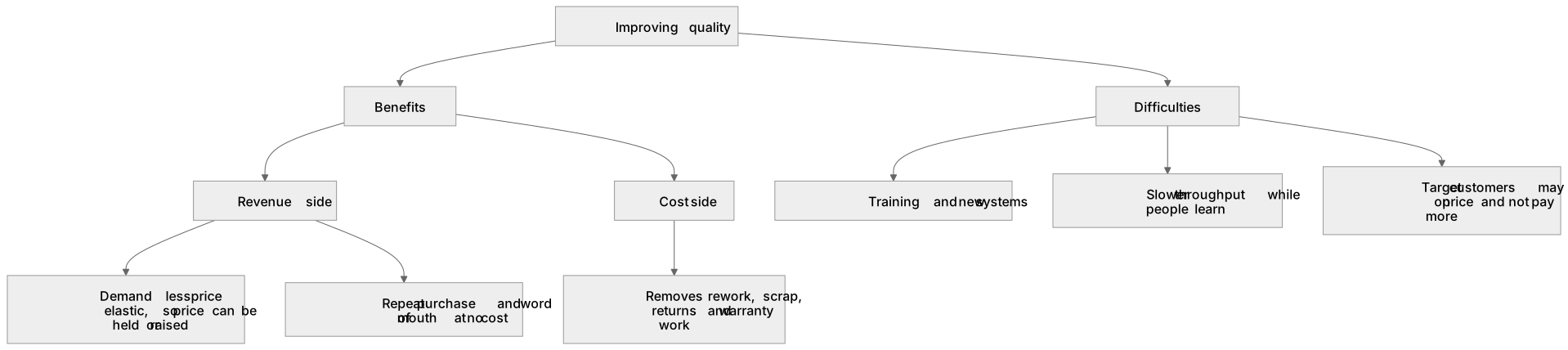
Better quality pays in two separate places, and answers that score well keep them apart. On the revenue side it lets a firm hold or raise price without losing many customers, because demand becomes less price elastic, and it brings repeat purchase and word of mouth that cost nothing to win. On the cost side it removes rework, scrap, returns and warranty work, which is money the firm has already spent and thrown away. Against that sit training, new systems, slower throughput while people learn, and the awkward possibility that the target customers are buying on price and will not pay a penny more for the improvement the business has just funded.
What earns the marks
- Separating the revenue effect from the cost saving effect and developing at least one into a chain, for example fewer returns leading to lower warranty costs and a higher net profit margin.
- Costing the improvement, including training days, new equipment and output lost during the transition, so the benefit is judged net rather than gross.
- Judging against the firm's position and target market, since a discount retailer and a premium brand get very different returns from identical spending.
Common mistakes and how to put them right
Asserting that better quality raises sales with no mechanism, when the marks sit in the link from reputation to repeat purchase to revenue.
Ignoring diminishing returns, so each extra pound spent on quality is assumed to bring the same gain as the first.
Forgetting the supply chain, when the defects described in the stem come from a bought in component and no amount of internal training will fix them.
Exam tips
- The difficulties half of these questions is where most marks are lost, so plan one developed difficulty before you start writing.
- If margins are given, use them; a quality programme that raises unit cost by more than the price rise the market will bear is exactly the argument the examiner wants.
- Assess questions expect a stated criterion, so say what you are judging against, such as the firm's objective of growth, of survival or of protecting cash flow.
Try the lesson
The start of the Making operational decisions to improve performance: improving quality: The benefits and difficulties of improving quality lesson, made from teaching notes for this specification point.
Have a go first
Which of the following is a benefit to a business of improving the quality of its products?
Listen
Better quality pays in two separate places, and answers that score well keep them apart. On the revenue side it lets a firm hold or raise price without losing many customers, because demand becomes less price elastic, and it brings repeat purchase and word of mouth that cost nothing to win. On the cost side it removes rework, scrap, returns and warranty work, which is money the firm has already spent and thrown away. Against that sit training, new systems, slower throughput while people learn, and the awkward possibility that the target customers are buying on price and will not pay a penny more for the improvement the business has just funded. A strong answer earns marks for these points. Separating the revenue effect from the cost saving effect and developing at least one into a chain, for example fewer returns leading to lower warranty costs and a higher net profit margin. Using price elasticity of demand, the percentage change in quantity demanded divided by the percentage change in price, to explain why a quality reputation protects a price rise, and saying what the elasticity in this market looks like. Costing the improvement, including training days, new equipment and output lost during the transition, so the benefit is judged net rather than gross. Judging against the firm's position and target market, since a discount retailer and a premium brand get very different returns from identical spending. Exam tip: The difficulties half of these questions is where most marks are lost, so plan one developed difficulty before you start writing.
See it
Key words
Say what each word means before you turn the card.
price elasticity of demand
Try answering aloud or in your head before turning the card.
cost of rework
Try answering aloud or in your head before turning the card.
return on quality spending
Try answering aloud or in your head before turning the card.
See every definition
- price elasticity of demand
- The percentage change in quantity demanded divided by the percentage change in price, used to explain why a quality reputation protects a price rise.
- cost of rework
- Money the firm has already spent and thrown away, removed on the cost side when quality improves, alongside scrap, returns and warranty work.
- return on quality spending
- The benefit judged net rather than gross, by costing the improvement including training days, new equipment and output lost during the transition.
Label the diagram
Some boxes have lost their names. Pick the right name for each number.
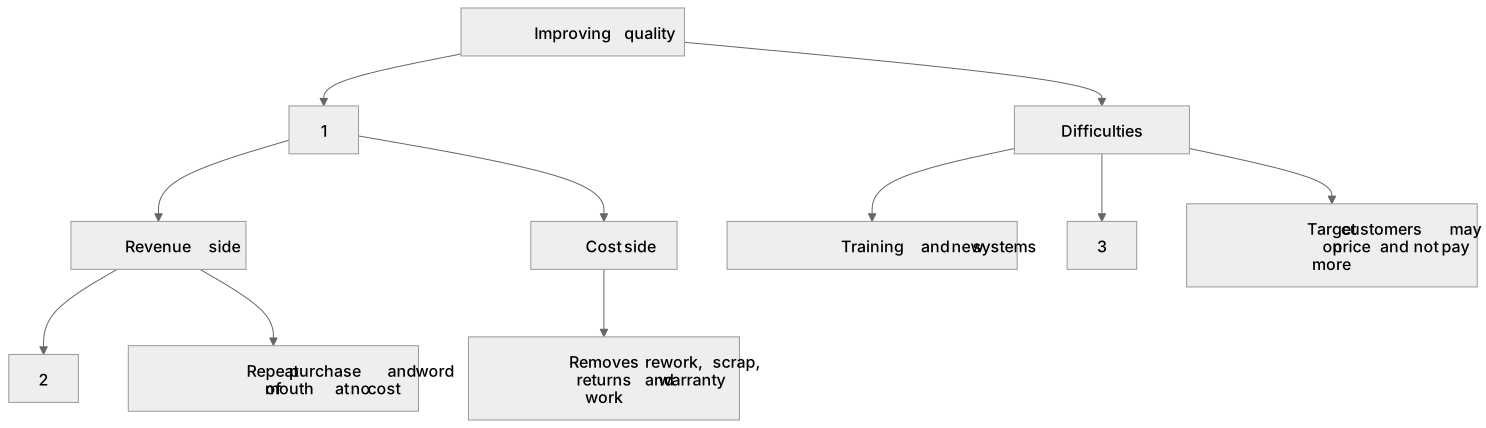
1Box 1
2Box 2
3Box 3
There is more to this lesson
The full lesson goes on to check your understanding and help you earn the marks. Create a free account to carry on, with your progress saved.
A week of Premium from your first lesson · Then the free plan continues · No card, no charge
Test your understanding of Making operational decisions to improve performance: improving quality: The benefits and difficulties of improving quality
Active recall beats re-reading. Take an instant quiz now to test what you’ve learned and lock it into long-term memory.
A week of Premium from your first lesson · Then the free plan continues · No card, no charge