AQA · A-Level · Business
Course version: 7132 · Version from Sept 2023
Improving quality: The consequences of poor quality
Full specification wording
Making operational decisions to improve performance: improving quality: The consequences of poor quality
It is expensive twice, once inside the factory and once out in the market, and the second bill is the larger and the slower to clear.
- Point 3 of 3
- 4 key terms
Study notes
From the teaching notes for this specification point.
The idea
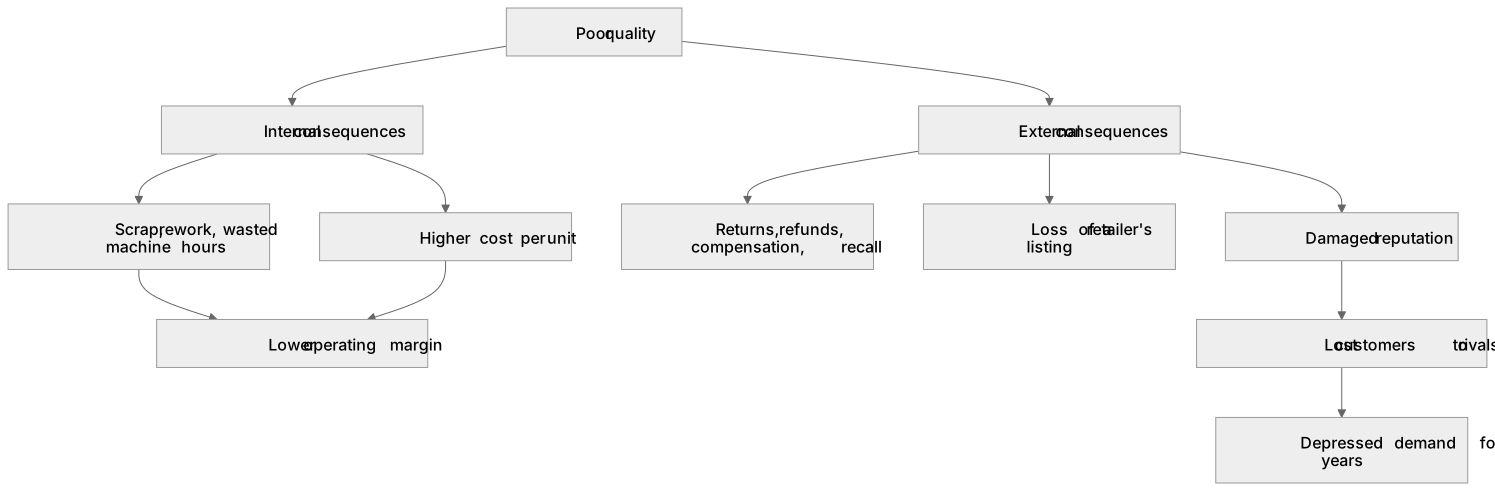
It is expensive twice, once inside the factory and once out in the market, and the second bill is the larger and the slower to clear. Internally it shows up as scrap, rework, wasted machine hours and a higher cost per unit, all of which come straight off the operating margin. Externally it shows as returns, refunds, compensation, the cost of a recall and the loss of a retailer's listing, and then as a reputation that takes years and a marketing budget to rebuild while rivals collect the customers who left. The supply chain matters here, because the horsemeat found in supermarket beef burgers was not produced in the supermarket, yet the brands on the packets carried the damage.
What earns the marks
- Splitting internal failure costs from external ones and showing why the external bill is larger, since the firm has already paid to make, ship and sell the faulty unit.
- Tracing the effect through to a financial measure in the stem, such as gross margin, net profit margin or cash flow, instead of stopping at damaged reputation.
- Recognising the time dimension, that lost trust depresses demand for years while a batch of scrap is a one off charge.
- Applying the consequence to this firm's market, so a business selling safety critical products faces regulators and liability claims that a fashion retailer does not.
Common mistakes and how to put them right
Stopping at the phrase bad reputation, which is an assertion.
Put it right: The marks are in explaining who stops buying, how fast, and what that does to revenue.
Ignoring staff, when working on a line that keeps producing rejects is demotivating and pushes up absenteeism and labour turnover.
Treating a recall as only the value of the returned goods, when retrieval, testing, legal advice and a regulator's fine usually cost far more.
Exam tips
- These are usually set as analyse the consequences, so build two or three developed chains rather than a long list of one line points.
- Look for a supplier in the case study, because the examiner often plants the source of the defect outside the firm to open an argument about assurance across the whole chain.
- Where a returns or complaints figure is given, convert it into lost revenue, since carrying a number through the chain lifts the answer.
Try the lesson
The start of the Making operational decisions to improve performance: improving quality: The consequences of poor quality lesson, made from teaching notes for this specification point.
Have a go first
Which of the following is a likely consequence for a business of producing poor-quality goods?
Listen
It is expensive twice, once inside the factory and once out in the market, and the second bill is the larger and the slower to clear. Internally it shows up as scrap, rework, wasted machine hours and a higher cost per unit, all of which come straight off the operating margin. Externally it shows as returns, refunds, compensation, the cost of a recall and the loss of a retailer's listing, and then as a reputation that takes years and a marketing budget to rebuild while rivals collect the customers who left. The supply chain matters here, because the horsemeat found in supermarket beef burgers was not produced in the supermarket, yet the brands on the packets carried the damage. A strong answer earns marks for these points. Splitting internal failure costs from external ones and showing why the external bill is larger, since the firm has already paid to make, ship and sell the faulty unit. Tracing the effect through to a financial measure in the stem, such as gross margin, net profit margin or cash flow, instead of stopping at damaged reputation. Recognising the time dimension, that lost trust depresses demand for years while a batch of scrap is a one off charge. Applying the consequence to this firm's market, so a business selling safety critical products faces regulators and liability claims that a fashion retailer does not. Exam tip: These are usually set as analyse the consequences, so build two or three developed chains rather than a long list of one line points.
See it
Key words
Say what each word means before you turn the card.
internal and external failure costs
Try answering aloud or in your head before turning the card.
product recall
Try answering aloud or in your head before turning the card.
reputational damage
Try answering aloud or in your head before turning the card.
supply chain quality
Try answering aloud or in your head before turning the card.
See every definition
- internal and external failure costs
- Costs that are expensive twice, once inside the factory and once out in the market, with the second bill larger and slower to clear.
- product recall
- An external failure cost whose cost is far more than the value of the returned goods, since retrieval, testing, legal advice and a regulator's fine usually cost far more.
- reputational damage
- A reputation that takes years and a marketing budget to rebuild while rivals collect the customers who left.
- supply chain quality
- The supply chain matters because a defect not produced in the firm can still leave the brands on the packets carrying the damage.
Label the diagram
Some boxes have lost their names. Pick the right name for each number.
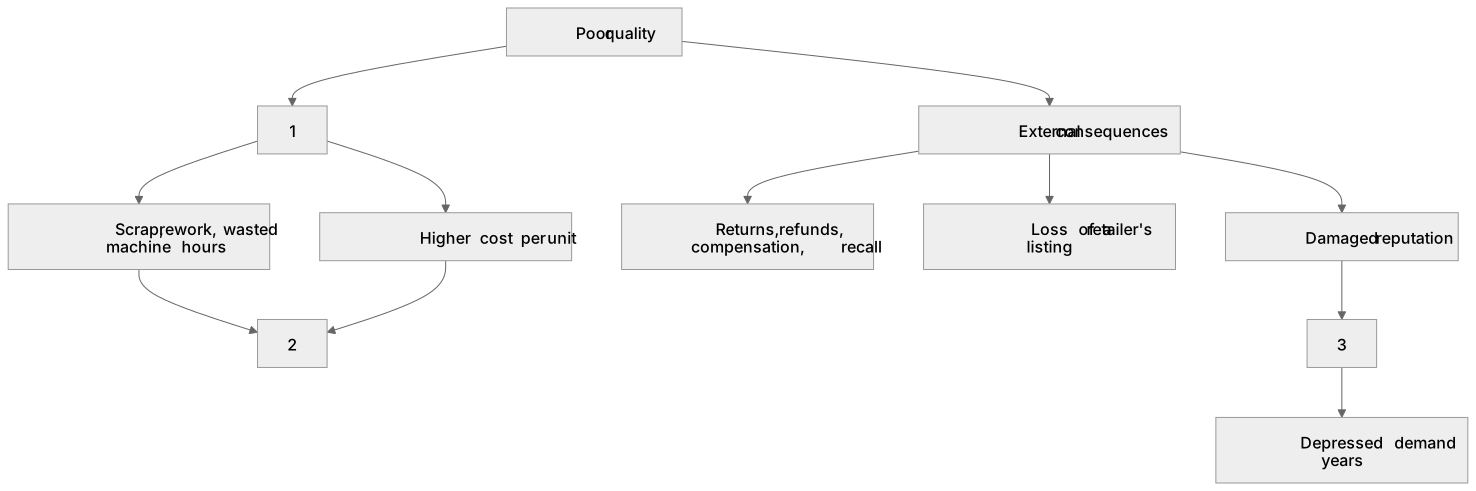
1Box 1
2Box 2
3Box 3
There is more to this lesson
The full lesson goes on to check your understanding and help you earn the marks. Create a free account to carry on, with your progress saved.
A week of Premium from your first lesson · Then the free plan continues · No card, no charge
Test your understanding of Making operational decisions to improve performance: improving quality: The consequences of poor quality
Active recall beats re-reading. Take an instant quiz now to test what you’ve learned and lock it into long-term memory.
A week of Premium from your first lesson · Then the free plan continues · No card, no charge