AQA · A-Level · Business
Course version: 7132 · Version from Sept 2023
Increasing efficiency and productivity: The importance of capacity (to…
Full specification wording
Making operational decisions to improve performance: increasing efficiency and productivity: The importance of capacity (to include: The importance of capacity should include how to utilise capacity efficiently.)
Capacity is the ceiling on what a plant, a kitchen or a call centre can turn out in a period with the resources it already has, and the number that does the work in an exam is capacity…
- Point 1 of 5
- 4 key terms
Study notes
From the teaching notes for this specification point.
The idea
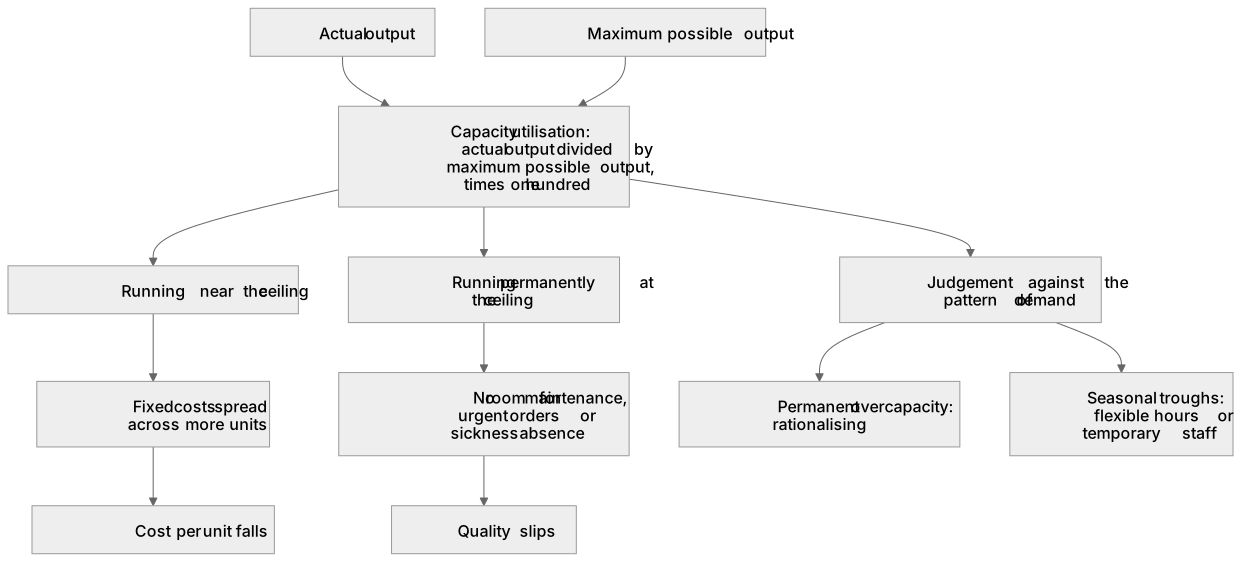
Capacity is the ceiling on what a plant, a kitchen or a call centre can turn out in a period with the resources it already has, and the number that does the work in an exam is capacity utilisation: actual output divided by maximum possible output, multiplied by one hundred, expressed as a percentage. Running near the ceiling spreads fixed costs across more units so cost per unit falls, which is why a hotel chases occupancy and an airline chases load factor. Running there permanently leaves no room for maintenance, an urgent order or a sickness absence, and quality slips. The judgement a case study wants is whether demand here is steady enough to justify cutting capacity by rationalising, or seasonal enough that the slack is worth paying for.
What earns the marks
- Calculating capacity utilisation from the figures in the stem and then saying what the percentage means for cost per unit at this business, rather than leaving the number bare.
- Explaining the fixed cost mechanism, that fixed costs do not change with output so fewer units each carry a larger share, which squeezes the margin at the current selling price.
- Naming a specific way of closing the gap, such as rationalising by closing a site, subcontracting the overflow, or raising demand through promotion, and stating the consequence for this firm.
- Judging the decision against the pattern of demand, because only permanent overcapacity justifies cutting capacity, while seasonal troughs argue for flexible hours or temporary staff.
Common mistakes and how to put them right
Treating full capacity as automatically good, when working flat out leaves no slack for maintenance, damages quality and forces the firm to turn away rush orders it could have charged a premium for.
Confusing capacity utilisation with labour productivity.
Put it right: Utilisation measures how much of the available capacity is in use, productivity measures output per worker, and a firm can be highly utilised and unproductive at once.
Recommending redundancies as though only the wage saving mattered, ignoring redundancy payments, lost skills and the cost of recruiting again when demand recovers.
Exam tips
- Data response often gives output and a maximum in different units or over different time periods, so convert both to the same period before you divide.
- Capacity is usually examined inside a decision, such as whether to accept a large one off order, so use the spare capacity figure to show whether it can be met without overtime or new equipment.
- For evaluation, argue that the right level depends on the industry, since a hospital or a fire service deliberately holds spare capacity while a budget airline does not.
Try the lesson
The start of the Making operational decisions to improve performance: increasing efficiency and productivity: The importance of capacity (to include: The importance of capacity should include how to utilise capacity efficiently.) lesson, made from teaching notes for this specification point.
Have a go first
What is meant by the capacity of a business operation?
Listen
Capacity is the ceiling on what a plant, a kitchen or a call centre can turn out in a period with the resources it already has, and the number that does the work in an exam is capacity utilisation: actual output divided by maximum possible output, multiplied by one hundred, expressed as a percentage. Running near the ceiling spreads fixed costs across more units so cost per unit falls, which is why a hotel chases occupancy and an airline chases load factor. Running there permanently leaves no room for maintenance, an urgent order or a sickness absence, and quality slips. The judgement a case study wants is whether demand here is steady enough to justify cutting capacity by rationalising, or seasonal enough that the slack is worth paying for. A strong answer earns marks for these points. Calculating capacity utilisation from the figures in the stem and then saying what the percentage means for cost per unit at this business, rather than leaving the number bare. Explaining the fixed cost mechanism, that fixed costs do not change with output so fewer units each carry a larger share, which squeezes the margin at the current selling price. Naming a specific way of closing the gap, such as rationalising by closing a site, subcontracting the overflow, or raising demand through promotion, and stating the consequence for this firm. Judging the decision against the pattern of demand, because only permanent overcapacity justifies cutting capacity, while seasonal troughs argue for flexible hours or temporary staff. Exam tip: Data response often gives output and a maximum in different units or over different time periods, so convert both to the same period before you divide.
See it
Key words
Say what each word means before you turn the card.
capacity utilisation
Try answering aloud or in your head before turning the card.
spare capacity
Try answering aloud or in your head before turning the card.
rationalisation
Try answering aloud or in your head before turning the card.
fixed cost per unit
Try answering aloud or in your head before turning the card.
See every definition
- capacity utilisation
- Actual output divided by maximum possible output, multiplied by one hundred, expressed as a percentage.
- spare capacity
- Slack left when a business is not running near the ceiling, giving room for maintenance, an urgent order or a sickness absence.
- rationalisation
- Cutting capacity by closing a site, which is justified only when demand is steady enough to support it.
- fixed cost per unit
- Fixed costs do not change with output, so running near the ceiling spreads them across more units and this falls.
Label the diagram
Some boxes have lost their names. Pick the right name for each number.
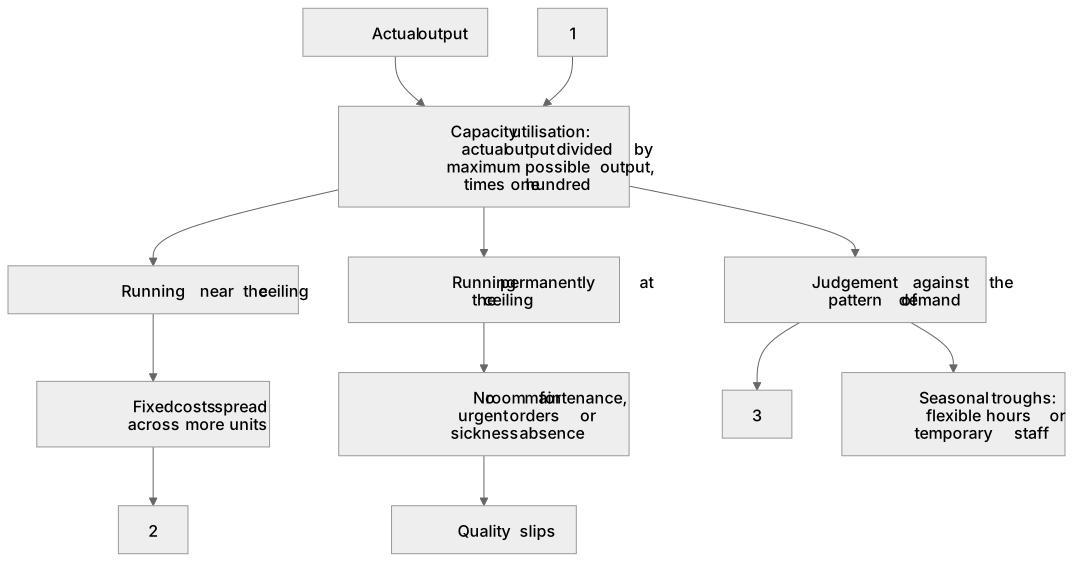
1Box 1
2Box 2
3Box 3
There is more to this lesson
The full lesson goes on to check your understanding and help you earn the marks. Create a free account to carry on, with your progress saved.
A week of Premium from your first lesson · Then the free plan continues · No card, no charge
Test your understanding of Making operational decisions to improve performance: increasing efficiency and productivity: The importance of capacity (to include: The importance of capacity should include how to utilise capacity efficiently.)
Active recall beats re-reading. Take an instant quiz now to test what you’ve learned and lock it into long-term memory.
A week of Premium from your first lesson · Then the free plan continues · No card, no charge