AQA · A-Level · Business
Course version: 7132 · Version from Sept 2023
Increasing efficiency and productivity: The importance of efficiency and…
Full specification wording
Making operational decisions to improve performance: increasing efficiency and productivity: The importance of efficiency and labour productivity (to include: The importance of efficiency and labour should include: how to increase efficiency and labour productivity, difficulties increasing efficiency and labour productivity.)
Output per worker in a period, total output divided by the number of employees, is the figure that decides whether a high wage is actually expensive.
- Point 2 of 5
Study notes
From the teaching notes for this specification point.
The idea
Output per worker in a period, total output divided by the number of employees, is the figure that decides whether a high wage is actually expensive. A firm paying thirty pounds an hour can undercut a rival paying ten if each of its workers makes six times as much, because what competes is labour cost per unit, not the wage rate. Raising it means training, better machinery, cell production, job redesign or simply motivating people, and every route spends money now for a return later. The difficulty worth writing about is that workers who suspect the gains mean fewer jobs will resist them, and that pushing output per head can quietly push defect rates up, so the saving in cost per unit is eaten by scrap and warranty claims.
What earns the marks
- Calculating output per worker and converting it into labour cost per unit, since that is the figure that tells the firm whether its wage bill is competitive.
- Explaining a named route with its mechanism, for example training that cuts machine changeover time, instead of asserting that training motivates staff.
- Recognising the timing problem, that the cost of new equipment or a training programme falls in this year's profit while the gain arrives over several years.
- Weighing difficulties specific to this workforce, such as resistance where redundancies followed the last efficiency drive, or a skills shortage that leaves new machinery idle.
Common mistakes and how to put them right
Using efficiency and productivity as if they were the same thing.
Put it right: Productivity is output per unit of input, efficiency is producing at the lowest cost per unit, and a productive firm buying expensive inputs is still inefficient.
Dividing output by hours worked and calling the result output per worker, or mixing a weekly output figure with an annual headcount.
Claiming higher pay always lifts productivity, when Herzberg treats pay as a hygiene factor that removes dissatisfaction rather than a motivator, and Taylor's piece rates only work where output is easy to measure.
Exam tips
- The stem usually gives output and employee numbers for two years or two sites, so compare them and comment on the direction of travel rather than quoting one figure.
- Assess questions about an efficiency drive reward judgement about people, so use Kotter and Schlesinger on handling resistance or Herzberg on job enrichment, and say what the model is blind to, such as the cost and time each approach takes.
- Watch for a firm whose selling point is quality; an argument that pushing speed would damage the brand scores better than a generic list of methods.
Try the lesson
The start of the Making operational decisions to improve performance: increasing efficiency and productivity: The importance of efficiency and labour productivity (to include: The importance of efficiency and labour should include: how to increase efficiency and labour productivity, difficulties increasing efficiency and labour productivity.) lesson, made from teaching notes for this specification point.
Have a go first
What is meant by labour productivity?
Listen
Output per worker in a period, total output divided by the number of employees, is the figure that decides whether a high wage is actually expensive. A firm paying thirty pounds an hour can undercut a rival paying ten if each of its workers makes six times as much, because what competes is labour cost per unit, not the wage rate. Raising it means training, better machinery, cell production, job redesign or simply motivating people, and every route spends money now for a return later. The difficulty worth writing about is that workers who suspect the gains mean fewer jobs will resist them, and that pushing output per head can quietly push defect rates up, so the saving in cost per unit is eaten by scrap and warranty claims. A strong answer earns marks for these points. Calculating output per worker and converting it into labour cost per unit, since that is the figure that tells the firm whether its wage bill is competitive. Explaining a named route with its mechanism, for example training that cuts machine changeover time, instead of asserting that training motivates staff. Recognising the timing problem, that the cost of new equipment or a training programme falls in this year's profit while the gain arrives over several years. Weighing difficulties specific to this workforce, such as resistance where redundancies followed the last efficiency drive, or a skills shortage that leaves new machinery idle. Exam tip: The stem usually gives output and employee numbers for two years or two sites, so compare them and comment on the direction of travel rather than quoting one figure.
See it
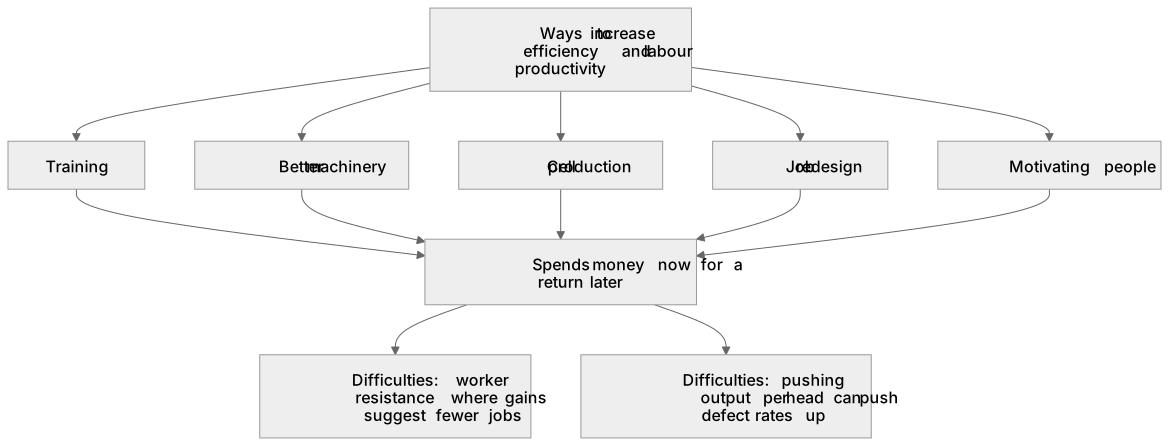
Label the diagram
Some boxes have lost their names. Pick the right name for each number.
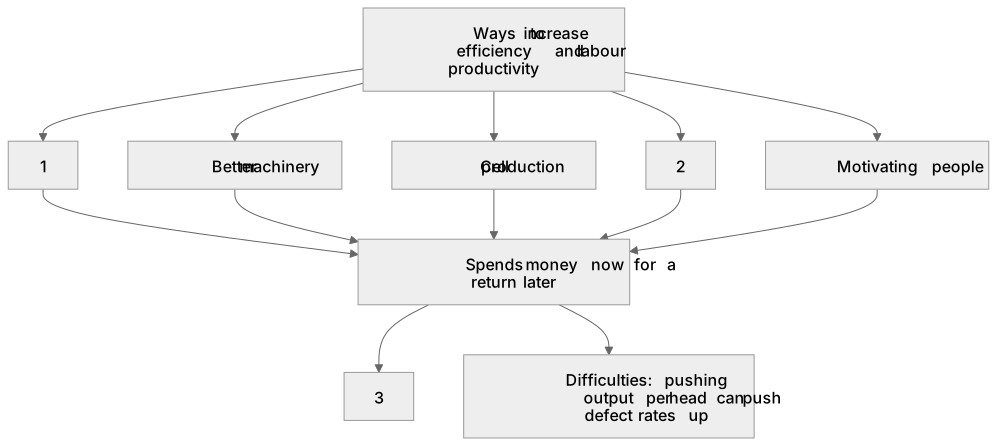
1Box 1
2Box 2
3Box 3
There is more to this lesson
The full lesson goes on to check your understanding and help you earn the marks. Create a free account to carry on, with your progress saved.
A week of Premium from your first lesson · Then the free plan continues · No card, no charge
Test your understanding of Making operational decisions to improve performance: increasing efficiency and productivity: The importance of efficiency and labour productivity (to include: The importance of efficiency and labour should include: how to increase efficiency and labour productivity, difficulties increasing efficiency and labour productivity.)
Active recall beats re-reading. Take an instant quiz now to test what you’ve learned and lock it into long-term memory.
A week of Premium from your first lesson · Then the free plan continues · No card, no charge