AQA · A-Level · Business
Course version: 7132 · Version from Sept 2023
Managing inventory and supply chains: How to manage the supply chain…
Full specification wording
Making operational decisions to improve performance: managing inventory and supply chains: How to manage the supply chain effectively and efficiently and the value of this
Effective and efficient are two different tests, and running them together loses the tension the question is built on: the first asks whether the right goods reach the right place at the right…
- Point 4 of 5
- 3 key terms
Study notes
From the teaching notes for this specification point.
The idea
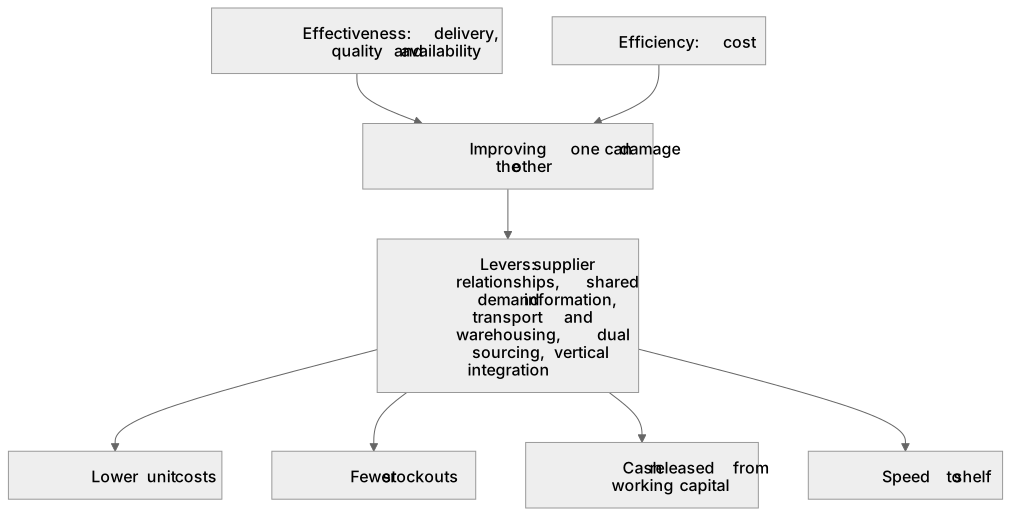
Effective and efficient are two different tests, and running them together loses the tension the question is built on: the first asks whether the right goods reach the right place at the right time and quality, the second asks what that cost. Squeeze hard enough and unit costs fall while the business becomes fragile, which is what the blocked Suez Canal and the semiconductor shortage exposed in firms that had stripped every buffer out. The levers are supplier relationships, shared demand information, transport and warehousing decisions, dual sourcing and sometimes vertical integration. The payoff shows up as lower unit costs, fewer stockouts, cash released from working capital and, for a business like Zara, a speed to shelf that rivals cannot copy.
What earns the marks
- Separating effectiveness, which is delivery, quality and availability, from efficiency, which is cost, and showing that improving one can damage the other.
- Tracing the chain from raw material supplier through to the end customer for the business in the case and identifying where its weak link actually is.
- Quantifying the gain where the data allows it, such as the working capital released by cutting inventory days or the saving from consolidating deliveries.
- Explaining the competitive consequence, for instance that dependable delivery supports a premium price while a lean chain supports a low cost strategy.
- Qualifying any recommendation to strip out buffers with what happens to this firm when a single supplier fails.
Common mistakes and how to put them right
Writing about the supply chain as though it were only purchasing, ignoring transport, warehousing, distribution and the retailer at the far end.
Assuming lean is always better, when a business that cannot fulfil orders loses customers who do not come back and whose lifetime value is lost with them.
Asserting that better supply chain management improves profit without naming the route, whether that is lower unit cost, higher volume or less capital tied up.
Describing what the firm did rather than analysing the effect, so the answer notes a new distribution centre and stops before delivery times, costs or capacity.
Exam tips
- This is common as a nine mark analyse question, where two fully developed chains of reasoning beat four undeveloped points every time.
- In the longer essays the best evaluation compares the cost of building resilience with the likelihood and cost of disruption for this particular firm.
- Look for supply chain data in the appendices, such as delivery reliability percentages or inventory turnover, and use the numbers rather than describing them.
Try the lesson
The start of the Making operational decisions to improve performance: managing inventory and supply chains: How to manage the supply chain effectively and efficiently and the value of this lesson, made from teaching notes for this specification point.
Have a go first
Which term describes the coordination of all activities from raw material suppliers through to the final customer?
Listen
Effective and efficient are two different tests, and running them together loses the tension the question is built on: the first asks whether the right goods reach the right place at the right time and quality, the second asks what that cost. Squeeze hard enough and unit costs fall while the business becomes fragile, which is what the blocked Suez Canal and the semiconductor shortage exposed in firms that had stripped every buffer out. The levers are supplier relationships, shared demand information, transport and warehousing decisions, dual sourcing and sometimes vertical integration. The payoff shows up as lower unit costs, fewer stockouts, cash released from working capital and, for a business like Zara, a speed to shelf that rivals cannot copy. A strong answer earns marks for these points. Separating effectiveness, which is delivery, quality and availability, from efficiency, which is cost, and showing that improving one can damage the other. Tracing the chain from raw material supplier through to the end customer for the business in the case and identifying where its weak link actually is. Quantifying the gain where the data allows it, such as the working capital released by cutting inventory days or the saving from consolidating deliveries. Explaining the competitive consequence, for instance that dependable delivery supports a premium price while a lean chain supports a low cost strategy. Exam tip: This is common as a nine mark analyse question, where two fully developed chains of reasoning beat four undeveloped points every time.
See it
Key words
Say what each word means before you turn the card.
effectiveness versus efficiency
Try answering aloud or in your head before turning the card.
supply chain resilience
Try answering aloud or in your head before turning the card.
logistics and distribution
Try answering aloud or in your head before turning the card.
See every definition
- effectiveness versus efficiency
- The first asks whether the right goods reach the right place at the right time and quality, the second asks what that cost, and improving one can damage the other.
- supply chain resilience
- The ability to withstand disruption, which stripping every buffer out undermines, as the blocked Suez Canal and the semiconductor shortage exposed.
- logistics and distribution
- Transport and warehousing decisions, which are among the levers for managing the supply chain.
Label the diagram
Some boxes have lost their names. Pick the right name for each number.
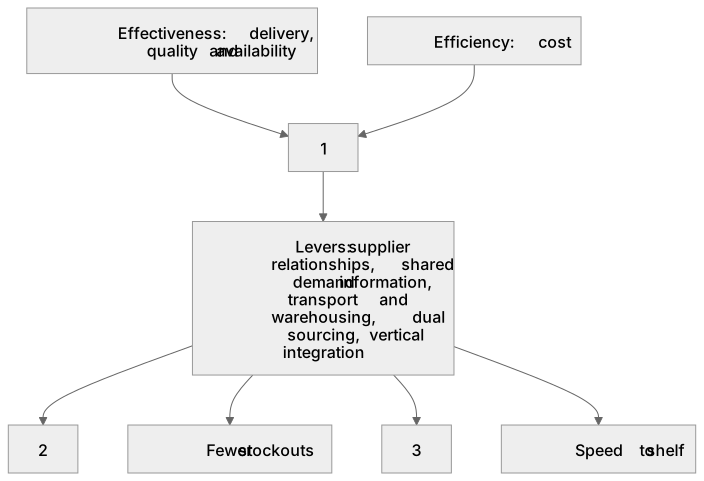
1Box 1
2Box 2
3Box 3
There is more to this lesson
The full lesson goes on to check your understanding and help you earn the marks. Create a free account to carry on, with your progress saved.
A week of Premium from your first lesson · Then the free plan continues · No card, no charge
Test your understanding of Making operational decisions to improve performance: managing inventory and supply chains: How to manage the supply chain effectively and efficiently and the value of this
Active recall beats re-reading. Take an instant quiz now to test what you’ve learned and lock it into long-term memory.
A week of Premium from your first lesson · Then the free plan continues · No card, no charge