AQA · A-Level · Business
Course version: 7132 · Version from Sept 2023
Managing inventory and supply chains: The value of outsourcing
Full specification wording
Making operational decisions to improve performance: managing inventory and supply chains: The value of outsourcing
Outsourcing involves contracting an external firm for an activity previously done in-house.
- Point 5 of 5
- 2 key terms
Study notes
From the teaching notes for this specification point.
The idea
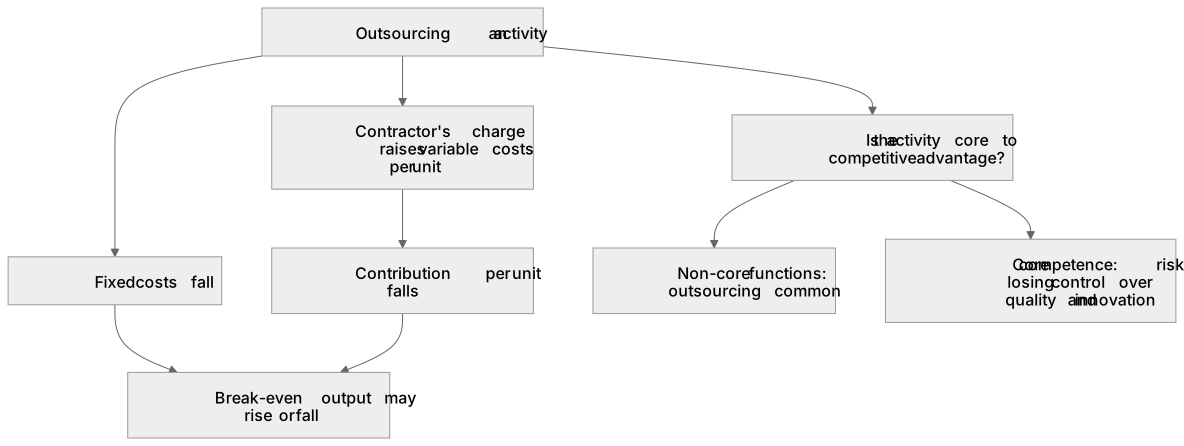
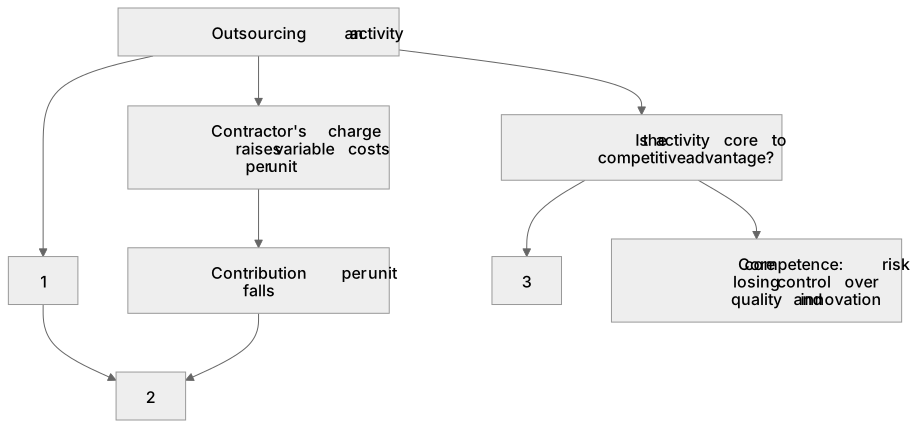
Outsourcing involves contracting an external firm for an activity previously done in-house. Its main value is often strategic and financial flexibility. It can convert a fixed cost, like a factory and permanent staff, into a variable cost based on a per-unit charge from the contractor. This can lower the financial risk during a downturn. However, the effect on the break-even point is not guaranteed: while fixed costs fall, the contractor's charge increases variable costs per unit, which reduces the contribution per unit. Break-even output may rise or fall depending on the balance of these changes. The key strategic decision is whether the activity is core to the business's competitive advantage. Outsourcing non-core functions like payroll or IT support is common, but outsourcing a core competence risks losing control over quality and innovation.
What earns the marks
- Calculating the financial impact of outsourcing by comparing the contractor's price with the relevant in-house variable costs and the specific fixed costs that would be saved.
- Analysing the effect on the break-even point, explaining that it depends on the relative change in fixed costs versus the contribution per unit.
- Distinguishing between core and non-core activities for the specific business in the case, and justifying why outsourcing one is more appropriate than the other.
- Explaining the potential loss of control over quality, delivery times, or flexibility, and the costs of managing the supplier relationship (eg monitoring, contracts).
- Reaching a justified conclusion that weighs the financial benefits (eg cost, flexibility) against the strategic risks (eg loss of control, impact on quality).
Common mistakes and how to put them right
Assuming outsourcing always cuts costs, without considering the contractor's profit margin and the firm's own costs of managing the contract.
Stating that outsourcing lowers the break-even point, without calculating or considering the impact of higher variable costs on the contribution per unit.
Confusing outsourcing (contracting another firm to do work) with offshoring (moving a business function to another country, which could be in-house or outsourced).
Exam tips
- Outsourcing questions often provide cost data. Always perform the calculations first (cost comparison, break-even) and use your results to support your final judgement.
- For evaluation, consider both the short-term financial case and the long-term strategic risks. Argue which is more important for the business in the case study.
Try the lesson
The start of the Making operational decisions to improve performance: managing inventory and supply chains: The value of outsourcing lesson, made from teaching notes for this specification point.
Have a go first
What is meant by outsourcing in an operations context?
Listen
Outsourcing involves contracting an external firm for an activity previously done in-house. Its main value is often strategic and financial flexibility. It can convert a fixed cost, like a factory and permanent staff, into a variable cost based on a per-unit charge from the contractor. This can lower the financial risk during a downturn. However, the effect on the break-even point is not guaranteed: while fixed costs fall, the contractor's charge increases variable costs per unit, which reduces the contribution per unit. Break-even output may rise or fall depending on the balance of these changes. The key strategic decision is whether the activity is core to the business's competitive advantage. Outsourcing non-core functions like payroll or IT support is common, but outsourcing a core competence risks losing control over quality and innovation. A strong answer earns marks for these points. Calculating the financial impact of outsourcing by comparing the contractor's price with the relevant in-house variable costs and the specific fixed costs that would be saved. Analysing the effect on the break-even point, explaining that it depends on the relative change in fixed costs versus the contribution per unit. Distinguishing between core and non-core activities for the specific business in the case, and justifying why outsourcing one is more appropriate than the other. Explaining the potential loss of control over quality, delivery times, or flexibility, and the costs of managing the supplier relationship (eg monitoring, contracts). Exam tip: Outsourcing questions often provide cost data. Always perform the calculations first (cost comparison, break-even) and use your results to support your final judgement.
See it
Key words
Say what each word means before you turn the card.
Outsourcing
Try answering aloud or in your head before turning the card.
Core vs non-core activities
Try answering aloud or in your head before turning the card.
See every definition
- Outsourcing
- Contracting an external firm for an activity previously done in-house, which can convert a fixed cost into a variable cost based on a per-unit charge.
- Core vs non-core activities
- The key strategic decision is whether the activity is core to the business's competitive advantage, with outsourcing non-core functions common but outsourcing a core competence risking loss of control over quality and innovation.
Label the diagram
Some boxes have lost their names. Pick the right name for each number.
1Box 1
2Box 2
3Box 3
There is more to this lesson
The full lesson goes on to check your understanding and help you earn the marks. Create a free account to carry on, with your progress saved.
A week of Premium from your first lesson · Then the free plan continues · No card, no charge
Test your understanding of Making operational decisions to improve performance: managing inventory and supply chains: The value of outsourcing
Active recall beats re-reading. Take an instant quiz now to test what you’ve learned and lock it into long-term memory.
A week of Premium from your first lesson · Then the free plan continues · No card, no charge