AQA · A-Level · Business
Course version: 7132 · Version from Sept 2023
The importance of organisational culture (to include: Cultural models…
Full specification wording
Managing organisational culture: The importance of organisational culture (to include: Cultural models should include Handy’s task culture, role culture, power culture and person culture.)
Culture is the set of shared values, habits and unwritten rules that decide how staff behave when nobody is watching, and it earns its place in a case study because it explains why two firms with…
- Point 1 of 3
- 4 key terms
Study notes
From the teaching notes for this specification point.
The idea
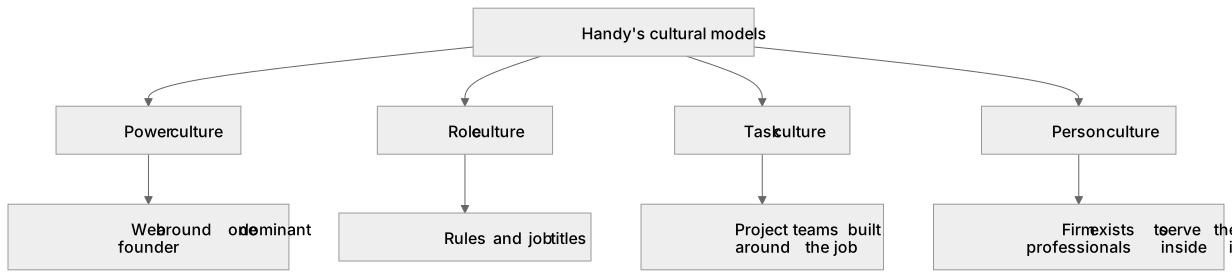
Culture is the set of shared values, habits and unwritten rules that decide how staff behave when nobody is watching, and it earns its place in a case study because it explains why two firms with the same structure and the same strategy get different results. Handy sorts it four ways: power, a web around one dominant founder, quick but fragile once the firm outgrows that person; role, rules and job titles, reliable and slow; task, project teams built around the job, flexible but costly to co-ordinate; person, the firm existing to serve the professionals inside it, as in a law partnership, and almost impossible to steer. The label is the easy half. Handy is blind to the subcultures inside one business, to national differences, which is Hofstede's ground, and to how a culture is actually shifted, which is Lewin's.
What earns the marks
- Naming the culture the case evidence actually supports and quoting that evidence, a founder signing off every decision for power culture, a thick procedures manual for role culture, rather than asserting a label.
- Linking the culture to a performance figure in the case such as labour turnover, absenteeism, the rate of new product launches or the level of customer complaints.
- Showing the same culture is an asset in one market and a liability in another, so a role culture that protects safety in an airline would slow a software house to a standstill.
- Recognising that a large business carries subcultures, so the sales floor and the finance office may not share the one the chief executive describes.
Common mistakes and how to put them right
Describing all four of Handy's types in turn when the question names one business, which pays only for knowledge and leaves the application and evaluation marks untouched.
Confusing culture with structure, so a tall hierarchy is called a role culture, when structure is the chart and culture is the behaviour that survives after the chart is redrawn.
Treating a strong culture as automatically good, when a strong culture built on aggressive sales targets, as at Wells Fargo, produced misconduct faster than a weak one would have.
Exam tips
- The extract plants culture in behaviour rather than in the word itself, so look for who decides, how quickly, and what happens to somebody who breaks an unwritten rule.
- On assess and evaluate questions, weigh whether culture or something cheaper to fix, such as pay, capacity or the product range, explains the problem, and say what evidence would settle it.
Try the lesson
The start of the Managing organisational culture: The importance of organisational culture (to include: Cultural models should include Handy’s task culture, role culture, power culture and person culture.) lesson, made from teaching notes for this specification point.
Have a go first
Which of Handy's cultural models describes an organisation in which a single central figure holds the main source of authority?
Listen
Culture is the set of shared values, habits and unwritten rules that decide how staff behave when nobody is watching, and it earns its place in a case study because it explains why two firms with the same structure and the same strategy get different results. Handy sorts it four ways: power, a web around one dominant founder, quick but fragile once the firm outgrows that person; role, rules and job titles, reliable and slow; task, project teams built around the job, flexible but costly to co-ordinate; person, the firm existing to serve the professionals inside it, as in a law partnership, and almost impossible to steer. The label is the easy half. Handy is blind to the subcultures inside one business, to national differences, which is Hofstede's ground, and to how a culture is actually shifted, which is Lewin's. A strong answer earns marks for these points. Naming the culture the case evidence actually supports and quoting that evidence, a founder signing off every decision for power culture, a thick procedures manual for role culture, rather than asserting a label. Linking the culture to a performance figure in the case such as labour turnover, absenteeism, the rate of new product launches or the level of customer complaints. Showing the same culture is an asset in one market and a liability in another, so a role culture that protects safety in an airline would slow a software house to a standstill. Recognising that a large business carries subcultures, so the sales floor and the finance office may not share the one the chief executive describes. Exam tip: The extract plants culture in behaviour rather than in the word itself, so look for who decides, how quickly, and what happens to somebody who breaks an unwritten rule.
See it
Key words
Say what each word means before you turn the card.
Handy's four cultures
Try answering aloud or in your head before turning the card.
power culture
Try answering aloud or in your head before turning the card.
role culture
Try answering aloud or in your head before turning the card.
person culture
Try answering aloud or in your head before turning the card.
See every definition
- Handy's four cultures
- A way of sorting organisational culture four ways: power, role, task and person.
- power culture
- A web around one dominant founder, quick but fragile once the firm outgrows that person.
- role culture
- Rules and job titles, reliable and slow.
- person culture
- The firm existing to serve the professionals inside it, as in a law partnership, and almost impossible to steer.
Label the diagram
Some boxes have lost their names. Pick the right name for each number.
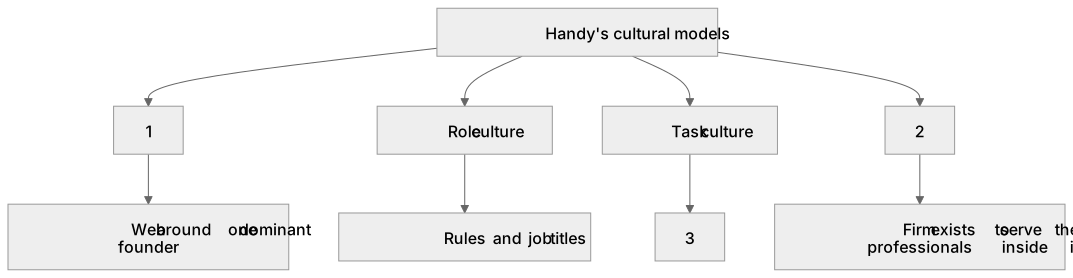
1Box 1
2Box 2
3Box 3
There is more to this lesson
The full lesson goes on to check your understanding and help you earn the marks. Create a free account to carry on, with your progress saved.
A week of Premium from your first lesson · Then the free plan continues · No card, no charge
Test your understanding of Managing organisational culture: The importance of organisational culture (to include: Cultural models should include Handy’s task culture, role culture, power culture and person culture.)
Active recall beats re-reading. Take an instant quiz now to test what you’ve learned and lock it into long-term memory.
A week of Premium from your first lesson · Then the free plan continues · No card, no charge