AQA · A-Level · Business
Course version: 7132 · Version from Sept 2023
Managing organisational culture: The influences on organisational culture
Culture is formed rather than chosen, so the useful question in a case is which force formed this one.
- Point 2 of 3
- 4 key terms
Study notes
From the teaching notes for this specification point.
The idea
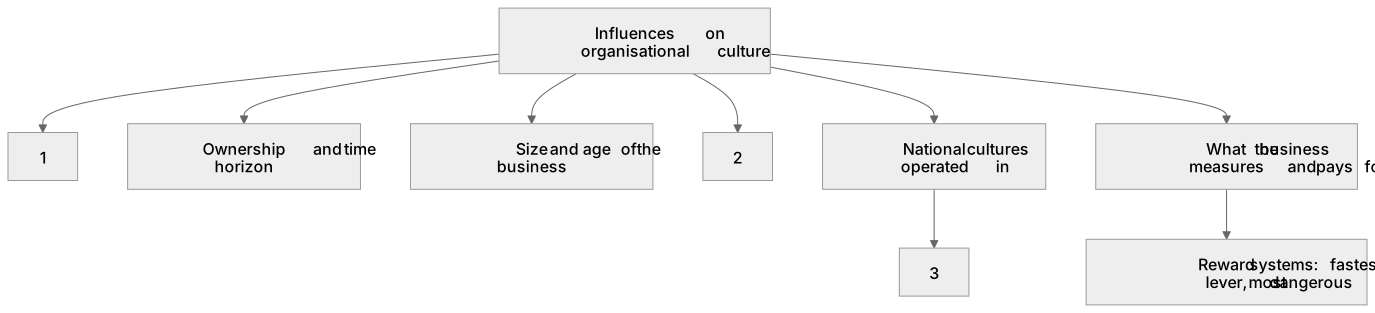
Culture is formed rather than chosen, so the useful question in a case is which force formed this one. The usual suspects are the founder's own values and the stories still told about them, ownership and the time horizon it imposes, since a family firm run for the grandchildren behaves differently from one bought by private equity on a five year exit, the size and age of the business, which is Greiner's territory as an informal start-up hardens into procedure, the technology and risk of the industry, the national cultures it operates in, where Hofstede's power distance and uncertainty avoidance earn their keep, and above all what the business measures and pays for. Reward systems are the fastest lever and the most dangerous, because people optimise the target rather than the intention behind it.
What earns the marks
- Tracing a named influence through to an observable behaviour in the case, such as a founder's engineering background showing up as a refusal to cut research spending during a downturn.
- Separating the influences management can move, pay, promotion criteria, recruitment and induction, from those it cannot, national culture, industry regulation and the firm's own history.
- Using Hofstede properly where the business trades abroad, naming the dimension at work rather than saying that cultures differ.
- Recognising the time lag, so an influence introduced this year shows up in behaviour over several years and cannot be judged by next quarter's results.
Common mistakes and how to put them right
Listing influences as a shopping list with no evidence from the extract, which reads as recall of a textbook page and stalls at knowledge.
Assuming a new chief executive changes the culture on arrival, when the appraisal and bonus system left in place usually holds the old behaviour firmly in position.
Treating national culture as a stereotype about a country rather than a dimension such as power distance that predicts how staff respond to a distant manager.
Exam tips
- Influences are usually asked through analyse questions in the nine to twelve mark band, so build two developed chains of reasoning rather than six undeveloped points.
- Where the case involves a merger or a takeover, the influence worth writing about is the collision of two sets of habits, and the evidence is normally resignations or a fall in productivity after completion.
Try the lesson
The start of the Managing organisational culture: The influences on organisational culture lesson, made from teaching notes for this specification point.
Have a go first
Which of the following is an influence on the culture of a business?
Listen
Culture is formed rather than chosen, so the useful question in a case is which force formed this one. The usual suspects are the founder's own values and the stories still told about them, ownership and the time horizon it imposes, since a family firm run for the grandchildren behaves differently from one bought by private equity on a five year exit, the size and age of the business, which is Greiner's territory as an informal start-up hardens into procedure, the technology and risk of the industry, the national cultures it operates in, where Hofstede's power distance and uncertainty avoidance earn their keep, and above all what the business measures and pays for. Reward systems are the fastest lever and the most dangerous, because people optimise the target rather than the intention behind it. A strong answer earns marks for these points. Tracing a named influence through to an observable behaviour in the case, such as a founder's engineering background showing up as a refusal to cut research spending during a downturn. Separating the influences management can move, pay, promotion criteria, recruitment and induction, from those it cannot, national culture, industry regulation and the firm's own history. Using Hofstede properly where the business trades abroad, naming the dimension at work rather than saying that cultures differ. Recognising the time lag, so an influence introduced this year shows up in behaviour over several years and cannot be judged by next quarter's results. Exam tip: Influences are usually asked through analyse questions in the nine to twelve mark band, so build two developed chains of reasoning rather than six undeveloped points.
See it

Key words
Say what each word means before you turn the card.
founder values
Try answering aloud or in your head before turning the card.
ownership and time horizon
Try answering aloud or in your head before turning the card.
reward systems
Try answering aloud or in your head before turning the card.
national culture
Try answering aloud or in your head before turning the card.
See every definition
- founder values
- The founder's own values and the stories still told about them, which help form a culture rather than the culture being chosen.
- ownership and time horizon
- Ownership and the time horizon it imposes, so a family firm run for the grandchildren behaves differently from one bought by private equity on a five year exit.
- reward systems
- What the business measures and pays for, the fastest lever and the most dangerous, because people optimise the target rather than the intention behind it.
- national culture
- The national cultures the business operates in, where Hofstede's power distance and uncertainty avoidance earn their keep.
Label the diagram
Some boxes have lost their names. Pick the right name for each number.
1Box 1
2Box 2
3Box 3
There is more to this lesson
The full lesson goes on to check your understanding and help you earn the marks. Create a free account to carry on, with your progress saved.
A week of Premium from your first lesson · Then the free plan continues · No card, no charge
Test your understanding of Managing organisational culture: The influences on organisational culture
Active recall beats re-reading. Take an instant quiz now to test what you’ve learned and lock it into long-term memory.
A week of Premium from your first lesson · Then the free plan continues · No card, no charge