AQA · A-Level · Business
Course version: 7132 · Version from Sept 2023
How developments in technology are affecting marketing decision making and…
Full specification wording
Marketing management: how developments in technology are affecting marketing decision making and activities (eg digital marketing and the use of social media, relationship marketing and dynamic pricing)
Technology transforms marketing by enhancing reach, communication, and pricing.
- Point 2 of 6
- 4 key terms
Study notes
From the teaching notes for this specification point.
The idea
Technology transforms marketing by enhancing reach, communication, and pricing. Digital marketing allows firms to target niche audiences globally and measure effectiveness with metrics like click-through and conversion rates. Social media creates a two-way dialogue, making customer service a public part of promotion and reputation management. Relationship marketing is enabled by CRM systems that track customer behaviour to foster loyalty. Technology also permits dynamic pricing, where prices adjust based on real-time market demand, like airline seats or ride-sharing services. This differs from personalised pricing, which targets individuals. While dynamic pricing can maximise revenue by responding to demand shifts, firms risk alienating customers who perceive it as unfair.
What earns the marks
- Explaining how specific digital tools (eg social media analytics, SEO) allow a business to target a specific market segment.
- Using a measure that technology makes available, such as conversion rate or customer retention rate, as evidence for a marketing decision.
- Explaining dynamic pricing as a response to market-wide demand changes, distinguishing it from price discrimination aimed at individuals.
- Analysing how technology facilitates relationship marketing, for example through loyalty schemes or targeted email communication, to improve customer retention.
- Evaluating the trade-off between the revenue gains from dynamic pricing and the potential damage to customer trust and brand reputation.
Common mistakes and how to put them right
Stating that social media is 'free', ignoring the significant costs of staff time, content creation, and managing online customer interactions.
Confusing dynamic pricing (price changes for all customers based on demand) with personalised pricing (different prices for different individuals).
Treating customer data as automatically valuable, without explaining how it must be analysed and used to inform specific marketing decisions.
Exam tips
- When discussing pricing, explain the mechanism. For dynamic pricing, link price changes to shifts in market demand, not just a desire for more profit.
- Use data from the case study (eg follower counts, website traffic) as evidence to support your arguments about the effectiveness of digital marketing.
Try the lesson
The start of the Marketing management: how developments in technology are affecting marketing decision making and activities (eg digital marketing and the use of social media, relationship marketing and dynamic pricing) lesson, made from teaching notes for this specification point.
Have a go first
Which of the following is an example of digital marketing?
Listen
Technology transforms marketing by enhancing reach, communication, and pricing. Digital marketing allows firms to target niche audiences globally and measure effectiveness with metrics like click-through and conversion rates. Social media creates a two-way dialogue, making customer service a public part of promotion and reputation management. Relationship marketing is enabled by CRM systems that track customer behaviour to foster loyalty. Technology also permits dynamic pricing, where prices adjust based on real-time market demand, like airline seats or ride-sharing services. This differs from personalised pricing, which targets individuals. While dynamic pricing can maximise revenue by responding to demand shifts, firms risk alienating customers who perceive it as unfair. A strong answer earns marks for these points. Explaining how specific digital tools (eg social media analytics, SEO) allow a business to target a specific market segment. Using a measure that technology makes available, such as conversion rate or customer retention rate, as evidence for a marketing decision. Explaining dynamic pricing as a response to market-wide demand changes, distinguishing it from price discrimination aimed at individuals. Analysing how technology facilitates relationship marketing, for example through loyalty schemes or targeted email communication, to improve customer retention. Exam tip: When discussing pricing, explain the mechanism. For dynamic pricing, link price changes to shifts in market demand, not just a desire for more profit.
See it
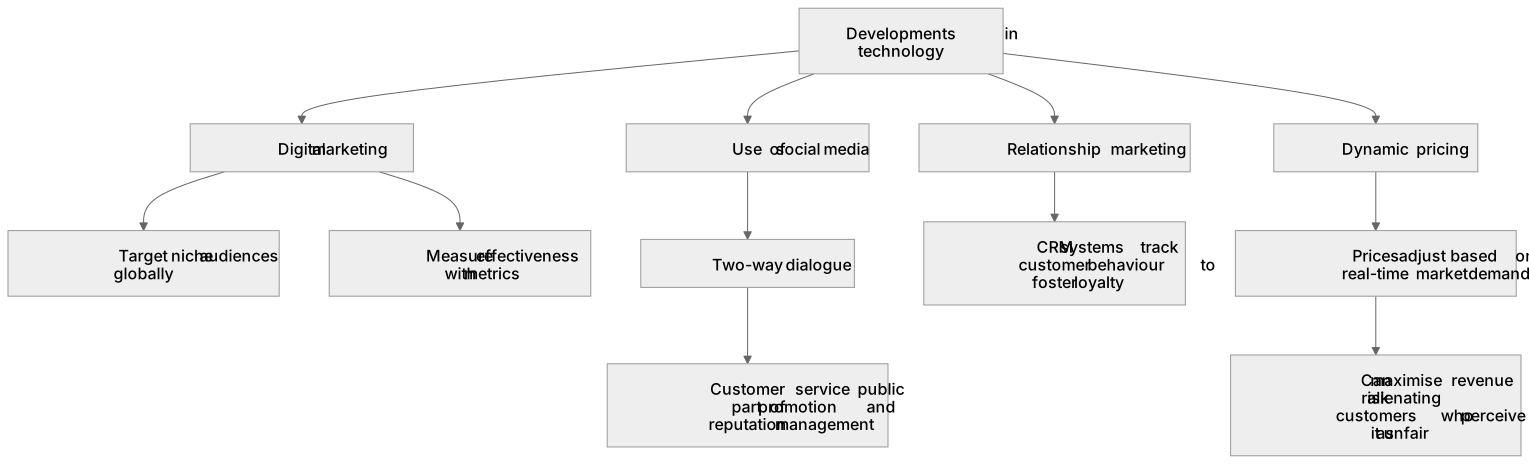
Key words
Say what each word means before you turn the card.
Digital marketing
Try answering aloud or in your head before turning the card.
Dynamic pricing
Try answering aloud or in your head before turning the card.
Relationship marketing
Try answering aloud or in your head before turning the card.
Personalised pricing
Try answering aloud or in your head before turning the card.
See every definition
- Digital marketing
- Allows firms to target niche audiences globally and measure effectiveness with metrics like click-through and conversion rates.
- Dynamic pricing
- Prices adjust based on real-time market demand, like airline seats or ride-sharing services, and can maximise revenue by responding to demand shifts.
- Relationship marketing
- Enabled by CRM systems that track customer behaviour to foster loyalty.
- Personalised pricing
- Targets individuals, differing from dynamic pricing where prices change for all customers based on demand.
Label the diagram
Some boxes have lost their names. Pick the right name for each number.
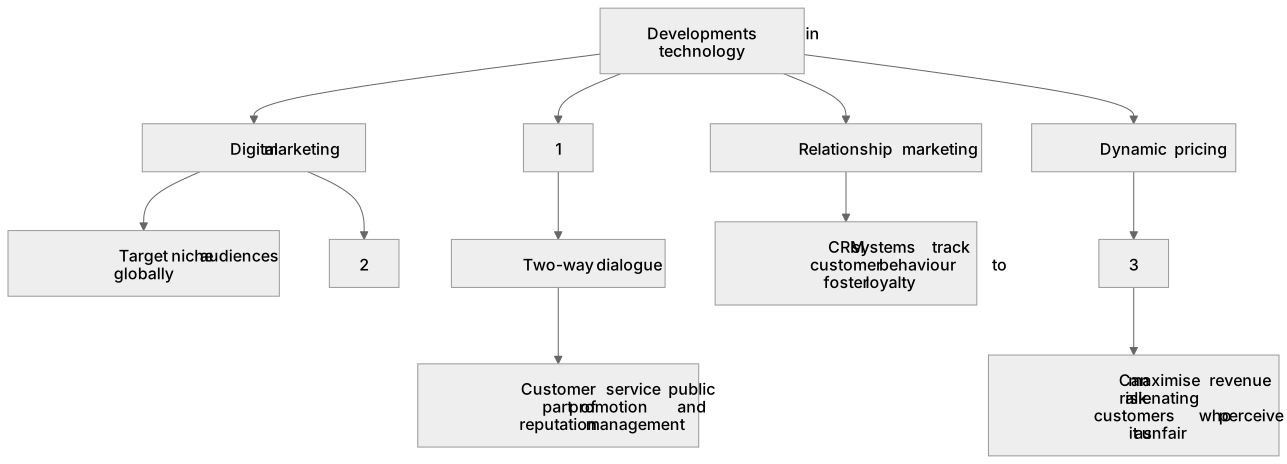
1Box 1
2Box 2
3Box 3
There is more to this lesson
The full lesson goes on to check your understanding and help you earn the marks. Create a free account to carry on, with your progress saved.
A week of Premium from your first lesson · Then the free plan continues · No card, no charge
Test your understanding of Marketing management: how developments in technology are affecting marketing decision making and activities (eg digital marketing and the use of social media, relationship marketing and dynamic pricing)
Active recall beats re-reading. Take an instant quiz now to test what you’ve learned and lock it into long-term memory.
A week of Premium from your first lesson · Then the free plan continues · No card, no charge