AQA · A-Level · Business
Course version: 7132 · Version from Sept 2023
Marketing management: how marketing decisions help improve competitiveness
Competitiveness is the ability to win and keep customers against rivals while still earning an acceptable margin, and marketing improves it along one of two routes.
- Point 5 of 6
- 4 key terms
Study notes
From the teaching notes for this specification point.
The idea
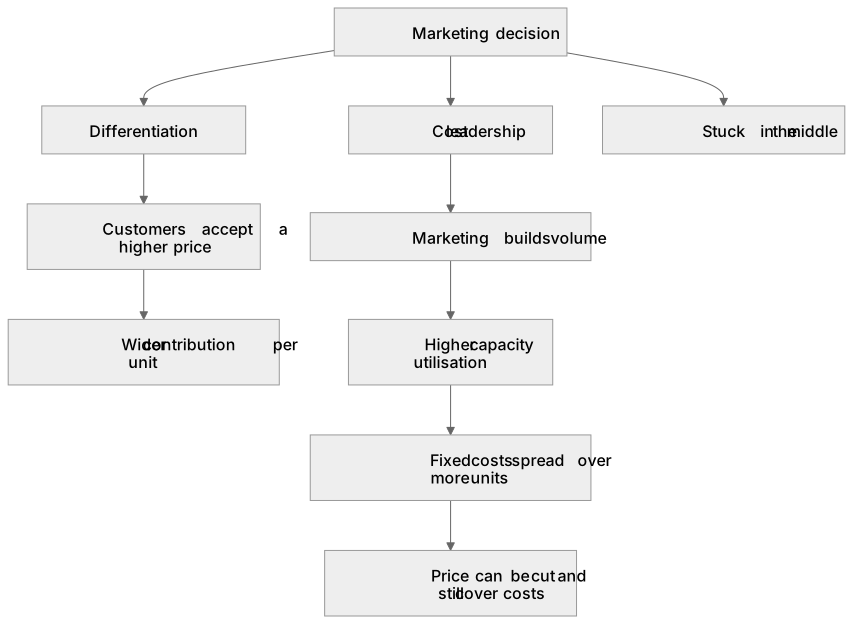
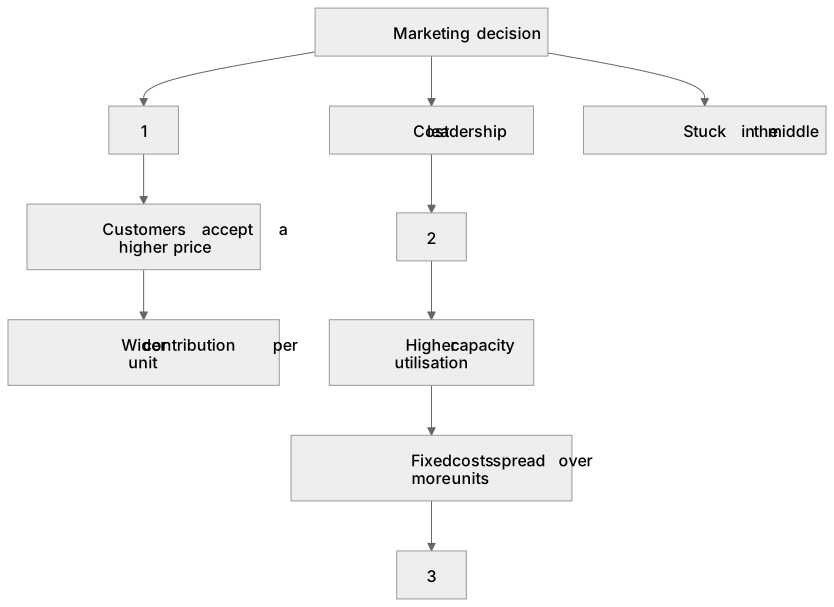
Competitiveness is the ability to win and keep customers against rivals while still earning an acceptable margin, and marketing improves it along one of two routes. Differentiation uses brand, quality, service or design so that customers accept a higher price, which widens contribution per unit, the selling price minus the variable cost per unit. Cost leadership uses marketing to build the volume that fills the factory, and capacity utilisation, actual output divided by maximum possible output, times one hundred, spreads fixed costs over more units so the price can be cut and still cover them. Porter warns against being stuck in the middle with neither advantage. The model is blind to firms that achieved both through lean production, and it understates speed, because a differentiating feature is often copied within a season, which is why brand and service usually outlast a product tweak.
What earns the marks
- Defining competitiveness in terms of customers won and margin earned, not simply as being better than rivals.
- Choosing a route for the named firm, differentiation or low cost, and showing how the specific marketing decision supports it.
- Running the chain to a number, for example that higher volume lifts capacity utilisation and cuts fixed cost per unit, so a lower price is still profitable.
- Naming Porter's generic strategies and using stuck in the middle as a warning about a firm doing a little of both.
- Evaluating durability, arguing which advantage rivals can copy quickly and which is protected by brand, patents or switching costs.
Common mistakes and how to put them right
Claiming more advertising makes a business more competitive without tracing the effect on sales, share, cost per unit or margin.
Treating a lower price as automatically more competitive, when it cuts contribution and can signal lower quality.
Ignoring the rival response, so the answer assumes a price cut or a new feature goes unmatched.
Confusing competitiveness with profitability, when a firm can hold share by discounting into a loss.
Exam tips
- Questions often ask you to assess whether one marketing decision will improve competitiveness, so define the measure you are judging against first, such as market share or margin.
- Use a calculation where the data allows it, since a contribution or utilisation figure makes the argument concrete.
- The strongest conclusions consider how long the advantage lasts and what the firm must keep spending to hold it.
- If asked to recommend between two marketing options, judge both against the same criterion rather than describing each in turn.
Try the lesson
The start of the Marketing management: how marketing decisions help improve competitiveness lesson, made from teaching notes for this specification point.
Have a go first
Which marketing decision is most likely to improve a firm's competitiveness by raising the perceived value of its product?
Listen
Competitiveness is the ability to win and keep customers against rivals while still earning an acceptable margin, and marketing improves it along one of two routes. Differentiation uses brand, quality, service or design so that customers accept a higher price, which widens contribution per unit, the selling price minus the variable cost per unit. Cost leadership uses marketing to build the volume that fills the factory, and capacity utilisation, actual output divided by maximum possible output, times one hundred, spreads fixed costs over more units so the price can be cut and still cover them. Porter warns against being stuck in the middle with neither advantage. The model is blind to firms that achieved both through lean production, and it understates speed, because a differentiating feature is often copied within a season, which is why brand and service usually outlast a product tweak. A strong answer earns marks for these points. Defining competitiveness in terms of customers won and margin earned, not simply as being better than rivals. Choosing a route for the named firm, differentiation or low cost, and showing how the specific marketing decision supports it. Running the chain to a number, for example that higher volume lifts capacity utilisation and cuts fixed cost per unit, so a lower price is still profitable. Naming Porter's generic strategies and using stuck in the middle as a warning about a firm doing a little of both. Exam tip: Questions often ask you to assess whether one marketing decision will improve competitiveness, so define the measure you are judging against first, such as market share or margin.
See it
Key words
Say what each word means before you turn the card.
Competitiveness
Try answering aloud or in your head before turning the card.
Differentiation
Try answering aloud or in your head before turning the card.
Cost leadership
Try answering aloud or in your head before turning the card.
Capacity utilisation
Try answering aloud or in your head before turning the card.
See every definition
- Competitiveness
- The ability to win and keep customers against rivals while still earning an acceptable margin.
- Differentiation
- Using brand, quality, service or design so that customers accept a higher price, which widens contribution per unit.
- Cost leadership
- Using marketing to build the volume that fills the factory, spreading fixed costs over more units so the price can be cut and still cover them.
- Capacity utilisation
- Actual output divided by maximum possible output, times one hundred.
Label the diagram
Some boxes have lost their names. Pick the right name for each number.
1Box 1
2Box 2
3Box 3
There is more to this lesson
The full lesson goes on to check your understanding and help you earn the marks. Create a free account to carry on, with your progress saved.
A week of Premium from your first lesson · Then the free plan continues · No card, no charge
Test your understanding of Marketing management: how marketing decisions help improve competitiveness
Active recall beats re-reading. Take an instant quiz now to test what you’ve learned and lock it into long-term memory.
A week of Premium from your first lesson · Then the free plan continues · No card, no charge