AQA · A-Level · Business
Course version: 7132 · Version from Sept 2023
Marketing management: market conditions and competition
Before judging any marketing decision, read the market it sits in: how big it is, whether it is growing or shrinking, where the product sits in its life cycle, how sensitive demand is to incomes,…
- Point 4 of 6
- 4 key terms
Study notes
From the teaching notes for this specification point.
The idea
Before judging any marketing decision, read the market it sits in: how big it is, whether it is growing or shrinking, where the product sits in its life cycle, how sensitive demand is to incomes, and how hard rivals will fight. Income elasticity of demand, the percentage change in quantity demanded divided by the percentage change in income, tells you what a downturn does to this firm, and a high positive value marks a luxury that falls furthest. Porter's five forces gives structure to the competition half: rivalry, threat of new entrants, threat of substitutes, buyer power and supplier power, and it explains why a market can be growing and still unprofitable. It is blind to time, since it is a snapshot that says nothing about how fast entry barriers are eroding, and it ignores partners, complementary products and government, which in a regulated market may matter more than rivalry.
What earns the marks
- Describing the market with evidence, using growth rate, market size or share data from the extract rather than calling it competitive.
- Applying a named force to the firm, such as buyer power where a few supermarkets take most of the output, and drawing out the effect on margin.
- Using income elasticity or the life cycle stage to predict what happens to demand, then connecting that to a marketing decision.
- Noting the limitation of the model, that it is a snapshot and silent on regulation and partnership, which earns the evaluative comment.
- Concluding on whether conditions favour the proposed decision for this business, rather than describing the market and stopping.
Common mistakes and how to put them right
Listing all five forces evenly when one or two decide the outcome, which produces description instead of analysis.
Treating a growing market as automatically attractive, when fast growth attracts entrants and can compress margins.
Mixing up income elasticity with price elasticity, so a recession argument is built on the wrong measure.
Calling every competitor a rival without considering substitutes, for example rail competing with a short haul airline.
Exam tips
- Market data in the extracts is usually there to be calculated with, so be ready to calculate market share or growth before you comment on conditions.
- When you use a model, spend one sentence on what it misses, because that is the cheapest evaluation mark in the paper.
- For analyse, run one force to a financial consequence rather than mentioning several, since depth is rewarded over coverage.
- Watch the dates on any market data given; a trend from before a recent shock in the case may no longer hold.
Try the lesson
The start of the Marketing management: market conditions and competition lesson, made from teaching notes for this specification point.
Have a go first
Which of the following best describes a market with many small firms selling similar products?
Listen
Before judging any marketing decision, read the market it sits in: how big it is, whether it is growing or shrinking, where the product sits in its life cycle, how sensitive demand is to incomes, and how hard rivals will fight. Income elasticity of demand, the percentage change in quantity demanded divided by the percentage change in income, tells you what a downturn does to this firm, and a high positive value marks a luxury that falls furthest. Porter's five forces gives structure to the competition half: rivalry, threat of new entrants, threat of substitutes, buyer power and supplier power, and it explains why a market can be growing and still unprofitable. It is blind to time, since it is a snapshot that says nothing about how fast entry barriers are eroding, and it ignores partners, complementary products and government, which in a regulated market may matter more than rivalry. A strong answer earns marks for these points. Describing the market with evidence, using growth rate, market size or share data from the extract rather than calling it competitive. Applying a named force to the firm, such as buyer power where a few supermarkets take most of the output, and drawing out the effect on margin. Using income elasticity or the life cycle stage to predict what happens to demand, then connecting that to a marketing decision. Noting the limitation of the model, that it is a snapshot and silent on regulation and partnership, which earns the evaluative comment. Exam tip: Market data in the extracts is usually there to be calculated with, so be ready to calculate market share or growth before you comment on conditions.
See it
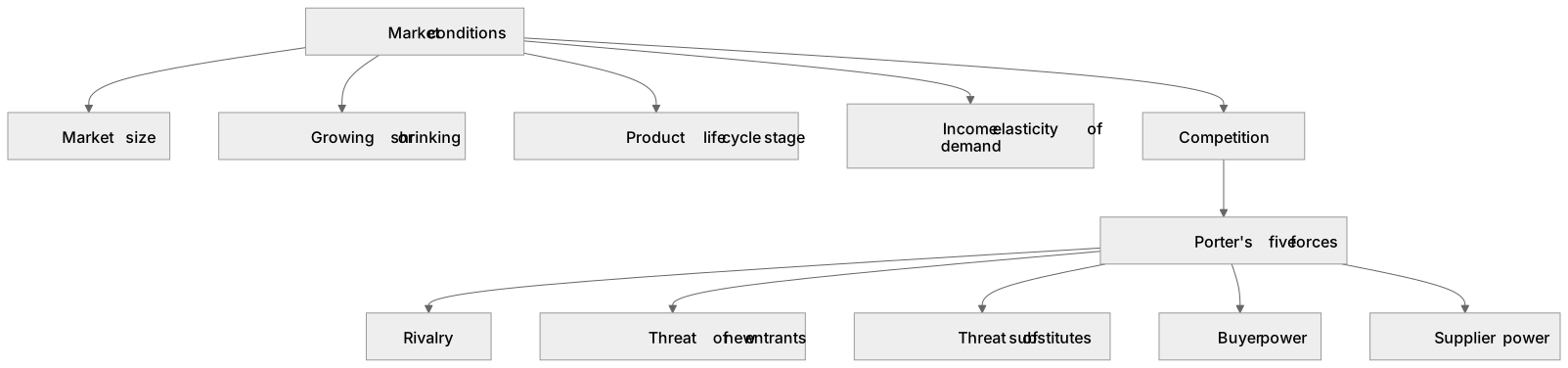
Key words
Say what each word means before you turn the card.
Income elasticity of demand
Try answering aloud or in your head before turning the card.
Porter's five forces
Try answering aloud or in your head before turning the card.
Market size and growth
Try answering aloud or in your head before turning the card.
Substitutes and buyer power
Try answering aloud or in your head before turning the card.
See every definition
- Income elasticity of demand
- The percentage change in quantity demanded divided by the percentage change in income, showing what a downturn does to the firm.
- Porter's five forces
- A structure for the competition half: rivalry, threat of new entrants, threat of substitutes, buyer power and supplier power.
- Market size and growth
- How big the market is and whether it is growing or shrinking, described with evidence rather than by calling it competitive.
- Substitutes and buyer power
- Forces within Porter's five forces, where substitutes compete and buyer power shows where a few buyers take most of the output.
Label the diagram
Some boxes have lost their names. Pick the right name for each number.
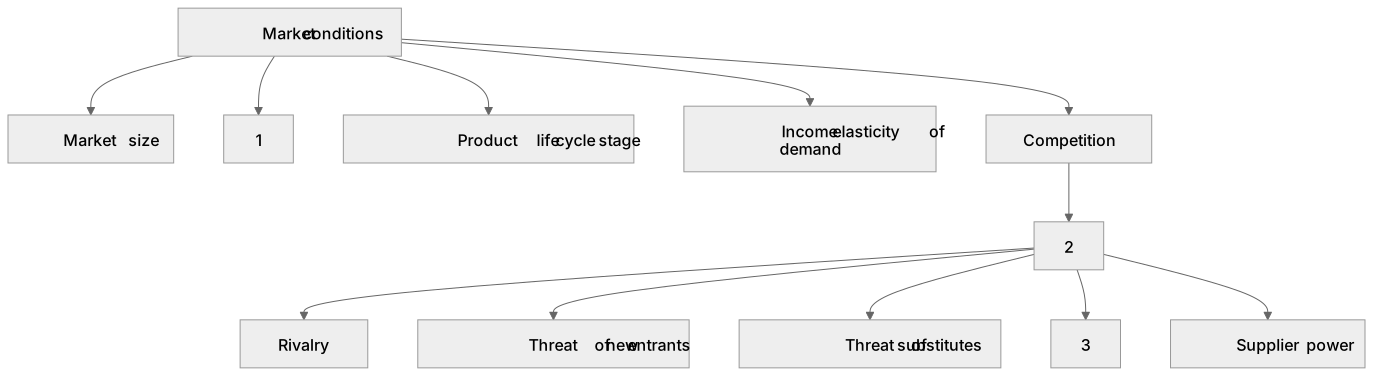
1Box 1
2Box 2
3Box 3
There is more to this lesson
The full lesson goes on to check your understanding and help you earn the marks. Create a free account to carry on, with your progress saved.
A week of Premium from your first lesson · Then the free plan continues · No card, no charge
Test your understanding of Marketing management: market conditions and competition
Active recall beats re-reading. Take an instant quiz now to test what you’ve learned and lock it into long-term memory.
A week of Premium from your first lesson · Then the free plan continues · No card, no charge