AQA · A-Level · Business
Course version: 7132 · Version from Sept 2023
The distinction between strategy and tactics
Full specification wording
Mission, corporate objectives, functional objectives and strategy: The distinction between strategy and tactics
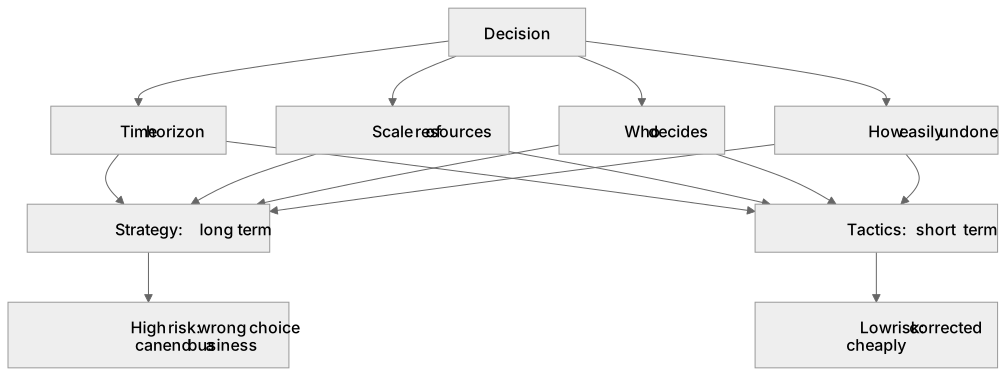
Four tests separate them: time horizon, scale of resources, who decides, and how easily the decision can be undone.
- Point 4 of 7
- 4 key terms
Study notes
From the teaching notes for this specification point.
The idea
Four tests separate them: time horizon, scale of resources, who decides, and how easily the decision can be undone. A long term commitment of significant money taken by the board and expensive to reverse sits at one end; a short term, low cost adjustment delegated to a manager and reversible next week sits at the other. The point of the test is risk, because getting the first kind wrong can end a business while the second kind is corrected cheaply. Tesco's move into the United States with Fresh and Easy was the first kind, and withdrawing in 2013 cost the group a loss running into hundreds of millions of pounds; a weekend promotion on bread is the second kind. Judgement marks come from noticing that no amount of clever short term action rescues a wrong long term choice.
What earns the marks
- Applying the tests to the actual decision in the case, time horizon, scale of resources, level of management and reversibility, rather than simply asserting it is strategic.
- Linking risk to reversibility, so a decision that cannot be undone without writing off assets deserves far more analysis before it is taken.
- Recognising that the same activity can be either, since a price cut for one weekend is tactical while a permanent move to everyday low pricing is strategic.
- Concluding with which kind the case decision is and what follows from that, board approval, funding and a longer payback period.
Common mistakes and how to put them right
Judging by the size of the number alone, so a large one off marketing spend is called strategic even though it is reversible and changes nothing about the firm's position.
Treating tactics as unimportant, when poor execution at store or shift level is what usually sinks a sound plan.
Confusing this split with the long term and short term split in finance, and writing about sources of funding instead.
Exam tips
- Frequently a short explain question hung on a case decision, where the marks are for two clear points of difference applied to that decision.
- In the longest essays the distinction is a framing line: say the decision is strategic, therefore judge it over years and against the cost of reversing it.
Try the lesson
The start of the Mission, corporate objectives, functional objectives and strategy: The distinction between strategy and tactics lesson, made from teaching notes for this specification point.
Have a go first
Which term describes the long-term overall direction of a whole business?
Listen
Four tests separate them: time horizon, scale of resources, who decides, and how easily the decision can be undone. A long term commitment of significant money taken by the board and expensive to reverse sits at one end; a short term, low cost adjustment delegated to a manager and reversible next week sits at the other. The point of the test is risk, because getting the first kind wrong can end a business while the second kind is corrected cheaply. Tesco's move into the United States with Fresh and Easy was the first kind, and withdrawing in 2013 cost the group a loss running into hundreds of millions of pounds; a weekend promotion on bread is the second kind. Judgement marks come from noticing that no amount of clever short term action rescues a wrong long term choice. A strong answer earns marks for these points. Applying the tests to the actual decision in the case, time horizon, scale of resources, level of management and reversibility, rather than simply asserting it is strategic. Linking risk to reversibility, so a decision that cannot be undone without writing off assets deserves far more analysis before it is taken. Recognising that the same activity can be either, since a price cut for one weekend is tactical while a permanent move to everyday low pricing is strategic. Concluding with which kind the case decision is and what follows from that, board approval, funding and a longer payback period. Exam tip: Frequently a short explain question hung on a case decision, where the marks are for two clear points of difference applied to that decision.
See it
Key words
Say what each word means before you turn the card.
time horizon
Try answering aloud or in your head before turning the card.
reversibility and risk
Try answering aloud or in your head before turning the card.
levels of management
Try answering aloud or in your head before turning the card.
resource commitment
Try answering aloud or in your head before turning the card.
See every definition
- time horizon
- One of the four tests separating strategy from tactics, where a long term commitment sits at one end and a short term adjustment at the other.
- reversibility and risk
- One of the four tests, where a decision expensive to reverse carries risk because getting it wrong can end a business, while a reversible one is corrected cheaply.
- levels of management
- One of the four tests, where a decision taken by the board sits at one end and one delegated to a manager at the other.
- resource commitment
- One of the four tests, where a commitment of significant money sits at one end and a low cost adjustment at the other.
Label the diagram
Some boxes have lost their names. Pick the right name for each number.
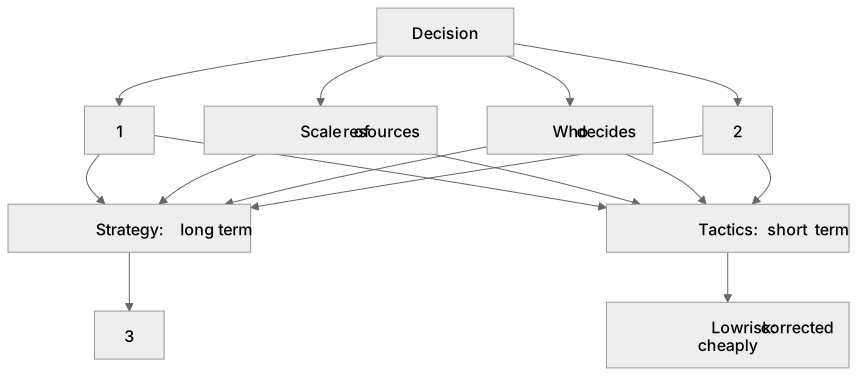
1Box 1
2Box 2
3Box 3
There is more to this lesson
The full lesson goes on to check your understanding and help you earn the marks. Create a free account to carry on, with your progress saved.
A week of Premium from your first lesson · Then the free plan continues · No card, no charge
Test your understanding of Mission, corporate objectives, functional objectives and strategy: The distinction between strategy and tactics
Active recall beats re-reading. Take an instant quiz now to test what you’ve learned and lock it into long-term memory.
A week of Premium from your first lesson · Then the free plan continues · No card, no charge