AQA · A-Level · Business
Course version: 7132 · Version from Sept 2023
The links between mission, corporate objectives and strategy
Full specification wording
Mission, corporate objectives, functional objectives and strategy: The links between mission, corporate objectives and strategy
Think of a chain with four links that has to hold: purpose at the top, then measurable goals for the whole firm, then the medium to long term plan that commits people and money, then the daily…
- Point 3 of 7
- 4 key terms
Study notes
From the teaching notes for this specification point.
The idea
Think of a chain with four links that has to hold: purpose at the top, then measurable goals for the whole firm, then the medium to long term plan that commits people and money, then the daily actions that deliver it. A marker wants that chain walked in one direction on one named business, so a purpose of affordable everyday food gives a goal of cutting unit costs by a tenth, which gives a low cost plan, which gives an operations decision to close a slow depot. The value is that it exposes waste, because any activity serving no goal is spending with no reason. The blind spot is that textbooks draw the chain after the event, while real plans are overtaken by a recession or a new entrant, so alignment is a claim to test against the case, not an assumption.
What earns the marks
- Walking the chain in order on the named firm, from purpose to a quantified goal to a plan to a functional decision, with evidence at each step.
- Showing the direction of travel, that goals are derived from purpose and the plan is chosen to hit those goals, rather than listing the three terms side by side.
- Using the chain as a test, by finding an action in the case that serves no stated goal and calling it drift, or evidence that the stated purpose is decoration.
- Evaluating how strong the link really is, since a vague purpose gives no guidance and lets almost any plan be justified after the event.
Common mistakes and how to put them right
Using strategy and objective interchangeably, so the answer says the objective is to enter Germany when that is the plan, not the goal.
Describing all three levels in general terms and never reaching the business in the case.
Assuming alignment exists because the company says so, when the spending in the appendix points somewhere else.
Exam tips
- Often set as a nine or twelve mark analyse question, where marks come from one connected chain of reasoning rather than three separate definitions.
- In an essay, use the chain as your evaluation structure: judge the plan against the goal it was meant to serve, not against your own opinion of it.
Try the lesson
The start of the Mission, corporate objectives, functional objectives and strategy: The links between mission, corporate objectives and strategy lesson, made from teaching notes for this specification point.
Have a go first
What is the main purpose of a mission statement?
Listen
Think of a chain with four links that has to hold: purpose at the top, then measurable goals for the whole firm, then the medium to long term plan that commits people and money, then the daily actions that deliver it. A marker wants that chain walked in one direction on one named business, so a purpose of affordable everyday food gives a goal of cutting unit costs by a tenth, which gives a low cost plan, which gives an operations decision to close a slow depot. The value is that it exposes waste, because any activity serving no goal is spending with no reason. The blind spot is that textbooks draw the chain after the event, while real plans are overtaken by a recession or a new entrant, so alignment is a claim to test against the case, not an assumption. A strong answer earns marks for these points. Walking the chain in order on the named firm, from purpose to a quantified goal to a plan to a functional decision, with evidence at each step. Showing the direction of travel, that goals are derived from purpose and the plan is chosen to hit those goals, rather than listing the three terms side by side. Using the chain as a test, by finding an action in the case that serves no stated goal and calling it drift, or evidence that the stated purpose is decoration. Evaluating how strong the link really is, since a vague purpose gives no guidance and lets almost any plan be justified after the event. Exam tip: Often set as a nine or twelve mark analyse question, where marks come from one connected chain of reasoning rather than three separate definitions.
See it
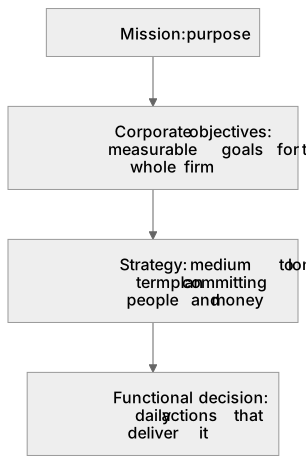
Put it in order
Put these steps in the order they happen.
- 1. Strategy: medium to long term plan committing people and money
- 2. Functional decision: daily actions that deliver it
- 3. Corporate objectives: measurable goals for the whole firm
- 4. Mission: purpose
Key words
Say what each word means before you turn the card.
mission
Try answering aloud or in your head before turning the card.
corporate objectives
Try answering aloud or in your head before turning the card.
strategy
Try answering aloud or in your head before turning the card.
alignment
Try answering aloud or in your head before turning the card.
See every definition
- mission
- The purpose at the top of the chain, which gives no guidance when it is vague and lets almost any plan be justified after the event.
- corporate objectives
- Measurable goals for the whole firm, derived from purpose, such as cutting unit costs by a tenth.
- strategy
- The medium to long term plan that commits people and money, chosen to hit the goals rather than being the goal itself.
- alignment
- A claim to test against the case, since real plans are overtaken by a recession or a new entrant, not an assumption.
Label the diagram
Some boxes have lost their names. Pick the right name for each number.
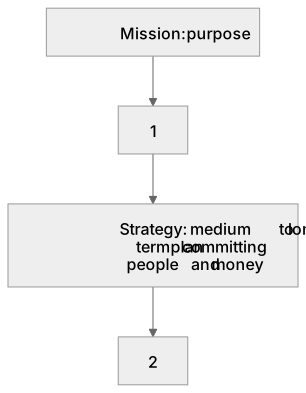
1Box 1
2Box 2
There is more to this lesson
The full lesson goes on to check your understanding and help you earn the marks. Create a free account to carry on, with your progress saved.
A week of Premium from your first lesson · Then the free plan continues · No card, no charge
Test your understanding of Mission, corporate objectives, functional objectives and strategy: The links between mission, corporate objectives and strategy
Active recall beats re-reading. Take an instant quiz now to test what you’ve learned and lock it into long-term memory.
A week of Premium from your first lesson · Then the free plan continues · No card, no charge