AQA · A-Level · Business
Course version: 7132 · Version from Sept 2023
Operational management: market conditions and competition
Operations decisions are made against a market rather than in a vacuum, and the same decision is right in a growing market and wrong in a shrinking one.
- Point 4 of 6
- 4 key terms
Study notes
From the teaching notes for this specification point.
The idea
Operations decisions are made against a market rather than in a vacuum, and the same decision is right in a growing market and wrong in a shrinking one. Where demand is rising and rivals are few, a firm can run close to full capacity and hold its price; where demand is volatile or rivals compete hard on price, it needs flexible capacity, short lead times and a low cost base, and spare capacity starts to look expensive. Porter's five forces is the usual frame for judging how hard the market squeezes, through rivalry, buyer power, supplier power, new entrants and substitutes, but it is blind to the firm's own resources, to government and to how fast the picture moves, which is precisely where evaluation marks live. Aldi and Lidl forced the established grocers to strip cost out of their supply chains rather than add service.
What earns the marks
- Describing the market conditions in the case with evidence, naming the growth rate, the seasonality or the number of rivals, before saying what operations should do about it.
- Tying a market condition to a specific operational choice, such as holding buffer stock because overseas lead times are long and demand is unpredictable.
- Using five forces or a direct comparison with a named rival as a structure, then saying what the model leaves out for this firm.
- Weighing capacity utilisation against responsiveness, since running full looks efficient but leaves nothing spare to take a rush order from a rival's customer.
Common mistakes and how to put them right
Answering about the market and never coming back to operations, so the response reads as a marketing answer with no mention of capacity, quality or lead time.
Treating high capacity utilisation as automatically good, when it also means no slack for maintenance, no flexibility and staff working under constant pressure.
Using five forces as five paragraphs of equal weight instead of identifying the one force that actually bites for this business.
Exam tips
- Market conditions usually arrive in the extracts as a trend or a competitor move, so quote that figure and build the operational argument on top of it.
- Competition questions reward comparison, so set the firm against a named rival on cost, speed or quality rather than against the abstract idea of a competitor.
- If you use a model, give it one sentence and the firm the rest; a described model with no application stays in the lower levels.
Try the lesson
The start of the Operational management: market conditions and competition lesson, made from teaching notes for this specification point.
Have a go first
Which of the following best describes market conditions?
Listen
Operations decisions are made against a market rather than in a vacuum, and the same decision is right in a growing market and wrong in a shrinking one. Where demand is rising and rivals are few, a firm can run close to full capacity and hold its price; where demand is volatile or rivals compete hard on price, it needs flexible capacity, short lead times and a low cost base, and spare capacity starts to look expensive. Porter's five forces is the usual frame for judging how hard the market squeezes, through rivalry, buyer power, supplier power, new entrants and substitutes, but it is blind to the firm's own resources, to government and to how fast the picture moves, which is precisely where evaluation marks live. Aldi and Lidl forced the established grocers to strip cost out of their supply chains rather than add service. A strong answer earns marks for these points. Describing the market conditions in the case with evidence, naming the growth rate, the seasonality or the number of rivals, before saying what operations should do about it. Tying a market condition to a specific operational choice, such as holding buffer stock because overseas lead times are long and demand is unpredictable. Using five forces or a direct comparison with a named rival as a structure, then saying what the model leaves out for this firm. Weighing capacity utilisation against responsiveness, since running full looks efficient but leaves nothing spare to take a rush order from a rival's customer. Exam tip: Market conditions usually arrive in the extracts as a trend or a competitor move, so quote that figure and build the operational argument on top of it.
See it

Key words
Say what each word means before you turn the card.
competitive rivalry
Try answering aloud or in your head before turning the card.
demand volatility and seasonality
Try answering aloud or in your head before turning the card.
capacity and flexibility
Try answering aloud or in your head before turning the card.
lead time and responsiveness
Try answering aloud or in your head before turning the card.
See every definition
- competitive rivalry
- One of the five forces through which the market squeezes a firm, alongside buyer power, supplier power, new entrants and substitutes.
- demand volatility and seasonality
- A market condition where demand is volatile, meaning a firm needs flexible capacity, short lead times and a low cost base.
- capacity and flexibility
- Running close to full capacity suits a growing market with few rivals, but flexible capacity is needed where demand is volatile or rivals compete hard on price.
- lead time and responsiveness
- Short lead times are needed where demand is volatile or rivals compete hard on price, and long overseas lead times may require buffer stock.
Label the diagram
Some boxes have lost their names. Pick the right name for each number.
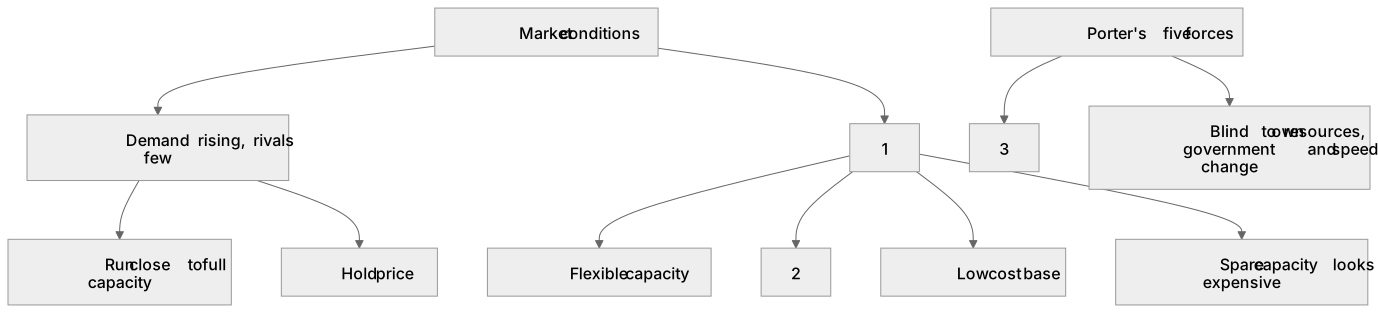
1Box 1
2Box 2
3Box 3
There is more to this lesson
The full lesson goes on to check your understanding and help you earn the marks. Create a free account to carry on, with your progress saved.
A week of Premium from your first lesson · Then the free plan continues · No card, no charge
Test your understanding of Operational management: market conditions and competition
Active recall beats re-reading. Take an instant quiz now to test what you’ve learned and lock it into long-term memory.
A week of Premium from your first lesson · Then the free plan continues · No card, no charge