AQA · A-Level · Business
Course version: 7132 · Version from Sept 2023
Ethical and environmental influences on operations decisions
Full specification wording
Operational management: ethical and environmental influences on operations decisions
Every sourcing, waste, packaging and energy choice in an operation carries a cost and a reputation consequence, and the two usually pull opposite ways in the short run and the same way over a…
- Point 3 of 6
- 4 key terms
Study notes
From the teaching notes for this specification point.
The idea
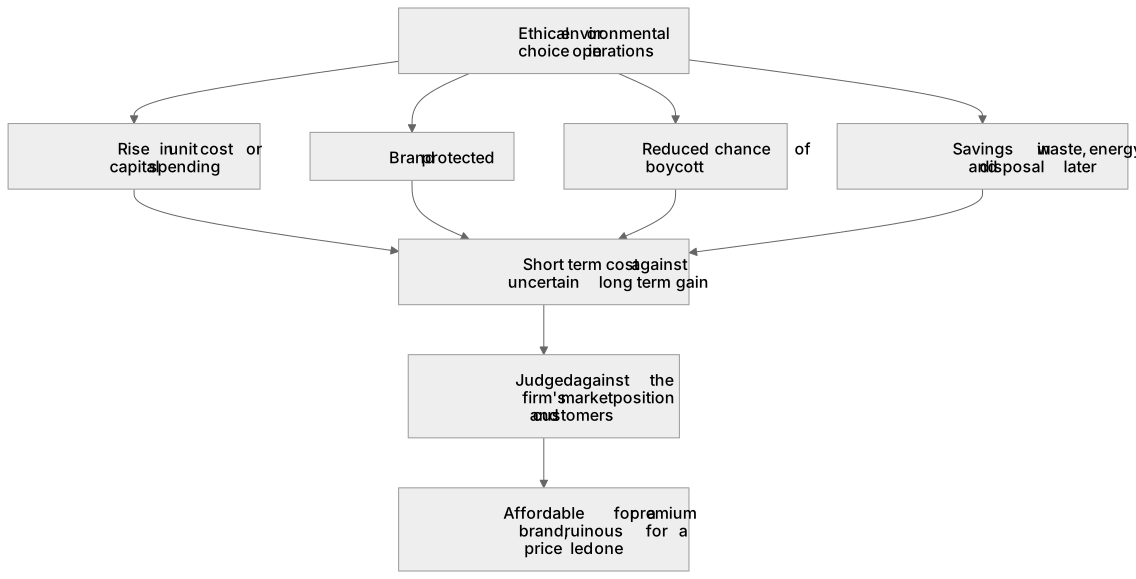
Every sourcing, waste, packaging and energy choice in an operation carries a cost and a reputation consequence, and the two usually pull opposite ways in the short run and the same way over a longer one. Auditing suppliers, paying above the local minimum wage, stripping out packaging or switching to recycled inputs all raise unit cost now; they protect the brand, reduce the chance of a boycott and often cut waste disposal and energy bills later. The marks are for arguing from the firm's own position, because a discounter competing on price has far less room than a premium brand whose customers pay for provenance. Patagonia repairs and resells worn clothing, which fits what it sells; the collapse of the Rana Plaza factory in Bangladesh showed what unaudited subcontracting eventually costs the retailers who relied on it.
What earns the marks
- Separating what the law requires from what the firm chooses, since compliance is a cost of trading and going beyond it is a strategic decision.
- Costing the decision in both directions, setting the rise in unit cost or capital spending against savings in waste, energy and disposal and the value of the brand protected.
- Judging the policy against the firm's market position and customers, because the same measure is affordable for a premium brand and ruinous for a price led one.
- Considering stakeholders beyond the customer, including suppliers, employees and the local community, and saying whose interest is being traded away.
Common mistakes and how to put them right
Asserting that behaving ethically always raises profit, when the case evidence is usually a clear short term cost set against an uncertain long term gain.
Confusing ethics with legislation, so the answer praises a firm for meeting emissions rules it had no choice about obeying.
Forgetting the supply chain, because a firm can only be as ethical as the suppliers it can afford to audit, police and if necessary replace.
Exam tips
- This is evaluation territory rather than knowledge, so expect assess and evaluate rather than state, and expect a cost figure in the extracts that you are meant to weigh.
- Use the objectives given earlier in the case; a green policy that contradicts a stated low cost objective is a strong evaluative point on its own.
- Keep moral language out of it. Credit comes from the business consequence, not from saying that a practice is wrong.
Try the lesson
The start of the Operational management: ethical and environmental influences on operations decisions lesson, made from teaching notes for this specification point.
Have a go first
Which of the following is an environmental influence on a manufacturer's operations decisions?
Listen
Every sourcing, waste, packaging and energy choice in an operation carries a cost and a reputation consequence, and the two usually pull opposite ways in the short run and the same way over a longer one. Auditing suppliers, paying above the local minimum wage, stripping out packaging or switching to recycled inputs all raise unit cost now; they protect the brand, reduce the chance of a boycott and often cut waste disposal and energy bills later. The marks are for arguing from the firm's own position, because a discounter competing on price has far less room than a premium brand whose customers pay for provenance. Patagonia repairs and resells worn clothing, which fits what it sells; the collapse of the Rana Plaza factory in Bangladesh showed what unaudited subcontracting eventually costs the retailers who relied on it. A strong answer earns marks for these points. Separating what the law requires from what the firm chooses, since compliance is a cost of trading and going beyond it is a strategic decision. Costing the decision in both directions, setting the rise in unit cost or capital spending against savings in waste, energy and disposal and the value of the brand protected. Judging the policy against the firm's market position and customers, because the same measure is affordable for a premium brand and ruinous for a price led one. Considering stakeholders beyond the customer, including suppliers, employees and the local community, and saying whose interest is being traded away. Exam tip: This is evaluation territory rather than knowledge, so expect assess and evaluate rather than state, and expect a cost figure in the extracts that you are meant to weigh.
See it
Key words
Say what each word means before you turn the card.
ethical sourcing and supply chain audits
Try answering aloud or in your head before turning the card.
environmental objectives and waste
Try answering aloud or in your head before turning the card.
reputation and brand value
Try answering aloud or in your head before turning the card.
cost against conscience
Try answering aloud or in your head before turning the card.
See every definition
- ethical sourcing and supply chain audits
- Every sourcing choice carries a cost and a reputation consequence, and a firm can only be as ethical as the suppliers it can afford to audit, police and if necessary replace.
- environmental objectives and waste
- Stripping out packaging or switching to recycled inputs raises unit cost now but often cuts waste disposal and energy bills later.
- reputation and brand value
- Paying above the local minimum wage or auditing suppliers protects the brand and reduces the chance of a boycott.
- cost against conscience
- Behaving ethically is usually a clear short term cost set against an uncertain long term gain, so the rise in unit cost is set against savings and the value of the brand protected.
Label the diagram
Some boxes have lost their names. Pick the right name for each number.
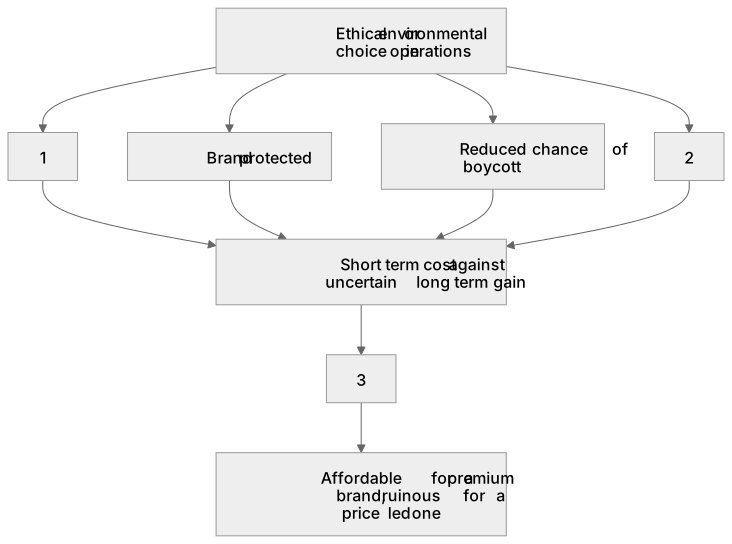
1Box 1
2Box 2
3Box 3
There is more to this lesson
The full lesson goes on to check your understanding and help you earn the marks. Create a free account to carry on, with your progress saved.
A week of Premium from your first lesson · Then the free plan continues · No card, no charge
Test your understanding of Operational management: ethical and environmental influences on operations decisions
Active recall beats re-reading. Take an instant quiz now to test what you’ve learned and lock it into long-term memory.
A week of Premium from your first lesson · Then the free plan continues · No card, no charge