AQA · A-Level · Business
Course version: 7132 · Version from Sept 2023
Students should consider the following throughout this section of the…
Full specification wording
Operational management: Students should consider the following throughout this section of the specification:
This opening line is not content to be revised in its own right; it is the board naming the lenses every operations answer is expected to be written through.
- Point 1 of 6
- 4 key terms
Study notes
From the teaching notes for this specification point.
The idea
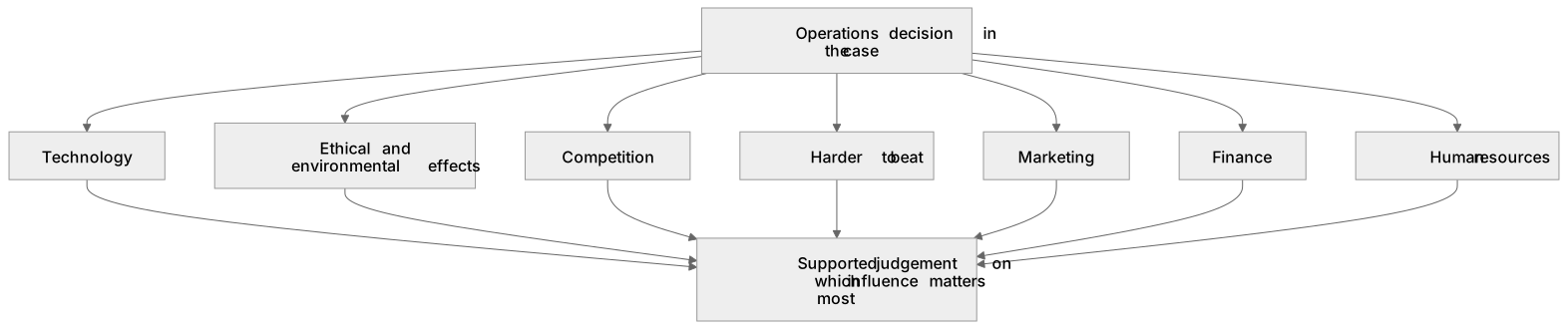
This opening line is not content to be revised in its own right; it is the board naming the lenses every operations answer is expected to be written through. Operations questions are always set on a named firm, so a paragraph that describes a stock control system without saying what it does to that firm's unit costs, lead times or reputation sits in the lower levels. Treat the bullets beneath it as a checklist to run over any operations decision in the case: what has technology changed, who is affected ethically or environmentally, what are rivals doing, does this make the firm harder to beat, and what does it do to marketing, finance and human resources. The last of those usually produces the sharpest evaluation, because an operations decision is rarely free elsewhere in the business.
What earns the marks
- Applying the operations idea to the named business in the case rather than to operations in general, so the answer uses the firm's own product, customers and cost base.
- Running the decision through at least one of the listed influences, usually technology or competition, and showing how that influence changes the size of the effect.
- Linking the operations decision to another function, so a fall in unit cost is traced through to the price marketing can charge or the cash finance has to find.
- Reaching a supported judgement about which influence matters most for this firm, instead of listing all of them at equal weight.
Common mistakes and how to put them right
Treating this line as a topic and writing generalised paragraphs about technology or ethics in business, when the examiner is marking application to one named firm.
Describing a change rather than analysing its effect, so the answer says the firm installed robots and stops, without following the chain through to unit cost, quality consistency, redundancy payments and morale.
Assuming technology and environmental measures are always improvements, when both carry capital cost, disruption and the risk that the payback never arrives.
Exam tips
- Operations appears on all three papers, so expect a short calculation, a nine mark analyse question and a longer essay that asks you to assess one decision such as relocating production or automating a line.
- The judgement marks in the longer questions sit in the trade-offs, so plan two points for and one against before writing, and close by naming the condition under which your answer would change.
- Build on the extracts; an operations essay that quotes no figure from the case data rarely reaches the top level.
Try the lesson
The start of the Operational management: Students should consider the following throughout this section of the specification: lesson, made from teaching notes for this specification point.
Have a go first
Which of the following is a key operational management objective for most businesses?
Listen
This opening line is not content to be revised in its own right; it is the board naming the lenses every operations answer is expected to be written through. Operations questions are always set on a named firm, so a paragraph that describes a stock control system without saying what it does to that firm's unit costs, lead times or reputation sits in the lower levels. Treat the bullets beneath it as a checklist to run over any operations decision in the case: what has technology changed, who is affected ethically or environmentally, what are rivals doing, does this make the firm harder to beat, and what does it do to marketing, finance and human resources. The last of those usually produces the sharpest evaluation, because an operations decision is rarely free elsewhere in the business. A strong answer earns marks for these points. Applying the operations idea to the named business in the case rather than to operations in general, so the answer uses the firm's own product, customers and cost base. Running the decision through at least one of the listed influences, usually technology or competition, and showing how that influence changes the size of the effect. Linking the operations decision to another function, so a fall in unit cost is traced through to the price marketing can charge or the cash finance has to find. Reaching a supported judgement about which influence matters most for this firm, instead of listing all of them at equal weight. Exam tip: Operations appears on all three papers, so expect a short calculation, a nine mark analyse question and a longer essay that asks you to assess one decision such as relocating production or automating a line.
See it
Key words
Say what each word means before you turn the card.
application to a named business
Try answering aloud or in your head before turning the card.
technology and automation
Try answering aloud or in your head before turning the card.
ethical and environmental constraints
Try answering aloud or in your head before turning the card.
functional interdependence
Try answering aloud or in your head before turning the card.
See every definition
- application to a named business
- Using the firm's own product, customers and cost base rather than describing operations in general.
- technology and automation
- An influence that changes the size of the effect of an operations decision, such as installing robots, which carries capital cost, disruption and the risk that the payback never arrives.
- ethical and environmental constraints
- An influence to run over any operations decision, asking who is affected ethically or environmentally.
- functional interdependence
- Linking the operations decision to another function, so a fall in unit cost is traced through to the price marketing can charge or the cash finance has to find.
Label the diagram
Some boxes have lost their names. Pick the right name for each number.
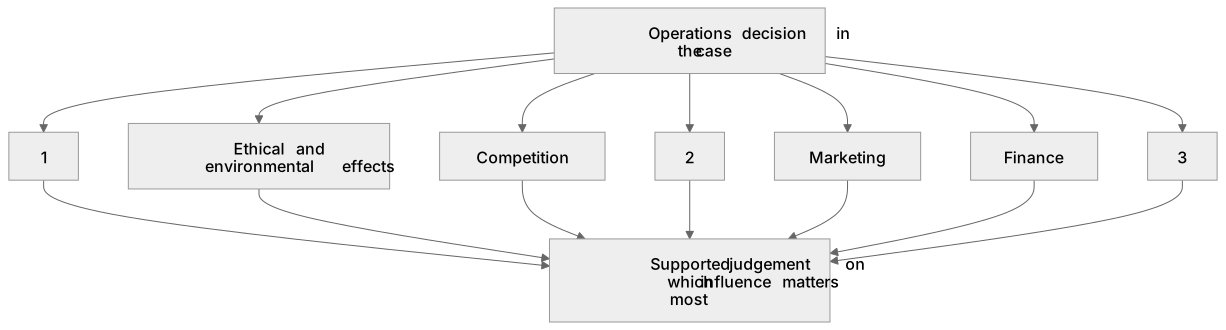
1Box 1
2Box 2
3Box 3
There is more to this lesson
The full lesson goes on to check your understanding and help you earn the marks. Create a free account to carry on, with your progress saved.
A week of Premium from your first lesson · Then the free plan continues · No card, no charge
Test your understanding of Operational management: Students should consider the following throughout this section of the specification:
Active recall beats re-reading. Take an instant quiz now to test what you’ve learned and lock it into long-term memory.
A week of Premium from your first lesson · Then the free plan continues · No card, no charge