AQA · A-Level · Business
Course version: 7132 · Version from Sept 2023
How developments in technology are affecting decision making and…
Full specification wording
Operational management: how developments in technology are affecting decision making and activities in operations (eg more online businesses, better links with customers, suppliers, inventory control, automation and robotics)
The range here runs from an online storefront and electronic links to suppliers, through barcode and radio frequency stock systems, to computer aided design and factory robots, and each is bought…
- Point 2 of 6
- 4 key terms
Study notes
From the teaching notes for this specification point.
The idea
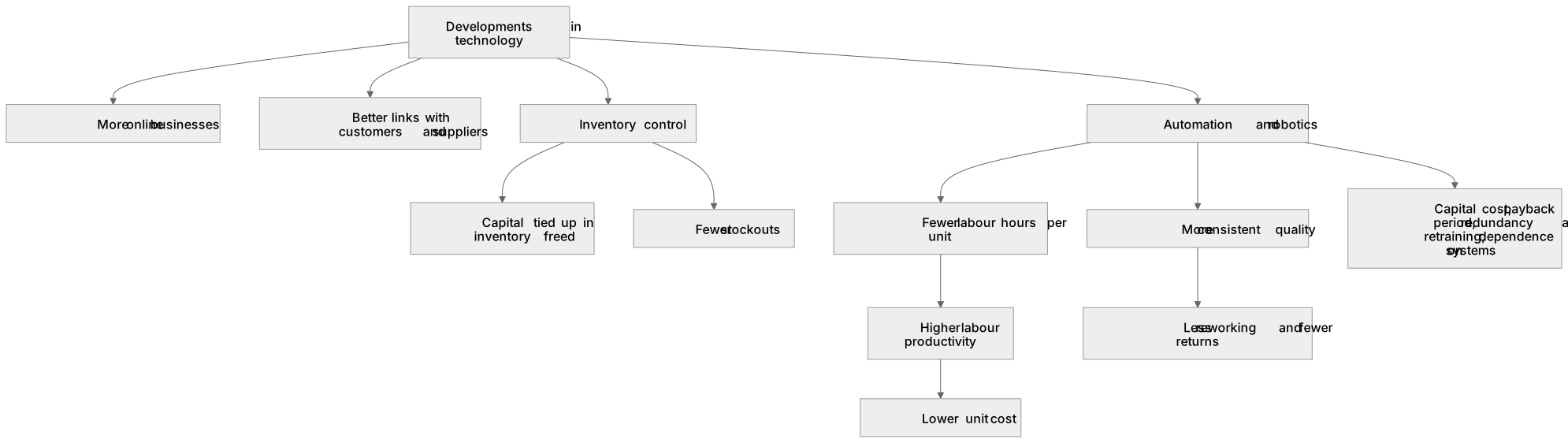
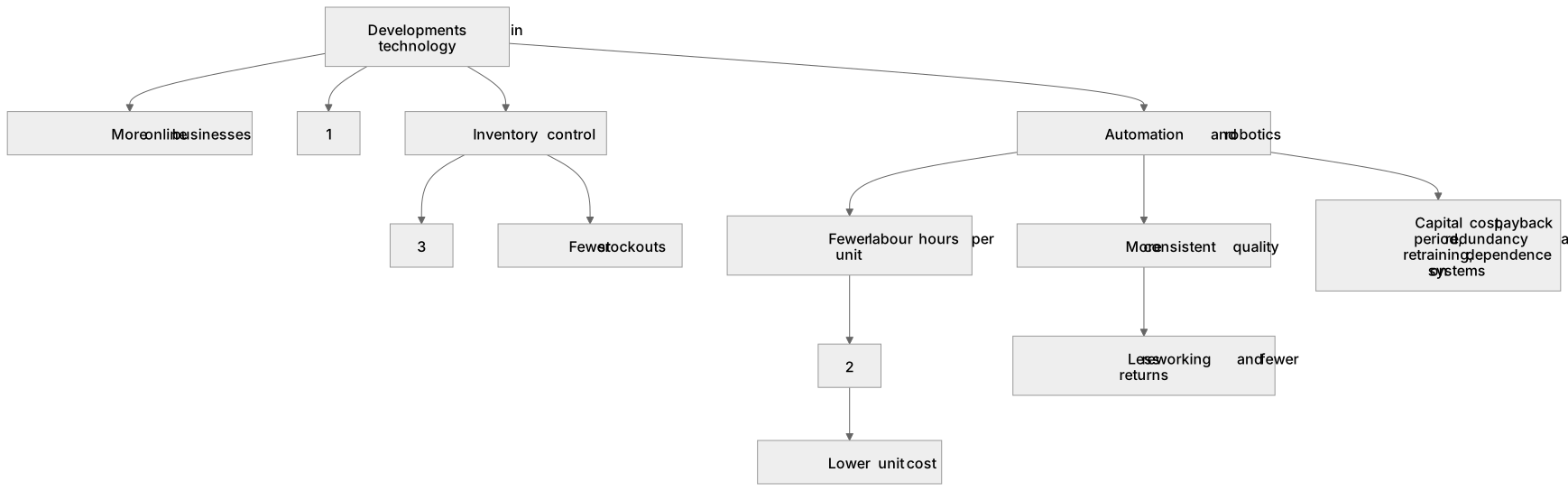
The range here runs from an online storefront and electronic links to suppliers, through barcode and radio frequency stock systems, to computer aided design and factory robots, and each is bought for a reason a marker can see in the numbers. Fewer labour hours per unit raises labour productivity, which is output per worker per period, and pulls unit cost down. Live stock data frees the capital tied up in inventory and cuts stockouts. Automated assembly makes quality more consistent, so reworking and returns fall. Against that sits the capital cost, a payback period measured in years, redundancy and retraining bills, and a new dependence on systems that fail. The robotic warehouses that pick an Ocado grocery order in minutes are the gain and the concentration of risk in the same building.
What earns the marks
- Naming the specific technology the case gives you, such as an inventory system or automated handling, rather than writing about technology in general.
- Quantifying the effect where the data allows, through labour productivity as output divided by the number of employees, or unit cost as total cost divided by output.
- Weighing the gain against the capital cost and the payback period, and saying who funds it and from where.
- Recognising the effect on flexibility, because a dedicated automated line is cheap per unit and expensive to switch to a different product.
Common mistakes and how to put them right
Writing that technology reduces costs without separating fixed from variable, when automation usually raises fixed costs and only lowers cost per unit once output is high enough to spread them.
Ignoring the human consequences, so the answer misses redundancy payments, retraining time and the drop in morale that makes the promised productivity gain slower to arrive.
Treating an online sales channel as a pure operations gain, when it brings picking, packing, delivery and a returns rate the shop floor never carried.
Exam tips
- The examples in the brackets are a menu, not a syllabus, so answer on the technology the case hands you rather than the one you revised.
- These questions often pair arithmetic with judgement, for instance capacity utilisation before and after new equipment, so do the calculation first and argue from your own figure.
- A strong closing line names the condition: the investment pays if demand holds at the forecast level and destroys value if it does not.
Try the lesson
The start of the Operational management: how developments in technology are affecting decision making and activities in operations (eg more online businesses, better links with customers, suppliers, inventory control, automation and robotics) lesson, made from teaching notes for this specification point.
Have a go first
Which development in technology most directly helps a business control its inventory?
Listen
The range here runs from an online storefront and electronic links to suppliers, through barcode and radio frequency stock systems, to computer aided design and factory robots, and each is bought for a reason a marker can see in the numbers. Fewer labour hours per unit raises labour productivity, which is output per worker per period, and pulls unit cost down. Live stock data frees the capital tied up in inventory and cuts stockouts. Automated assembly makes quality more consistent, so reworking and returns fall. Against that sits the capital cost, a payback period measured in years, redundancy and retraining bills, and a new dependence on systems that fail. The robotic warehouses that pick an Ocado grocery order in minutes are the gain and the concentration of risk in the same building. A strong answer earns marks for these points. Naming the specific technology the case gives you, such as an inventory system or automated handling, rather than writing about technology in general. Quantifying the effect where the data allows, through labour productivity as output divided by the number of employees, or unit cost as total cost divided by output. Weighing the gain against the capital cost and the payback period, and saying who funds it and from where. Recognising the effect on flexibility, because a dedicated automated line is cheap per unit and expensive to switch to a different product. Exam tip: The examples in the brackets are a menu, not a syllabus, so answer on the technology the case hands you rather than the one you revised.
See it
Key words
Say what each word means before you turn the card.
automation and robotics
Try answering aloud or in your head before turning the card.
inventory control
Try answering aloud or in your head before turning the card.
labour productivity
Try answering aloud or in your head before turning the card.
capital investment and payback
Try answering aloud or in your head before turning the card.
See every definition
- automation and robotics
- Computer aided design and factory robots used in operations, bought for a reason a marker can see in the numbers.
- inventory control
- Barcode and radio frequency stock systems giving live stock data that frees the capital tied up in inventory and cuts stockouts.
- labour productivity
- Output per worker per period, which fewer labour hours per unit raises and which pulls unit cost down.
- capital investment and payback
- The capital cost of technology, with a payback period measured in years, weighed against the gain it brings.
Label the diagram
Some boxes have lost their names. Pick the right name for each number.
1Box 1
2Box 2
3Box 3
There is more to this lesson
The full lesson goes on to check your understanding and help you earn the marks. Create a free account to carry on, with your progress saved.
A week of Premium from your first lesson · Then the free plan continues · No card, no charge
Test your understanding of Operational management: how developments in technology are affecting decision making and activities in operations (eg more online businesses, better links with customers, suppliers, inventory control, automation and robotics)
Active recall beats re-reading. Take an instant quiz now to test what you’ve learned and lock it into long-term memory.
A week of Premium from your first lesson · Then the free plan continues · No card, no charge