AQA · A-Level · Business
Course version: 7132 · Version from Sept 2023
Difficulties of strategic decision making and implementing strategy
Full specification wording
Problems with strategy and why strategies fail: Difficulties of strategic decision making and implementing strategy
A strategic decision commits large resources for years and is costly to unwind, so it is taken on incomplete information, forecasts that are educated guesses and a board that leans towards…
- Point 1 of 6
- 4 key terms
Study notes
From the teaching notes for this specification point.
The idea
A strategic decision commits large resources for years and is costly to unwind, so it is taken on incomplete information, forecasts that are educated guesses and a board that leans towards whatever worked last time. The harder half is delivery, because the people who carry out a plan were rarely in the room when it was written, so the gap between intent and outcome opens in the middle of the hierarchy. Kotter and Schlesinger offer six ways of handling resistance, running from education and involvement through to coercion, and Lewin insists a position is unfrozen before it is moved. Both are blind to internal politics, and both treat resistance as an obstacle when it is sometimes the shop floor telling the board the plan is wrong. Tesco's withdrawal from the United States after heavy losses shows a commitment that was easy to make and expensive to reverse.
What earns the marks
- Separating the decision itself from its implementation, then saying which of the two is where the named business is actually stuck.
- Naming a specific difficulty from the case, a forecast resting on one year of data, a management team already stretched, or a culture that has never had to change, rather than listing difficulties in general.
- Using Kotter and Schlesinger to match a method of handling resistance to the time and money available, since participation buys commitment slowly while coercion buys speed at the cost of trust.
- Sizing the commitment involved, the capital tied up, the payback period or the share of capacity affected, so the difficulty is measured rather than asserted.
Common mistakes and how to put them right
Writing that staff resist change because they fear the unknown and stopping there, when the extract usually names the real reason, a lost bonus, a longer journey to work, or a threat to status.
Treating a strategic decision as reversible, so the answer suggests trying it and seeing, which ignores the sunk cost and the signal sent to staff, suppliers and investors.
Listing every difficulty in the textbook and weighting none of them, when the judgement marks come from arguing which one actually binds in this business.
Exam tips
- The long essay on the case study paper rewards depth, so plan two developed difficulties leading to a judgement rather than six named ones.
- Anchor every difficulty in a line of the extract or a figure in the appendix, because an answer that would fit any business scores knowledge and little else.
- Finish with what would have to change for the strategy to be delivered successfully, since that conditional sentence is where the top band is won.
Try the lesson
The start of the Problems with strategy and why strategies fail: Difficulties of strategic decision making and implementing strategy lesson, made from teaching notes for this specification point.
Have a go first
Which of the following best describes why implementing a new strategy can be difficult for a business?
Listen
A strategic decision commits large resources for years and is costly to unwind, so it is taken on incomplete information, forecasts that are educated guesses and a board that leans towards whatever worked last time. The harder half is delivery, because the people who carry out a plan were rarely in the room when it was written, so the gap between intent and outcome opens in the middle of the hierarchy. Kotter and Schlesinger offer six ways of handling resistance, running from education and involvement through to coercion, and Lewin insists a position is unfrozen before it is moved. Both are blind to internal politics, and both treat resistance as an obstacle when it is sometimes the shop floor telling the board the plan is wrong. Tesco's withdrawal from the United States after heavy losses shows a commitment that was easy to make and expensive to reverse. A strong answer earns marks for these points. Separating the decision itself from its implementation, then saying which of the two is where the named business is actually stuck. Naming a specific difficulty from the case, a forecast resting on one year of data, a management team already stretched, or a culture that has never had to change, rather than listing difficulties in general. Using Kotter and Schlesinger to match a method of handling resistance to the time and money available, since participation buys commitment slowly while coercion buys speed at the cost of trust. Sizing the commitment involved, the capital tied up, the payback period or the share of capacity affected, so the difficulty is measured rather than asserted. Exam tip: The long essay on the case study paper rewards depth, so plan two developed difficulties leading to a judgement rather than six named ones.
See it

Key words
Say what each word means before you turn the card.
uncertainty and risk
Try answering aloud or in your head before turning the card.
resistance to change
Try answering aloud or in your head before turning the card.
implementation gap
Try answering aloud or in your head before turning the card.
organisational culture
Try answering aloud or in your head before turning the card.
See every definition
- uncertainty and risk
- A strategic decision is taken on incomplete information and forecasts that are educated guesses.
- resistance to change
- Kotter and Schlesinger offer six ways of handling it, running from education and involvement through to coercion.
- implementation gap
- The gap between intent and outcome opens in the middle of the hierarchy, because the people who carry out a plan were rarely in the room when it was written.
- organisational culture
- A difficulty can be a culture that has never had to change.
Label the diagram
Some boxes have lost their names. Pick the right name for each number.
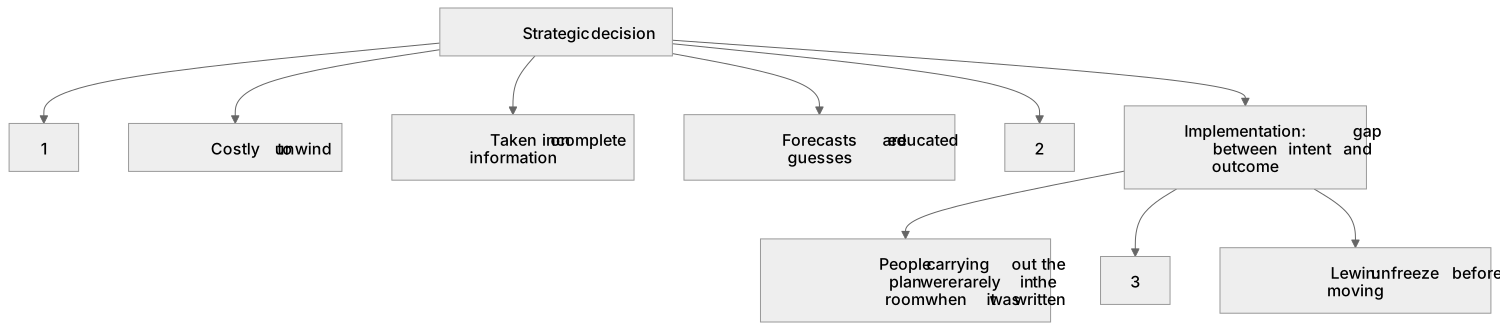
1Box 1
2Box 2
3Box 3
There is more to this lesson
The full lesson goes on to check your understanding and help you earn the marks. Create a free account to carry on, with your progress saved.
A week of Premium from your first lesson · Then the free plan continues · No card, no charge
Test your understanding of Problems with strategy and why strategies fail: Difficulties of strategic decision making and implementing strategy
Active recall beats re-reading. Take an instant quiz now to test what you’ve learned and lock it into long-term memory.
A week of Premium from your first lesson · Then the free plan continues · No card, no charge