AQA · A-Level · Business
Course version: 7132 · Version from Sept 2023
Problems with strategy and why strategies fail: Planned v emergent strategy
A planned (or deliberate) strategy is designed in advance through a formal process.
- Point 2 of 6
- 4 key terms
Study notes
From the teaching notes for this specification point.
The idea
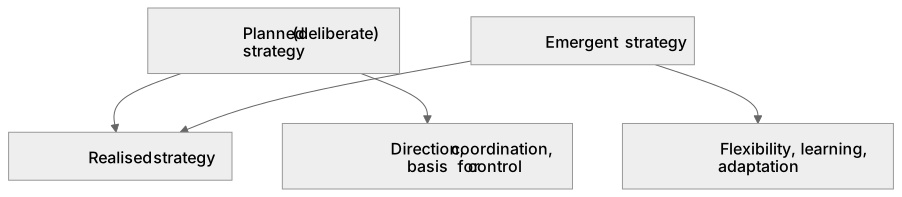
A planned (or deliberate) strategy is designed in advance through a formal process. An emergent strategy is an unplanned pattern that arises from a series of decisions made in response to unexpected opportunities or challenges. Henry Mintzberg argued that a firm's realised strategy is a combination of its deliberate strategy and its emergent strategy. The balance is key: planning provides direction, coordination, and a basis for control, which can reassure investors. Emergence allows for flexibility, learning, and adaptation in fast-changing markets. For example, one interpretation of Honda's success in the US is that it emerged from an unplanned focus on smaller motorcycles, contrasting with their initial deliberate strategy. However, emergent strategy is not an excuse for having no direction.
What earns the marks
- Defining emergent as a realised pattern rather than as an absence of planning, and showing it at work in the case, a product line that grew out of one customer request, say.
- Linking the right balance to the pace of change in the market, so a regulated utility can plan further ahead than a fashion retailer can.
- Recognising that the two coexist, so a sound recommendation sets direction centrally and leaves the route open lower down.
- Drawing out the consequence for control, since an emergent approach makes budgets and variance analysis much harder to use as a discipline.
Common mistakes and how to put them right
Treating emergent strategy as a polite name for having no plan, which turns a description of how firms behave into an argument for drifting.
Arguing that planning always fails because the future is uncertain, when a capital project with a long lead time cannot be run any other way.
Describing both approaches in the abstract and never saying which one the named business is using, which leaves the answer stranded at knowledge.
Exam tips
- Questions here often put a formal plan in the extract and an unplanned success in the appendix, so the marks sit in explaining why the second happened.
- On evaluate, make the judgement conditional on the market, on the lead time of the investment and on how much cash the business has to absorb a mistake.
Try the lesson
The start of the Problems with strategy and why strategies fail: Planned v emergent strategy lesson, made from teaching notes for this specification point.
Have a go first
What name is given to a strategy that develops over time from the day-to-day decisions of managers rather than from a formal plan?
Listen
A planned (or deliberate) strategy is designed in advance through a formal process. An emergent strategy is an unplanned pattern that arises from a series of decisions made in response to unexpected opportunities or challenges. Henry Mintzberg argued that a firm's realised strategy is a combination of its deliberate strategy and its emergent strategy. The balance is key: planning provides direction, coordination, and a basis for control, which can reassure investors. Emergence allows for flexibility, learning, and adaptation in fast-changing markets. For example, one interpretation of Honda's success in the US is that it emerged from an unplanned focus on smaller motorcycles, contrasting with their initial deliberate strategy. However, emergent strategy is not an excuse for having no direction. A strong answer earns marks for these points. Defining emergent as a realised pattern rather than as an absence of planning, and showing it at work in the case, a product line that grew out of one customer request, say. Linking the right balance to the pace of change in the market, so a regulated utility can plan further ahead than a fashion retailer can. Recognising that the two coexist, so a sound recommendation sets direction centrally and leaves the route open lower down. Drawing out the consequence for control, since an emergent approach makes budgets and variance analysis much harder to use as a discipline. Exam tip: Questions here often put a formal plan in the extract and an unplanned success in the appendix, so the marks sit in explaining why the second happened.
See it
Key words
Say what each word means before you turn the card.
deliberate strategy
Try answering aloud or in your head before turning the card.
emergent strategy
Try answering aloud or in your head before turning the card.
realised strategy
Try answering aloud or in your head before turning the card.
flexibility versus control
Try answering aloud or in your head before turning the card.
See every definition
- deliberate strategy
- A strategy designed in advance through a formal process, providing direction, coordination and a basis for control.
- emergent strategy
- An unplanned pattern that arises from a series of decisions made in response to unexpected opportunities or challenges.
- realised strategy
- The combination of a firm's deliberate strategy and its emergent strategy, as argued by Henry Mintzberg.
- flexibility versus control
- The balance between planning, which provides direction and a basis for control, and emergence, which allows for flexibility, learning and adaptation in fast-changing markets.
Label the diagram
Some boxes have lost their names. Pick the right name for each number.
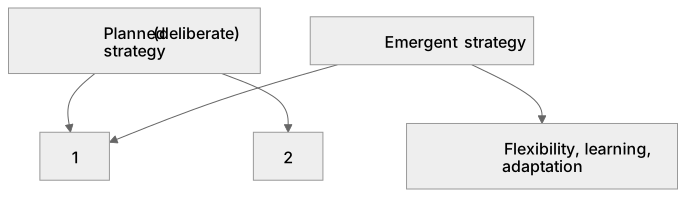
1Box 1
2Box 2
There is more to this lesson
The full lesson goes on to check your understanding and help you earn the marks. Create a free account to carry on, with your progress saved.
A week of Premium from your first lesson · Then the free plan continues · No card, no charge
Test your understanding of Problems with strategy and why strategies fail: Planned v emergent strategy
Active recall beats re-reading. Take an instant quiz now to test what you’ve learned and lock it into long-term memory.
A week of Premium from your first lesson · Then the free plan continues · No card, no charge