AQA · A-Level · Business
Course version: 7132 · Version from Sept 2023
Problems with strategy and why strategies fail: Reasons for strategic drift
This is what happens when a business changes by small increments while its market changes by large ones, so the gap between what it offers and what buyers now want widens quietly until performance…
- Point 3 of 6
- 3 key terms
Study notes
From the teaching notes for this specification point.
The idea
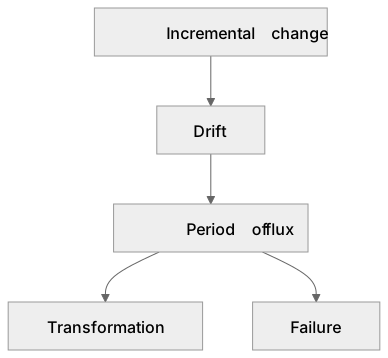
This is what happens when a business changes by small increments while its market changes by large ones, so the gap between what it offers and what buyers now want widens quietly until performance breaks. Johnson and Scholes trace four phases: incremental change, then drift, then a period of flux in which managers try several directions at once, then transformation or failure. The causes are mostly internal, a culture that treats past success as proof, weak scanning of the outside world, risk aversion in managers paid on this year's result, and powerful groups defending the position that made them powerful. The early symptoms are measurable: market share falling while revenue still rises, return on capital employed sliding year on year, and the most inventive staff leaving. Kodak built an early digital camera and still went bankrupt, which is the whole idea in one sentence.
What earns the marks
- Identifying drift from evidence rather than assertion, such as sales growing more slowly than the market or share falling while revenue holds up.
- Explaining why the business could not see it, naming the specific inertia, a founder who will not revisit the original formula, or a board with no outside voice on it.
- Distinguishing a slow loss of fit from a one off shock, because a recession is not drift and the responses differ.
- Proposing a response with a cost attached, systematic scanning, new appointments, or a transformation that needs funding and will unsettle staff.
Common mistakes and how to put them right
Blaming external change alone, when the model is about the failure to respond rather than about the change itself.
Using the word complacency as though it were an explanation, instead of showing what the business kept doing and why that stopped working.
Assuming transformation is always the answer, when a firm can sometimes be pulled clear by changing one part of the model rather than all of it.
Exam tips
- The appendix usually prints market growth next to company growth, so compare the two before you write, because that gap is the evidence.
- Strong answers close on timing: say how long the business has before drift turns into flux, using the cash position and the trend in the data.
Try the lesson
The start of the Problems with strategy and why strategies fail: Reasons for strategic drift lesson, made from teaching notes for this specification point.
Have a go first
What is meant by strategic drift?
Listen
This is what happens when a business changes by small increments while its market changes by large ones, so the gap between what it offers and what buyers now want widens quietly until performance breaks. Johnson and Scholes trace four phases: incremental change, then drift, then a period of flux in which managers try several directions at once, then transformation or failure. The causes are mostly internal, a culture that treats past success as proof, weak scanning of the outside world, risk aversion in managers paid on this year's result, and powerful groups defending the position that made them powerful. The early symptoms are measurable: market share falling while revenue still rises, return on capital employed sliding year on year, and the most inventive staff leaving. Kodak built an early digital camera and still went bankrupt, which is the whole idea in one sentence. A strong answer earns marks for these points. Identifying drift from evidence rather than assertion, such as sales growing more slowly than the market or share falling while revenue holds up. Explaining why the business could not see it, naming the specific inertia, a founder who will not revisit the original formula, or a board with no outside voice on it. Distinguishing a slow loss of fit from a one off shock, because a recession is not drift and the responses differ. Proposing a response with a cost attached, systematic scanning, new appointments, or a transformation that needs funding and will unsettle staff. Exam tip: The appendix usually prints market growth next to company growth, so compare the two before you write, because that gap is the evidence.
See it
Key words
Say what each word means before you turn the card.
environmental scanning
Try answering aloud or in your head before turning the card.
transformational change
Try answering aloud or in your head before turning the card.
loss of market share
Try answering aloud or in your head before turning the card.
See every definition
- environmental scanning
- Looking at the outside world; weak scanning is one of the internal causes of strategic drift.
- transformational change
- The final phase, after a period of flux, in which managers either transform the business or it fails.
- loss of market share
- An early measurable symptom of drift, in which market share falls while revenue still rises.
Label the diagram
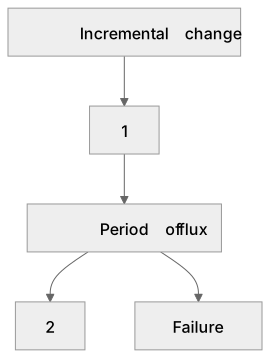
Some boxes have lost their names. Pick the right name for each number.
1Box 1
2Box 2
There is more to this lesson
The full lesson goes on to check your understanding and help you earn the marks. Create a free account to carry on, with your progress saved.
A week of Premium from your first lesson · Then the free plan continues · No card, no charge
Test your understanding of Problems with strategy and why strategies fail: Reasons for strategic drift
Active recall beats re-reading. Take an instant quiz now to test what you’ve learned and lock it into long-term memory.
A week of Premium from your first lesson · Then the free plan continues · No card, no charge