AQA · A-Level · Business
Course version: 7132 · Version from Sept 2023
The value of contingency planning and crisis management
Full specification wording
Problems with strategy and why strategies fail: The value of contingency planning and crisis management
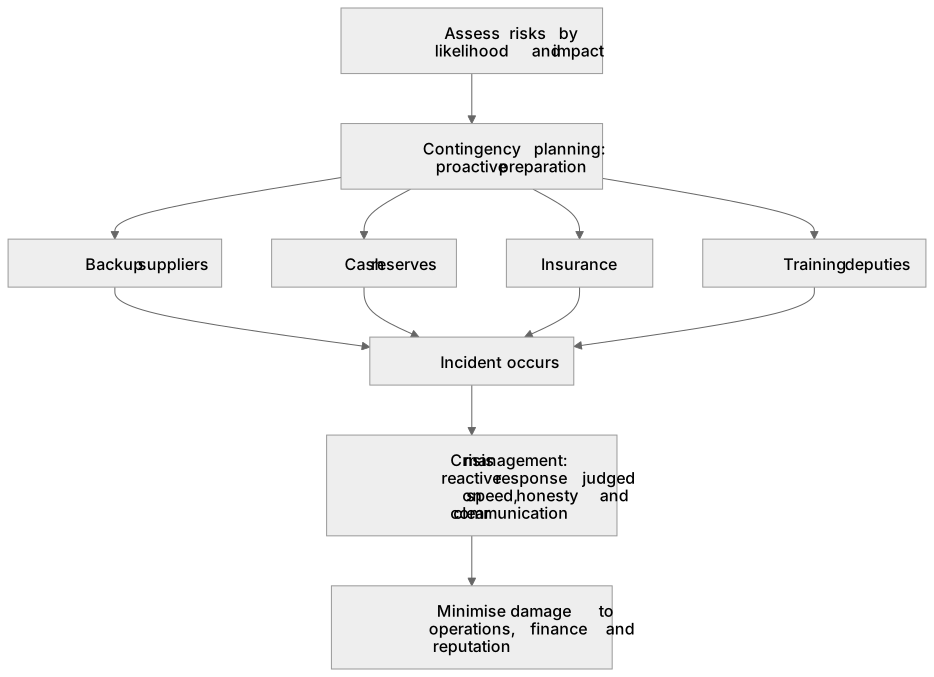
Contingency planning is proactive preparation for foreseeable but disruptive events.
- Point 6 of 6
- 2 key terms
Study notes
From the teaching notes for this specification point.
The idea
Contingency planning is proactive preparation for foreseeable but disruptive events. It involves assessing risks by their likelihood and impact, then creating plans to mitigate them. Measures include arranging backup suppliers, having cash reserves, buying insurance, and training deputies. Crisis management is the reactive response once an incident occurs, judged on speed, honesty, and clear communication. The value of planning lies in minimising damage to operations, finance, and reputation. Businesses must weigh the real costs of preparation (e.g., management time, idle resources) against the potential cost of a crisis. Risk assessment uses historical data and expert judgement but can struggle to anticipate unprecedented 'black swan' events.
What earns the marks
- Sizing the exposure in the case, the share of output from one factory or the proportion of supply from one supplier, so the preparation is proportionate.
- Separating what is done beforehand (contingency planning) from what is done during the event (crisis management).
- Naming the measurable damage, such as lost revenue during closure, compensation claims, the cost of a product recall, and a reputation effect that outlasts all three.
- Bringing in opportunity cost, because money tied up in buffer stock or an unused standby site is money not invested in growth.
Common mistakes and how to put them right
Reducing preparation to insurance and missing the operational side, such as second suppliers, spare capacity, trained deputies and tested backups.
Recommending a plan for every conceivable risk, which no business can afford, instead of ranking risks by likelihood and impact.
Judging the response by whether the event was avoided rather than by how quickly and honestly the business acted once it was not.
Exam tips
- The case study usually plants a single point of failure, such as one key supplier, one factory, or one key person, so find it before deciding what should be covered.
- Use probability language in the judgement: a small chance of a catastrophic loss can justify spending that a high chance of a trivial loss cannot.
Try the lesson
The start of the Problems with strategy and why strategies fail: The value of contingency planning and crisis management lesson, made from teaching notes for this specification point.
Have a go first
What is meant by contingency planning in a business context?
Listen
Contingency planning is proactive preparation for foreseeable but disruptive events. It involves assessing risks by their likelihood and impact, then creating plans to mitigate them. Measures include arranging backup suppliers, having cash reserves, buying insurance, and training deputies. Crisis management is the reactive response once an incident occurs, judged on speed, honesty, and clear communication. The value of planning lies in minimising damage to operations, finance, and reputation. Businesses must weigh the real costs of preparation (e.g., management time, idle resources) against the potential cost of a crisis. Risk assessment uses historical data and expert judgement but can struggle to anticipate unprecedented 'black swan' events. A strong answer earns marks for these points. Sizing the exposure in the case, the share of output from one factory or the proportion of supply from one supplier, so the preparation is proportionate. Separating what is done beforehand (contingency planning) from what is done during the event (crisis management). Naming the measurable damage, such as lost revenue during closure, compensation claims, the cost of a product recall, and a reputation effect that outlasts all three. Bringing in opportunity cost, because money tied up in buffer stock or an unused standby site is money not invested in growth. Exam tip: The case study usually plants a single point of failure, such as one key supplier, one factory, or one key person, so find it before deciding what should be covered.
See it
Key words
Say what each word means before you turn the card.
risk assessment
Try answering aloud or in your head before turning the card.
single point of failure
Try answering aloud or in your head before turning the card.
See every definition
- risk assessment
- Assessing risks by their likelihood and impact, using historical data and expert judgement, though it can struggle to anticipate unprecedented 'black swan' events.
- single point of failure
- A vulnerability such as one key supplier, one factory, or one key person that the case study usually plants.
Label the diagram
Some boxes have lost their names. Pick the right name for each number.
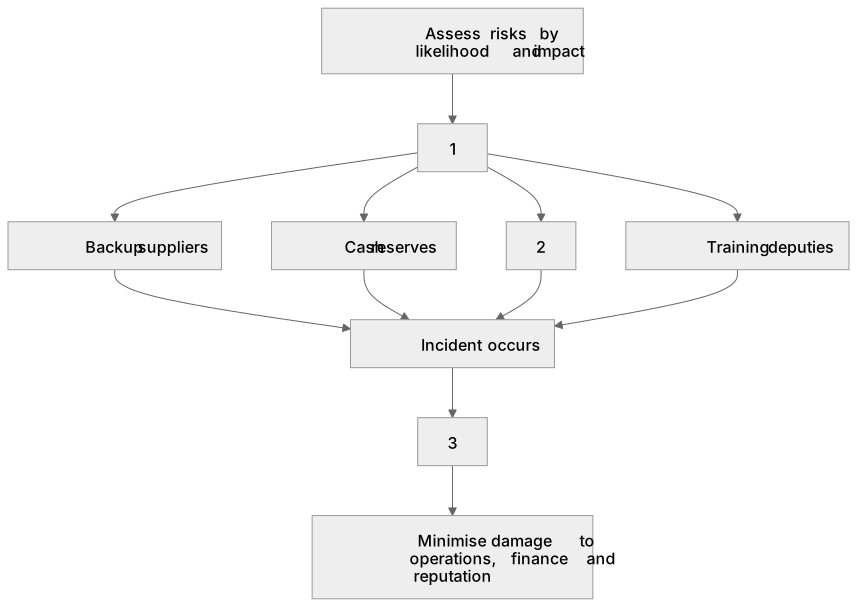
1Box 1
2Box 2
3Box 3
There is more to this lesson
The full lesson goes on to check your understanding and help you earn the marks. Create a free account to carry on, with your progress saved.
A week of Premium from your first lesson · Then the free plan continues · No card, no charge
Test your understanding of Problems with strategy and why strategies fail: The value of contingency planning and crisis management
Active recall beats re-reading. Take an instant quiz now to test what you’ve learned and lock it into long-term memory.
A week of Premium from your first lesson · Then the free plan continues · No card, no charge