AQA · A-Level · Business
Course version: 7132 · Version from Sept 2023
The value of strategic planning
Full specification wording
Problems with strategy and why strategies fail: The value of strategic planning
Formal planning asks four questions in order: where are we, answered by a position audit using tools such as Porter's five forces and a SWOT analysis; where do we want to be, answered by mission…
- Point 5 of 6
- 4 key terms
Study notes
From the teaching notes for this specification point.
The idea
Formal planning asks four questions in order: where are we, answered by a position audit using tools such as Porter's five forces and a SWOT analysis; where do we want to be, answered by mission and measurable objectives; how do we get there, answered by Ansoff's matrix or a choice of generic strategy; and did we get there, answered by control data. The benefit is coordination, a yardstick to hold managers to, a discipline that forces the outside world into the boardroom, and a document that often helps when raising finance. The cost is management time, a ritual that hardens into form filling, and forecasts that are opinions carried to two decimal places. So the payoff rises with long lead times and heavy capital, an airline ordering aircraft years before delivery, and falls in fast, unpredictable markets. Five forces is blind to speed and to complementors, and a SWOT weights nothing.
What earns the marks
- Setting the worth of planning against the volatility of the named market rather than treating planning as good or bad in itself.
- Saying what the plan is for in this business, raising finance, coordinating a takeover, or allocating a limited capital budget, since the purpose sets the test.
- Using a model properly, so a five forces point identifies the force and explains why it bites here, and an Ansoff point names the quadrant and the risk that goes with it.
- Costing the process, the management hours and the delay before acting, so the judgement weighs both sides rather than one.
- Distinguishing the plan as a process from the plan as a document, since much of the value lies in having the argument, not the binder.
Common mistakes and how to put them right
Describing a SWOT or the five forces at length and never reaching a conclusion, which fills a page and earns application at best.
Arguing that planning is pointless because the future is uncertain, which would leave a capital intensive business buying equipment on instinct.
Confusing the plan with the objective, so the answer judges whether the target was ambitious instead of whether the process added anything.
Claiming that no bank will lend without a formal strategic plan, when lenders can and do lend without one.
Exam tips
- When asked to assess the worth of planning, split it into the process and the document, because most of the benefit sits in the process of having the argument.
- Name the business in every paragraph; the difference between a middle band and a top band answer here is usually context rather than theory.
Try the lesson
The start of the Problems with strategy and why strategies fail: The value of strategic planning lesson, made from teaching notes for this specification point.
Have a go first
What is the main purpose of strategic planning for a business?
Listen
Formal planning asks four questions in order: where are we, answered by a position audit using tools such as Porter's five forces and a SWOT analysis; where do we want to be, answered by mission and measurable objectives; how do we get there, answered by Ansoff's matrix or a choice of generic strategy; and did we get there, answered by control data. The benefit is coordination, a yardstick to hold managers to, a discipline that forces the outside world into the boardroom, and a document that often helps when raising finance. The cost is management time, a ritual that hardens into form filling, and forecasts that are opinions carried to two decimal places. So the payoff rises with long lead times and heavy capital, an airline ordering aircraft years before delivery, and falls in fast, unpredictable markets. Five forces is blind to speed and to complementors, and a SWOT weights nothing. A strong answer earns marks for these points. Setting the worth of planning against the volatility of the named market rather than treating planning as good or bad in itself. Saying what the plan is for in this business, raising finance, coordinating a takeover, or allocating a limited capital budget, since the purpose sets the test. Using a model properly, so a five forces point identifies the force and explains why it bites here, and an Ansoff point names the quadrant and the risk that goes with it. Costing the process, the management hours and the delay before acting, so the judgement weighs both sides rather than one. Exam tip: When asked to assess the worth of planning, split it into the process and the document, because most of the benefit sits in the process of having the argument.
See it
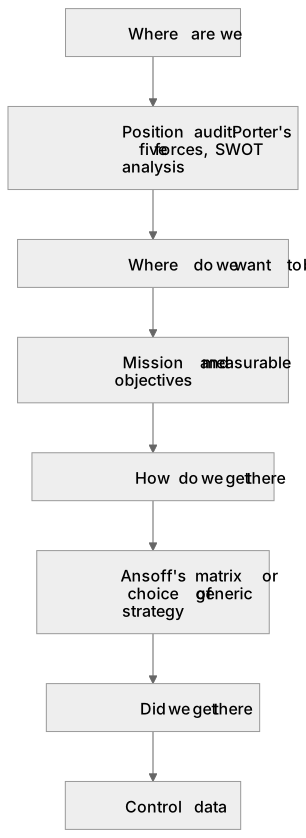
Put it in order
Put these steps in the order they happen.
- 1. How do we get there
- 2. Control data
- 3. Ansoff's matrix or choice of generic strategy
- 4. Where are we
- 5. Position audit: Porter's five forces, SWOT analysis
- 6. Did we get there
- 7. Where do we want to be
- 8. Mission and measurable objectives
Key words
Say what each word means before you turn the card.
position audit
Try answering aloud or in your head before turning the card.
mission and objectives
Try answering aloud or in your head before turning the card.
planning versus flexibility
Try answering aloud or in your head before turning the card.
limits of forecasting
Try answering aloud or in your head before turning the card.
See every definition
- position audit
- Answers the question where are we, using tools such as Porter's five forces and a SWOT analysis.
- mission and objectives
- Answers the question where do we want to be, with objectives being measurable.
- planning versus flexibility
- The payoff from planning rises with long lead times and heavy capital and falls in fast, unpredictable markets.
- limits of forecasting
- Forecasts are opinions carried to two decimal places, and five forces is blind to speed and to complementors.
Label the diagram
Some boxes have lost their names. Pick the right name for each number.
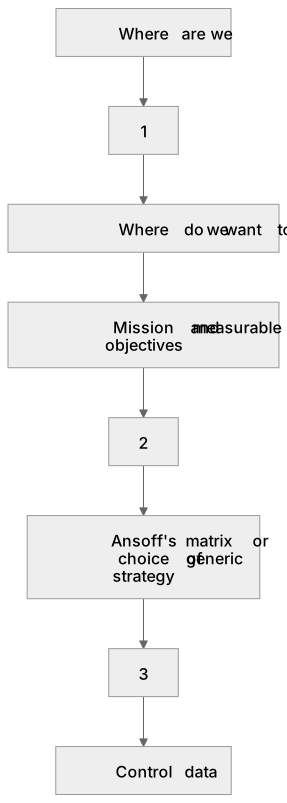
1Box 1
2Box 2
3Box 3
There is more to this lesson
The full lesson goes on to check your understanding and help you earn the marks. Create a free account to carry on, with your progress saved.
A week of Premium from your first lesson · Then the free plan continues · No card, no charge
Test your understanding of Problems with strategy and why strategies fail: The value of strategic planning
Active recall beats re-reading. Take an instant quiz now to test what you’ve learned and lock it into long-term memory.
A week of Premium from your first lesson · Then the free plan continues · No card, no charge