AQA · A-Level · Business
Course version: 7132 · Version from Sept 2023
Setting financial objectives: The distinction between cash flow and profit
This is the difference that closes businesses.
- Point 2 of 3
- 2 key terms
Study notes
From the teaching notes for this specification point.
The idea
This is the difference that closes businesses. Profit is recorded when a sale is made and a cost incurred, so a firm that invoices in March books the profit in March even if the payment lands in June, and the depreciation charge cuts profit without any money moving at all. Cash is the bank balance, and it drops when stock is bought, when a machine is paid for and when the tax bill arrives, none of which touch profit in the same way or in the same month. That is why a growing, profitable firm can run out of money, a condition called overtrading, and why a loss making firm with a large opening balance can survive for years. Examiners want that mechanism, not the slogan.
What earns the marks
- Explaining timing explicitly, that profit is recognised when the sale happens while cash moves when the customer actually pays, and applying that to the credit terms given in the stem.
- Identifying an item that hits one and not the other, such as depreciation reducing profit with no outflow, or a delivery van draining cash while only its depreciation reaches the profit figure.
- Using the term overtrading correctly, that rapid growth ties cash up in stock and in trade receivables faster than the profit comes in.
- Recommending a realistic remedy and pricing it, for example an overdraft with interest, invoice factoring at a discount, or leasing the asset rather than buying it.
Common mistakes and how to put them right
Saying that cash flow is money in and out while profit is revenue less costs and stopping there, which is a pair of definitions rather than the distinction being asked for.
Assuming a business showing a healthy profit cannot fail, so the answer never reaches the cash argument the case study was built around.
Reading a negative monthly net cash flow as a loss, when a firm can have a poor month for cash and still be comfortably profitable across the year.
Exam tips
- This underpins cash flow forecast questions, so expect to complete or correct a forecast and then comment on what the closing balance means for the business.
- In an assess or evaluate question, weigh the cost of the cash solution against the damage of running out, because the cheapest option is rarely the safest.
- Use the words receipts and payments for cash and the words revenue and costs for profit, so the marker can see you are keeping the two apart.
Try the lesson
The start of the Setting financial objectives: The distinction between cash flow and profit lesson, made from teaching notes for this specification point.
Have a go first
Which statement best describes the difference between cash flow and profit?
Listen
This is the difference that closes businesses. Profit is recorded when a sale is made and a cost incurred, so a firm that invoices in March books the profit in March even if the payment lands in June, and the depreciation charge cuts profit without any money moving at all. Cash is the bank balance, and it drops when stock is bought, when a machine is paid for and when the tax bill arrives, none of which touch profit in the same way or in the same month. That is why a growing, profitable firm can run out of money, a condition called overtrading, and why a loss making firm with a large opening balance can survive for years. Examiners want that mechanism, not the slogan. A strong answer earns marks for these points. Explaining timing explicitly, that profit is recognised when the sale happens while cash moves when the customer actually pays, and applying that to the credit terms given in the stem. Identifying an item that hits one and not the other, such as depreciation reducing profit with no outflow, or a delivery van draining cash while only its depreciation reaches the profit figure. Using the term overtrading correctly, that rapid growth ties cash up in stock and in trade receivables faster than the profit comes in. Recommending a realistic remedy and pricing it, for example an overdraft with interest, invoice factoring at a discount, or leasing the asset rather than buying it. Exam tip: This underpins cash flow forecast questions, so expect to complete or correct a forecast and then comment on what the closing balance means for the business.
See it
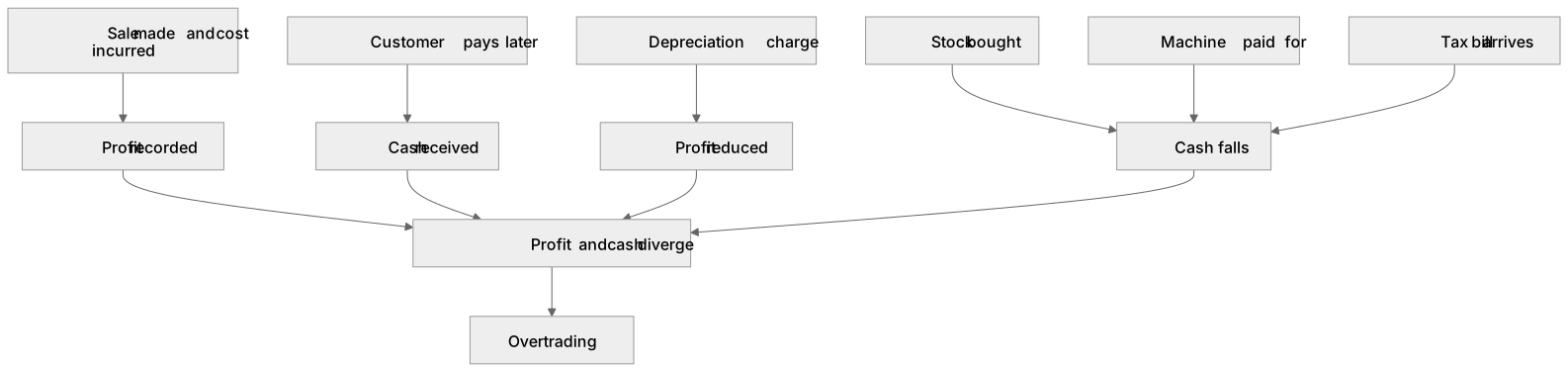
Key words
Say what each word means before you turn the card.
timing of cash and profit
Try answering aloud or in your head before turning the card.
overtrading
Try answering aloud or in your head before turning the card.
See every definition
- timing of cash and profit
- Profit is recorded when a sale is made and a cost incurred, while cash moves when the customer actually pays.
- overtrading
- A condition where rapid growth ties cash up in stock and in trade receivables faster than the profit comes in.
Label the diagram
Some boxes have lost their names. Pick the right name for each number.
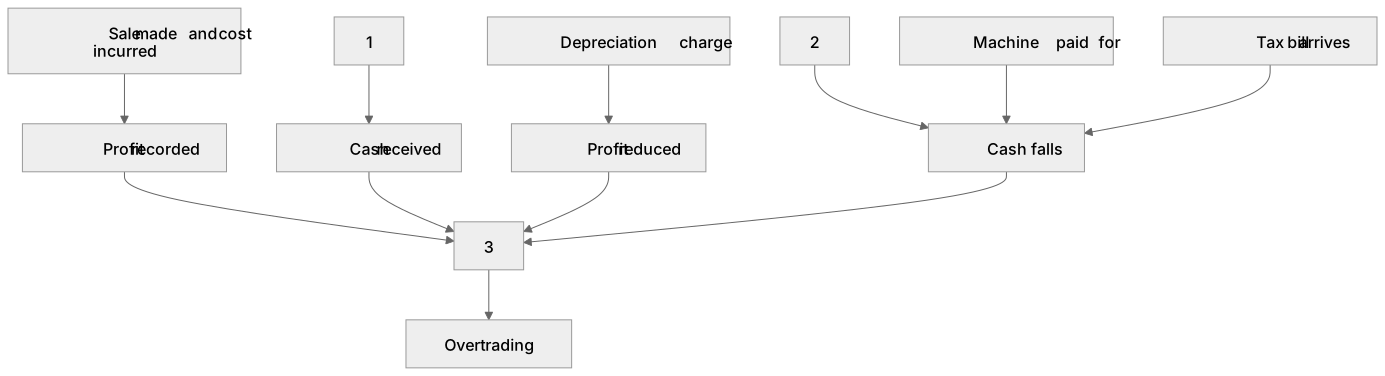
1Box 1
2Box 2
3Box 3
There is more to this lesson
The full lesson goes on to check your understanding and help you earn the marks. Create a free account to carry on, with your progress saved.
A week of Premium from your first lesson · Then the free plan continues · No card, no charge
Test your understanding of Setting financial objectives: The distinction between cash flow and profit
Active recall beats re-reading. Take an instant quiz now to test what you’ve learned and lock it into long-term memory.
A week of Premium from your first lesson · Then the free plan continues · No card, no charge