AQA · A-Level · Business
Course version: 7132 · Version from Sept 2023
The impact of technology on strategic decision making
Full specification wording
Strategic decision making (A-level only): the impact of technology on strategic decision making
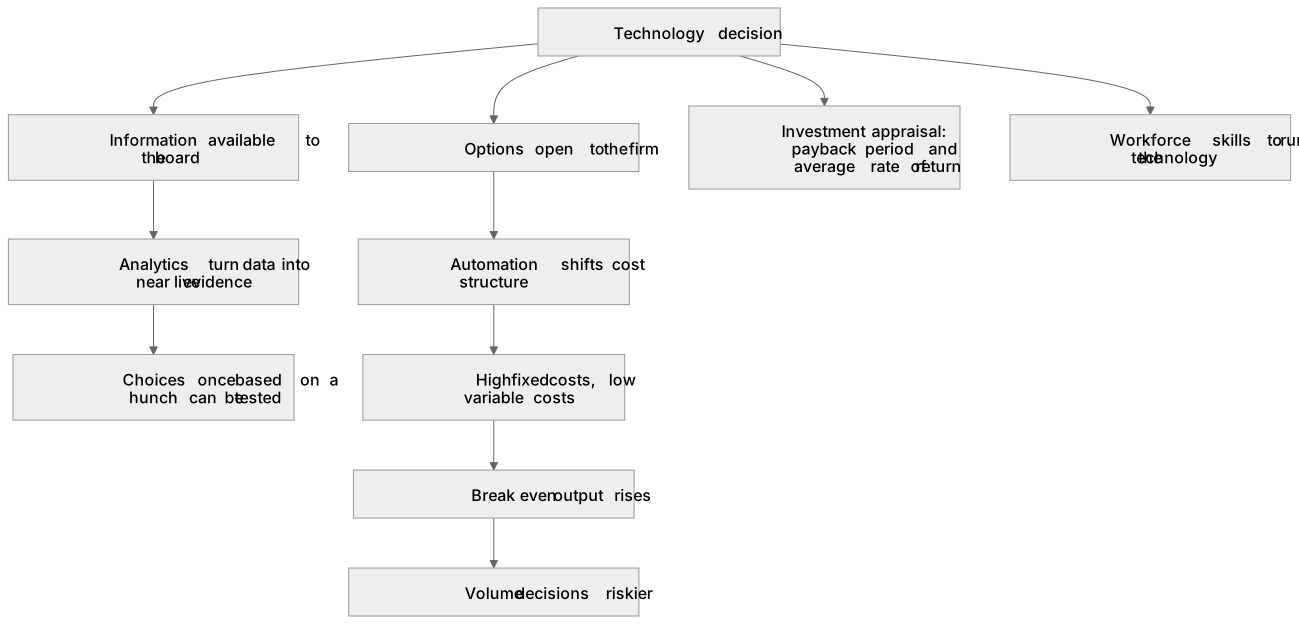
Technology changes both the information a board has and the options open to it.
- Point 2 of 6
- 4 key terms
Study notes
From the teaching notes for this specification point.
The idea
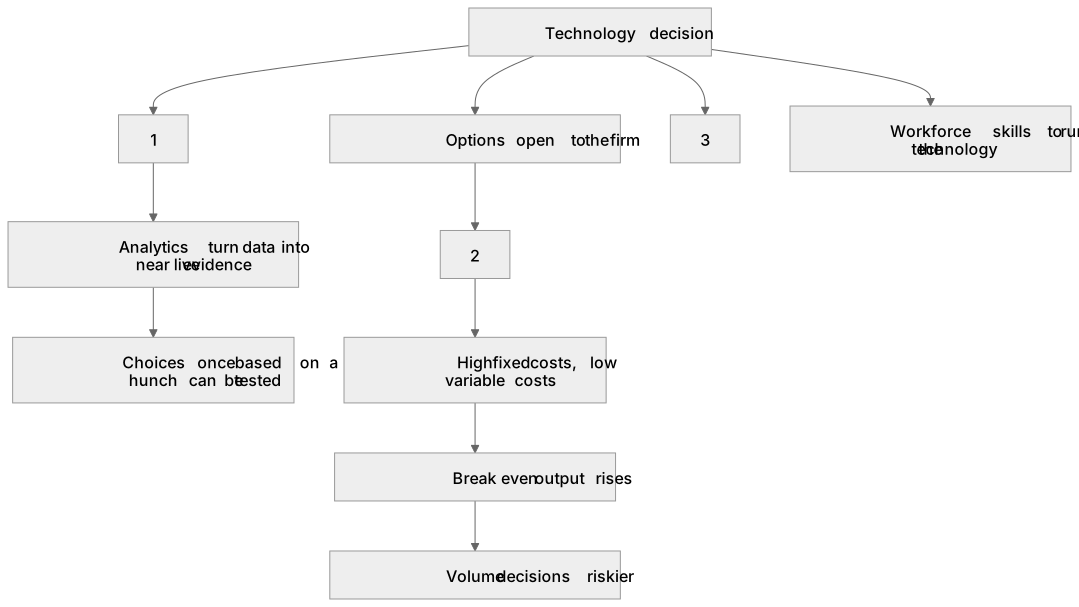
Technology changes both the information a board has and the options open to it. Analytics turn till data and web traffic into near live evidence, so choices that once rested on a hunch can be tested, while automation shifts the cost structure towards high fixed costs and low variable costs, which raises the break even output and makes volume decisions riskier. The real question is rarely whether the equipment works; it is whether the payback period and the average rate of return justify locking up capital in assets that may be obsolete before they are written off, and whether the workforce has the skills to run them. The judgement usually turns on the size of the outlay against the firm's cash position, the speed of change in the market, and how easily rivals can copy it.
What earns the marks
- Naming the technology precisely, such as data analytics, e-commerce, robotics, computer aided design or enterprise resource planning, rather than using the word technology on its own.
- Explaining the effect on the cost structure, that automation raises fixed costs and cuts variable cost per unit, so break even output rises and profit becomes more sensitive to demand.
- Applying investment appraisal to the decision: payback period in years and months, average rate of return as a percentage of the initial outlay, or net present value using the discount factors given.
- Linking technology to competitive position through Porter's five forces, for example lower entry barriers online raising the threat of new entrants, or price comparison sites raising buyer power.
- Bringing in the human resource consequence, that automation raises labour productivity, which is output divided by the number of employees over a period, while it can damage morale and raise labour turnover.
- Judging against the pace of change in the market, since a long payback is far riskier where the technology dates quickly.
Common mistakes and how to put them right
Claiming that technology always cuts costs.
Put it right: It cuts variable cost per unit but adds fixed cost, so unit costs can rise at low volumes.
Confusing payback with profitability.
Put it right: Payback says how fast the cash comes back, not whether the project earns a good return over its life, which is what average rate of return or net present value shows.
Treating more data as automatically better decisions, when analytics describe the past and say nothing about a market that is about to turn.
Writing only about benefits to the business, so the effect on customers, employees and suppliers that the question wanted never appears.
Exam tips
- Technology often appears as a calculation followed by a judgement, so do the payback or the average rate of return first and then use your own figure as the evidence in the evaluation.
- Hunt in the extracts for the line that shows how fast the market moves, because that is the cue for arguing a long payback is unacceptable here.
- If the stem gives a capital cost and annual savings, the appraisal is expected, not a general discussion of robots.
Try the lesson
The start of the Strategic decision making (A-level only): the impact of technology on strategic decision making lesson, made from teaching notes for this specification point.
Have a go first
Which of the following best describes how information technology can affect strategic decision making in a business?
Listen
Technology changes both the information a board has and the options open to it. Analytics turn till data and web traffic into near live evidence, so choices that once rested on a hunch can be tested, while automation shifts the cost structure towards high fixed costs and low variable costs, which raises the break even output and makes volume decisions riskier. The real question is rarely whether the equipment works; it is whether the payback period and the average rate of return justify locking up capital in assets that may be obsolete before they are written off, and whether the workforce has the skills to run them. The judgement usually turns on the size of the outlay against the firm's cash position, the speed of change in the market, and how easily rivals can copy it. A strong answer earns marks for these points. Naming the technology precisely, such as data analytics, e-commerce, robotics, computer aided design or enterprise resource planning, rather than using the word technology on its own. Explaining the effect on the cost structure, that automation raises fixed costs and cuts variable cost per unit, so break even output rises and profit becomes more sensitive to demand. Applying investment appraisal to the decision: payback period in years and months, average rate of return as a percentage of the initial outlay, or net present value using the discount factors given. Linking technology to competitive position through Porter's five forces, for example lower entry barriers online raising the threat of new entrants, or price comparison sites raising buyer power. Exam tip: Technology often appears as a calculation followed by a judgement, so do the payback or the average rate of return first and then use your own figure as the evidence in the evaluation.
See it
Key words
Say what each word means before you turn the card.
Automation and the cost structure
Try answering aloud or in your head before turning the card.
Investment appraisal of new technology
Try answering aloud or in your head before turning the card.
Competitive advantage and imitation
Try answering aloud or in your head before turning the card.
Risk of obsolescence
Try answering aloud or in your head before turning the card.
See every definition
- Automation and the cost structure
- Shifts the cost structure towards high fixed costs and low variable costs, which raises the break even output and makes volume decisions riskier.
- Investment appraisal of new technology
- Whether the payback period and the average rate of return justify locking up capital in assets that may be obsolete before they are written off.
- Competitive advantage and imitation
- The judgement usually turns on how easily rivals can copy it.
- Risk of obsolescence
- A long payback is far riskier where the technology dates quickly.
Label the diagram
Some boxes have lost their names. Pick the right name for each number.
1Box 1
2Box 2
3Box 3
There is more to this lesson
The full lesson goes on to check your understanding and help you earn the marks. Create a free account to carry on, with your progress saved.
A week of Premium from your first lesson · Then the free plan continues · No card, no charge
Test your understanding of Strategic decision making (A-level only): the impact of technology on strategic decision making
Active recall beats re-reading. Take an instant quiz now to test what you’ve learned and lock it into long-term memory.
A week of Premium from your first lesson · Then the free plan continues · No card, no charge