AQA · A-Level · Business
Course version: 7132 · Version from Sept 2023
The study of strategic decision making should build on the study of…
Full specification wording
Strategic decision making (A-level only): The study of strategic decision making should build on the study of decision making in the functional areas. Students should consider:
A strategic decision commits large resources over years and is hard to unwind, which is what separates it from the tactical choices a marketing or operations manager makes each week.
- Point 1 of 6
- 4 key terms
Study notes
From the teaching notes for this specification point.
The idea
A strategic decision commits large resources over years and is hard to unwind, which is what separates it from the tactical choices a marketing or operations manager makes each week. The exam expects the two to be joined up: a corporate objective of growth is delivered by functional targets such as raising capacity utilisation, cutting labour turnover or widening the product portfolio, and the evidence for whether the plan is working comes back as functional numbers, margins, ratios and productivity figures. Judgement comes from asking whether the firm has the finance, the people and the capacity to carry the plan out, and what it gives up by choosing it. Treat every question here as a choice made under uncertainty by managers with incomplete information, rather than as a topic to describe.
What earns the marks
- Defining a strategic decision by its scale, time horizon and difficulty of reversal, and contrasting it with a tactical decision taken inside a single function.
- Showing the chain from mission to corporate objectives to functional objectives to tactics, using the case study's own targets at each level.
- Using a functional measure as evidence for a whole business judgement, for example capacity utilisation already running near the maximum to argue that growth needs new capacity rather than more promotion.
- Recognising opportunity cost, that the finance and management time spent on one option are not available for another, so the judgement is comparative.
- Handling uncertainty explicitly by saying what the decision rests on and what would change the recommendation.
- Reaching a judgement that names the criterion being used, such as cash flow risk or long run competitive position, and applies it to the named business.
Common mistakes and how to put them right
Writing about strategy in general with no reference to the business in the stem, which holds the answer in the lowest level because application is never awarded.
Calling every decision in the case study strategic.
Put it right: A price cut on one product line is tactical, and losing that distinction loses the point of the question.
Listing advantages and disadvantages and ending with it depends, without saying what it depends on for this firm.
Answering from one functional topic only, such as writing a pure motivation answer when the question asks whether a restructuring plan will work.
Exam tips
- Paper 3 is one compulsory case study with roughly six questions, so the same business runs through the whole paper and evidence from an early extract is usually meant to be reused later.
- In a twenty five mark essay, define the strategic issue in the first line and spend the final paragraph on a judgement with a stated criterion, because evaluation carries the top level.
- Quote figures from the extracts rather than paraphrasing them, since a number used as evidence is what lifts analysis into evaluation.
- Read the command word: assess and evaluate need a weighed judgement, while analyse needs a developed chain of reasoning and no verdict.
Try the lesson
The start of the Strategic decision making (A-level only): The study of strategic decision making should build on the study of decision making in the functional areas. Students should consider: lesson, made from teaching notes for this specification point.
Have a go first
Which of the following best describes a strategic decision?
Listen
A strategic decision commits large resources over years and is hard to unwind, which is what separates it from the tactical choices a marketing or operations manager makes each week. The exam expects the two to be joined up: a corporate objective of growth is delivered by functional targets such as raising capacity utilisation, cutting labour turnover or widening the product portfolio, and the evidence for whether the plan is working comes back as functional numbers, margins, ratios and productivity figures. Judgement comes from asking whether the firm has the finance, the people and the capacity to carry the plan out, and what it gives up by choosing it. Treat every question here as a choice made under uncertainty by managers with incomplete information, rather than as a topic to describe. A strong answer earns marks for these points. Defining a strategic decision by its scale, time horizon and difficulty of reversal, and contrasting it with a tactical decision taken inside a single function. Showing the chain from mission to corporate objectives to functional objectives to tactics, using the case study's own targets at each level. Using a functional measure as evidence for a whole business judgement, for example capacity utilisation already running near the maximum to argue that growth needs new capacity rather than more promotion. Recognising opportunity cost, that the finance and management time spent on one option are not available for another, so the judgement is comparative. Exam tip: Paper 3 is one compulsory case study with roughly six questions, so the same business runs through the whole paper and evidence from an early extract is usually meant to be reused later.
See it
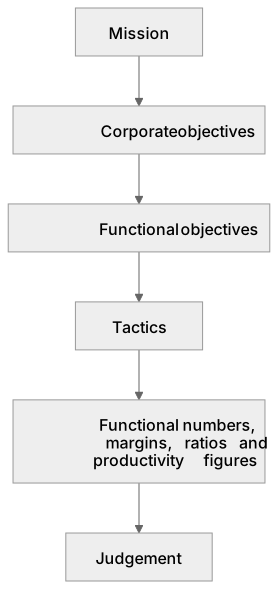
Put it in order
Put these steps in the order they happen.
- 1. Functional objectives
- 2. Corporate objectives
- 3. Mission
- 4. Judgement
- 5. Functional numbers, margins, ratios and productivity figures
- 6. Tactics
Key words
Say what each word means before you turn the card.
Strategic decision
Try answering aloud or in your head before turning the card.
Tactical decision
Try answering aloud or in your head before turning the card.
Functional objectives
Try answering aloud or in your head before turning the card.
Opportunity cost
Try answering aloud or in your head before turning the card.
See every definition
- Strategic decision
- A decision that commits large resources over years and is hard to unwind.
- Tactical decision
- A choice taken inside a single function, such as the choices a marketing or operations manager makes each week.
- Functional objectives
- Targets such as raising capacity utilisation, cutting labour turnover or widening the product portfolio that deliver a corporate objective of growth.
- Opportunity cost
- The finance and management time spent on one option are not available for another, so the judgement is comparative.
Label the diagram
Some boxes have lost their names. Pick the right name for each number.
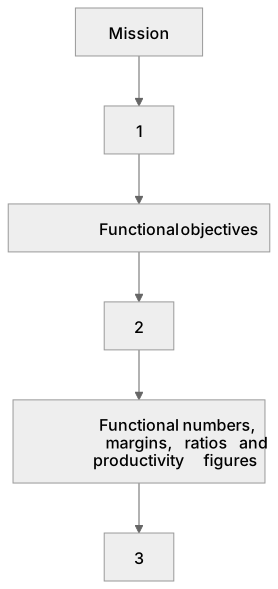
1Box 1
2Box 2
3Box 3
There is more to this lesson
The full lesson goes on to check your understanding and help you earn the marks. Create a free account to carry on, with your progress saved.
A week of Premium from your first lesson · Then the free plan continues · No card, no charge
Test your understanding of Strategic decision making (A-level only): The study of strategic decision making should build on the study of decision making in the functional areas. Students should consider:
Active recall beats re-reading. Take an instant quiz now to test what you’ve learned and lock it into long-term memory.
A week of Premium from your first lesson · Then the free plan continues · No card, no charge