AQA · A-Level · Business
Course version: 7132 · Version from Sept 2023
Choosing which markets to compete in and what products to offer: Factors…
Full specification wording
Strategic direction: choosing which markets to compete in and what products to offer: Factors influencing which markets to compete in and which products to offer (to include: Strategic direction to include the Ansoff matrix and value of: market penetration, market development, new product development, diversification.)
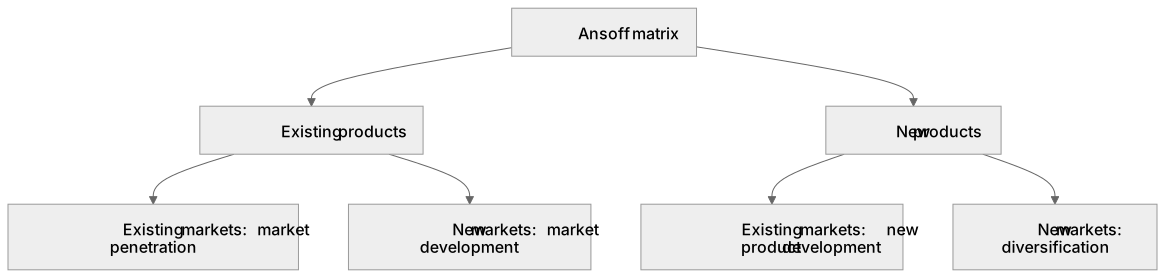
Ansoff sorts growth options by how far each takes the firm from what it already knows, pairing existing and new products with existing and new markets.
- Point 1 of 2
- 4 key terms
Study notes
From the teaching notes for this specification point.
The idea
Ansoff sorts growth options by how far each takes the firm from what it already knows, pairing existing and new products with existing and new markets. Selling more of the current range to current customers is penetration, the cheapest because the product works and the channel exists. Taking that range into a new segment or country is market development. Building something new for existing customers is product development, which leans on the brand but carries development cost and the risk of failure. Doing both at once is diversification, which spreads risk across markets while asking the firm to learn two unfamiliar things at the same time. The grid earns its place by forcing a comparison instead of a preference, and its blind spots are the marks: it says nothing about how rivals will respond, nothing about whether the money and the people exist, and nothing about timing.
What earns the marks
- Placing the proposal in the correct quadrant and justifying the placement, since a familiar product sold to a genuinely new customer group is market development rather than penetration.
- Connecting the quadrant to the level of risk and to the cost of getting there, so a likely small return is weighed against an unlikely large one.
- Using evidence from the case, such as a saturated home market, spare capacity or a trusted brand, to argue why one quadrant suits this firm now.
- Naming a limitation of the model, for instance that it ignores competitor reaction and the finance available, and showing how that changes the judgement.
Common mistakes and how to put them right
Describing all four boxes in turn and never choosing one, which answers a question nobody asked and leaves the evaluation empty.
Labelling any new product as diversification, when a new product sold to the firm's existing customers is product development.
Treating diversification as automatically reckless instead of showing that it cuts dependence on one market while stretching management thin.
Exam tips
- Ansoff usually appears in a longer question naming two options, so structure the answer as a comparison and reach a supported choice.
- One quadrant applied well beats a full grid described, because markers reward the application and not the diagram.
- Pair the model with a figure from the appendix, such as market share or sales growth, so the judgement rests on evidence.
Try the lesson
The start of the Strategic direction: choosing which markets to compete in and what products to offer: Factors influencing which markets to compete in and which products to offer (to include: Strategic direction to include the Ansoff matrix and value of: market penetration, market development, new product development, diversification.) lesson, made from teaching notes for this specification point.
Have a go first
In the Ansoff matrix, which strategic direction involves selling existing products in existing markets?
Listen
Ansoff sorts growth options by how far each takes the firm from what it already knows, pairing existing and new products with existing and new markets. Selling more of the current range to current customers is penetration, the cheapest because the product works and the channel exists. Taking that range into a new segment or country is market development. Building something new for existing customers is product development, which leans on the brand but carries development cost and the risk of failure. Doing both at once is diversification, which spreads risk across markets while asking the firm to learn two unfamiliar things at the same time. The grid earns its place by forcing a comparison instead of a preference, and its blind spots are the marks: it says nothing about how rivals will respond, nothing about whether the money and the people exist, and nothing about timing. A strong answer earns marks for these points. Placing the proposal in the correct quadrant and justifying the placement, since a familiar product sold to a genuinely new customer group is market development rather than penetration. Connecting the quadrant to the level of risk and to the cost of getting there, so a likely small return is weighed against an unlikely large one. Using evidence from the case, such as a saturated home market, spare capacity or a trusted brand, to argue why one quadrant suits this firm now. Naming a limitation of the model, for instance that it ignores competitor reaction and the finance available, and showing how that changes the judgement. Exam tip: Ansoff usually appears in a longer question naming two options, so structure the answer as a comparison and reach a supported choice.
See it
Key words
Say what each word means before you turn the card.
Ansoff matrix
Try answering aloud or in your head before turning the card.
market penetration
Try answering aloud or in your head before turning the card.
market development
Try answering aloud or in your head before turning the card.
diversification
Try answering aloud or in your head before turning the card.
See every definition
- Ansoff matrix
- Sorts growth options by how far each takes the firm from what it already knows, pairing existing and new products with existing and new markets.
- market penetration
- Selling more of the current range to current customers, the cheapest because the product works and the channel exists.
- market development
- Taking the current range into a new segment or country.
- diversification
- Doing both at once, which spreads risk across markets while asking the firm to learn two unfamiliar things at the same time.
Label the diagram
Some boxes have lost their names. Pick the right name for each number.
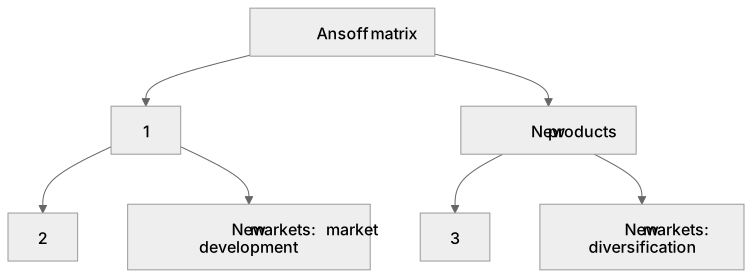
1Box 1
2Box 2
3Box 3
There is more to this lesson
The full lesson goes on to check your understanding and help you earn the marks. Create a free account to carry on, with your progress saved.
A week of Premium from your first lesson · Then the free plan continues · No card, no charge
Test your understanding of Strategic direction: choosing which markets to compete in and what products to offer: Factors influencing which markets to compete in and which products to offer (to include: Strategic direction to include the Ansoff matrix and value of: market penetration, market development, new product development, diversification.)
Active recall beats re-reading. Take an instant quiz now to test what you’ve learned and lock it into long-term memory.
A week of Premium from your first lesson · Then the free plan continues · No card, no charge