AQA · A-Level · Business
Course version: 7132 · Version from Sept 2023
The factors that might determine whether a decision is successful eg the…
Full specification wording
Subject content: the factors that might determine whether a decision is successful eg the quality of data and the degree of uncertainty
Judge a choice by its process and its conditions, not only by how it turned out, because a well made decision can still be beaten by a rival or a recession.
- Point 6 of 9
- 4 key terms
Study notes
From the teaching notes for this specification point.
The idea
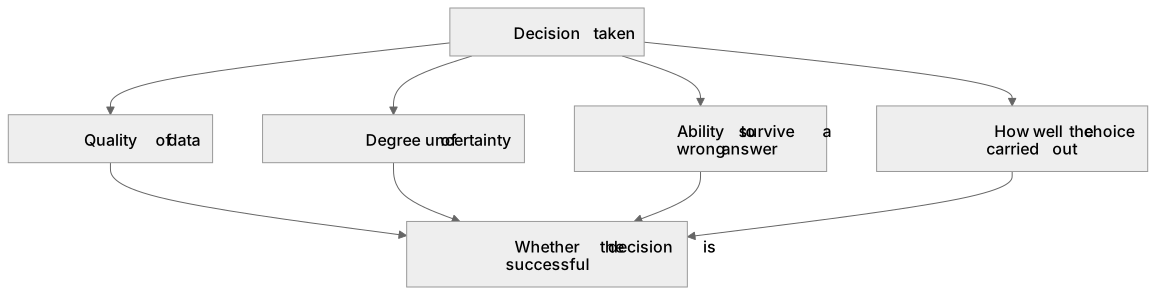
Judge a choice by its process and its conditions, not only by how it turned out, because a well made decision can still be beaten by a rival or a recession. Scientific decision making leans on evidence and on techniques such as the decision tree, where the expected value of an option is each payoff multiplied by its probability, summed, then less the cost of taking that option. The technique is blind to the quality of its own inputs: probabilities are estimates, payoffs are forecasts, reputation and morale never appear, and it assumes one decision taken once. So what really determines success is how recent, how large and how unbiased the data is, how much of the future is genuinely unknowable, whether the firm can survive a wrong answer, and how well the choice is carried out.
What earns the marks
- Separating risk, where outcomes can be given probabilities, from uncertainty, where they cannot, and saying which of the two this firm faces.
- Interrogating the data itself: how old it is, how it was gathered, how large the sample was and who paid for it.
- Calculating an expected value or a net gain correctly and then refusing to treat it as the decision, because the probabilities were somebody's judgement.
- Naming the implementation risks that decide success after the choice is made, such as staff resistance, supplier capacity or a competitor response.
Common mistakes and how to put them right
Calling a decision wrong because the outcome was poor, which confuses a bad result with a bad decision.
Reciting the limitations of decision trees as a memorised list without applying one of them to the probabilities the case actually gives.
Ignoring opportunity cost, so an option is judged successful without asking what the money and the management time would have earned elsewhere.
Exam tips
- An expected value calculation nearly always leads into an assess or evaluate part on the same data, so leave time to argue against your own number.
- Write down the probabilities and payoffs before you multiply, since method marks survive an arithmetic slip only if the working is visible.
- If the case dates its market research, say how the world has moved since, because that is the cheapest evaluation point on the page.
Try the lesson
The start of the Subject content: the factors that might determine whether a decision is successful eg the quality of data and the degree of uncertainty lesson, made from teaching notes for this specification point.
Have a go first
Which of the following is most likely to improve the success of a business decision?
Listen
Judge a choice by its process and its conditions, not only by how it turned out, because a well made decision can still be beaten by a rival or a recession. Scientific decision making leans on evidence and on techniques such as the decision tree, where the expected value of an option is each payoff multiplied by its probability, summed, then less the cost of taking that option. The technique is blind to the quality of its own inputs: probabilities are estimates, payoffs are forecasts, reputation and morale never appear, and it assumes one decision taken once. So what really determines success is how recent, how large and how unbiased the data is, how much of the future is genuinely unknowable, whether the firm can survive a wrong answer, and how well the choice is carried out. A strong answer earns marks for these points. Separating risk, where outcomes can be given probabilities, from uncertainty, where they cannot, and saying which of the two this firm faces. Interrogating the data itself: how old it is, how it was gathered, how large the sample was and who paid for it. Calculating an expected value or a net gain correctly and then refusing to treat it as the decision, because the probabilities were somebody's judgement. Naming the implementation risks that decide success after the choice is made, such as staff resistance, supplier capacity or a competitor response. Exam tip: An expected value calculation nearly always leads into an assess or evaluate part on the same data, so leave time to argue against your own number.
See it
Key words
Say what each word means before you turn the card.
risk
Try answering aloud or in your head before turning the card.
uncertainty
Try answering aloud or in your head before turning the card.
expected value
Try answering aloud or in your head before turning the card.
data quality
Try answering aloud or in your head before turning the card.
See every definition
- risk
- A situation where outcomes can be given probabilities, as opposed to uncertainty where they cannot.
- uncertainty
- A situation where outcomes cannot be given probabilities, as opposed to risk where they can.
- expected value
- Each payoff multiplied by its probability, summed, then less the cost of taking that option.
- data quality
- How recent, how large and how unbiased the data is.
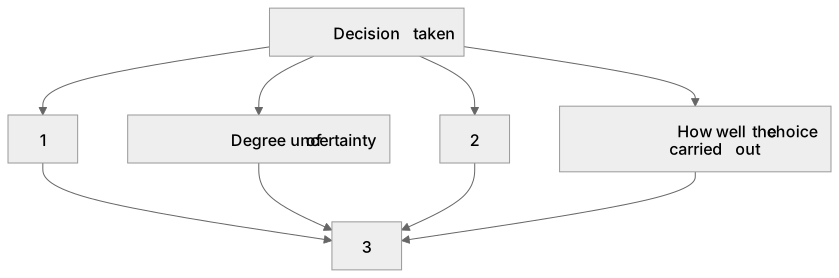
Label the diagram
Some boxes have lost their names. Pick the right name for each number.
1Box 1
2Box 2
3Box 3
There is more to this lesson
The full lesson goes on to check your understanding and help you earn the marks. Create a free account to carry on, with your progress saved.
A week of Premium from your first lesson · Then the free plan continues · No card, no charge
Test your understanding of Subject content: the factors that might determine whether a decision is successful eg the quality of data and the degree of uncertainty
Active recall beats re-reading. Take an instant quiz now to test what you’ve learned and lock it into long-term memory.
A week of Premium from your first lesson · Then the free plan continues · No card, no charge