AQA · A-Level · Business
Course version: 7132 · Version from Sept 2023
Reasons for choosing different forms of business and for changing business…
Full specification wording
Understanding different business forms: Reasons for choosing different forms of business and for changing business form (to include: Different forms of business include: sole traders, private limited companies and public limited companies, private sector and public sector organisations, non-profit organisations, social enterprises. Issues with different forms of business include: unlimited and limited liability, ordinary share capital, market capitalisation, dividends.)
The choice of business form depends on objectives for risk, control, and purpose.
- Point 1 of 4
- 4 key terms
Study notes
From the teaching notes for this specification point.
The idea
The choice of business form depends on objectives for risk, control, and purpose. The private sector aims for profit, the public sector delivers government services (e.g., the NHS), and non-profits like charities or social enterprises pursue social missions. A sole trader has total control but also unlimited liability, risking personal assets if the business fails. Incorporating as a private limited company (Ltd) creates a separate legal entity, granting shareholders limited liability—they can only lose their investment. This allows capital to be raised by selling ordinary shares to a select group. A public limited company (PLC) can sell shares to the public, raising more capital but requiring greater disclosure. A PLC's value is tracked by market capitalisation (share price × issued shares), and it may distribute profits as dividends.
What earns the marks
- Distinguishing between business forms based on their primary objective: profit (private sector), public service (public sector), or a social mission (non-profit/social enterprise).
- Correctly linking a business form (e.g., sole trader) to the type of liability (unlimited) and explaining what this means for the owner's personal financial risk.
- Calculating market capitalisation as share price multiplied by the number of shares issued, and explaining its significance as a measure of a PLC's value.
- Explaining a change of form as a trade-off, such as a sole trader incorporating to gain limited liability and access to finance at the cost of sharing ownership and control.
Common mistakes and how to put them right
Stating that limited liability means the company has limited debts.
Put it right: Liability limits what a shareholder can lose (their investment); the company itself is still liable for all its debts.
Confusing a public limited company (PLC) with a public sector organisation.
Put it right: A PLC is in the private sector, owned by shareholders; public sector organisations are state-owned.
Treating market capitalisation as cash the business holds.
Put it right: It is the total market value of the company's shares, not a cash asset on its balance sheet.
Exam tips
- Short-answer questions often require precise definitions of liability or an exact calculation of market capitalisation, so learn these thoroughly.
- In longer answers, justify the choice of business form for a specific owner in the case study, considering their personal attitude to risk, need for capital, and desire for control.
- When assessing a business form, always weigh the benefits (e.g., access to finance, limited liability) against the drawbacks (e.g., loss of control, disclosure requirements, profit distribution rules).
Try the lesson
The start of the Understanding different business forms: Reasons for choosing different forms of business and for changing business form (to include: Different forms of business include: sole traders, private limited companies and public limited companies, private sector and public sector organisations, non-profit organisations, social enterprises. Issues with different forms of business include: unlimited and limited liability, ordinary share capital, market capitalisation, dividends.) lesson, made from teaching notes for this specification point.
Have a go first
Which form of business organisation gives its owners limited liability?
Listen
The choice of business form depends on objectives for risk, control, and purpose. The private sector aims for profit, the public sector delivers government services (e.g., the NHS), and non-profits like charities or social enterprises pursue social missions. A sole trader has total control but also unlimited liability, risking personal assets if the business fails. Incorporating as a private limited company (Ltd) creates a separate legal entity, granting shareholders limited liability—they can only lose their investment. This allows capital to be raised by selling ordinary shares to a select group. A public limited company (PLC) can sell shares to the public, raising more capital but requiring greater disclosure. A PLC's value is tracked by market capitalisation (share price × issued shares), and it may distribute profits as dividends. A strong answer earns marks for these points. Distinguishing between business forms based on their primary objective: profit (private sector), public service (public sector), or a social mission (non-profit/social enterprise). Correctly linking a business form (e.g., sole trader) to the type of liability (unlimited) and explaining what this means for the owner's personal financial risk. Calculating market capitalisation as share price multiplied by the number of shares issued, and explaining its significance as a measure of a PLC's value. Explaining a change of form as a trade-off, such as a sole trader incorporating to gain limited liability and access to finance at the cost of sharing ownership and control. A common slip: Stating that limited liability means the company has limited debts. Instead, Liability limits what a shareholder can lose (their investment); the company itself is still liable for all its debts. Exam tip: Short-answer questions often require precise definitions of liability or an exact calculation of market capitalisation, so learn these thoroughly.
See it
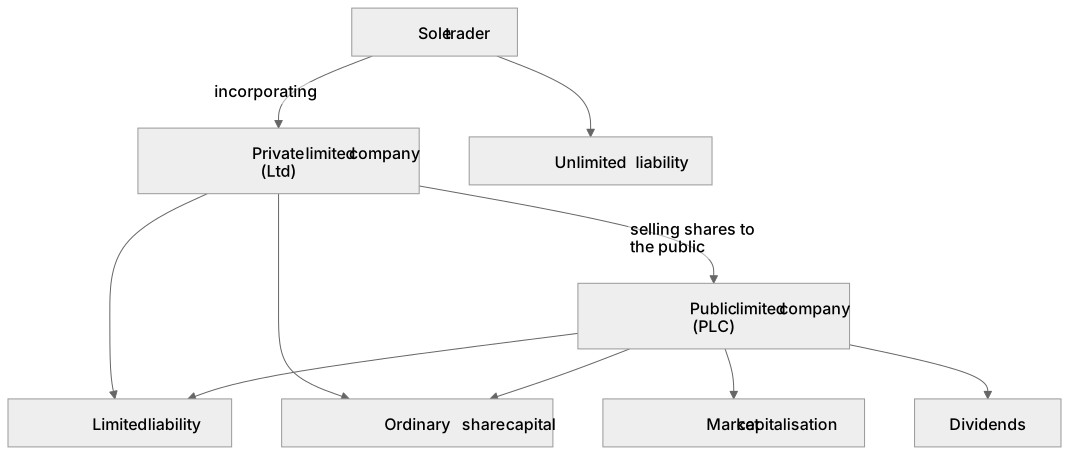
Key words
Say what each word means before you turn the card.
unlimited liability
Try answering aloud or in your head before turning the card.
limited liability
Try answering aloud or in your head before turning the card.
market capitalisation
Try answering aloud or in your head before turning the card.
dividends
Try answering aloud or in your head before turning the card.
See every definition
- unlimited liability
- A sole trader has total control but also this, risking personal assets if the business fails.
- limited liability
- Incorporating as a private limited company creates a separate legal entity, granting shareholders this, so they can only lose their investment.
- market capitalisation
- A measure of a PLC's value, tracked as share price multiplied by issued shares.
- dividends
- Profits that a PLC may distribute.
Label the diagram
Some boxes have lost their names. Pick the right name for each number.
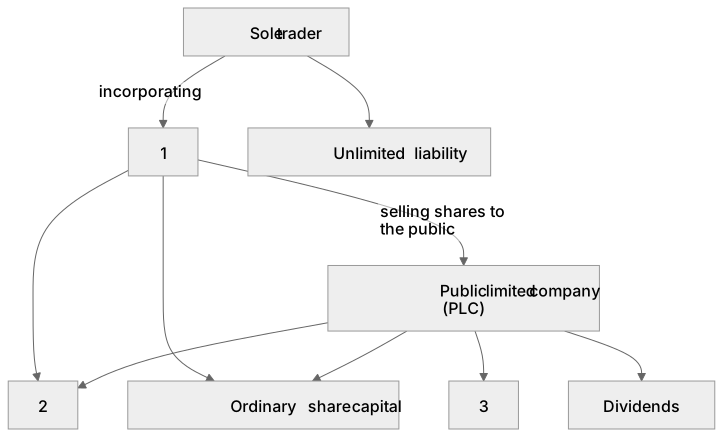
1Box 1
2Box 2
3Box 3
There is more to this lesson
The full lesson goes on to check your understanding and help you earn the marks. Create a free account to carry on, with your progress saved.
A week of Premium from your first lesson · Then the free plan continues · No card, no charge
Test your understanding of Understanding different business forms: Reasons for choosing different forms of business and for changing business form (to include: Different forms of business include: sole traders, private limited companies and public limited companies, private sector and public sector organisations, non-profit organisations, social enterprises. Issues with different forms of business include: unlimited and limited liability, ordinary share capital, market capitalisation, dividends.)
Active recall beats re-reading. Take an instant quiz now to test what you’ve learned and lock it into long-term memory.
A week of Premium from your first lesson · Then the free plan continues · No card, no charge