AQA · A-Level · Business
Course version: 7132 · Version from Sept 2023
The value of sampling (to include: Sampling methods should include:…
Full specification wording
Understanding markets and customers: The value of sampling (to include: Sampling methods should include: random, stratified, quota.)
Sampling provides business insights without the cost of a full census, but its value depends on the method.
- Point 2 of 6
- 3 key terms
Study notes
From the teaching notes for this specification point.
The idea
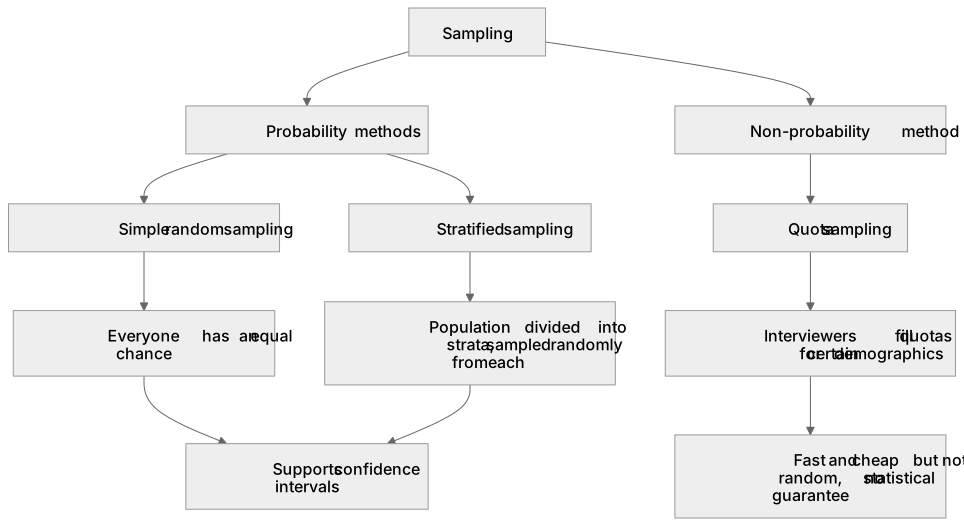
Sampling provides business insights without the cost of a full census, but its value depends on the method. Probability methods, where each person has a known chance of selection, allow for statistical inference. Simple random sampling gives everyone an equal chance. Stratified sampling divides the population into subgroups (strata) and samples randomly from each, ensuring key groups are represented. Both methods support confidence intervals. In contrast, quota sampling is a non-probability method where interviewers fill quotas for certain demographics. It is fast and cheap but not random, so it carries no statistical guarantee. The choice of method involves a trade-off between cost and confidence. A larger sample size reduces random error, but cannot fix underlying bias in the sampling frame or method.
What earns the marks
- Naming the method and the reason it suits this firm, such as a stratified approach because the product sells to several distinct age groups that each have to be heard.
- Linking sample size to the width of the interval around the result, so a larger sample narrows the range the true figure is expected to sit in.
- Costing the sample against the decision it informs, so a small firm launching one product is not told to fund a thousand interviews.
- Recognising that a biased sampling frame makes a large sample no safer, because the error is systematic rather than random.
Common mistakes and how to put them right
Treating a bigger sample as automatically better, when a thousand responses from the wrong people are worth less than fifty from the target group.
Describing the quota method as random because the interviewer stops people in the street, when the quota fixes the composition and the selection is not by chance.
Quoting a percentage from a sample as if it were the whole market, with no mention of the margin of error or confidence interval around it.
Exam tips
- Sampling usually appears inside a longer question about the value of the research rather than on its own, so use it as evidence when you evaluate whether a firm should act on the findings.
- Multiple choice questions test the definitions directly, so be able to separate the stratified method from the quota method in one sentence each.
Try the lesson
The start of the Understanding markets and customers: The value of sampling (to include: Sampling methods should include: random, stratified, quota.) lesson, made from teaching notes for this specification point.
Have a go first
Which sampling method involves selecting participants purely by chance so that every member of the target population has an equal chance of being chosen?
Listen
Sampling provides business insights without the cost of a full census, but its value depends on the method. Probability methods, where each person has a known chance of selection, allow for statistical inference. Simple random sampling gives everyone an equal chance. Stratified sampling divides the population into subgroups (strata) and samples randomly from each, ensuring key groups are represented. Both methods support confidence intervals. In contrast, quota sampling is a non-probability method where interviewers fill quotas for certain demographics. It is fast and cheap but not random, so it carries no statistical guarantee. The choice of method involves a trade-off between cost and confidence. A larger sample size reduces random error, but cannot fix underlying bias in the sampling frame or method. A strong answer earns marks for these points. Naming the method and the reason it suits this firm, such as a stratified approach because the product sells to several distinct age groups that each have to be heard. Linking sample size to the width of the interval around the result, so a larger sample narrows the range the true figure is expected to sit in. Costing the sample against the decision it informs, so a small firm launching one product is not told to fund a thousand interviews. Recognising that a biased sampling frame makes a large sample no safer, because the error is systematic rather than random. Exam tip: Sampling usually appears inside a longer question about the value of the research rather than on its own, so use it as evidence when you evaluate whether a firm should act on the findings.
See it
Key words
Say what each word means before you turn the card.
simple random sampling
Try answering aloud or in your head before turning the card.
stratified sampling
Try answering aloud or in your head before turning the card.
quota sampling
Try answering aloud or in your head before turning the card.
See every definition
- simple random sampling
- A probability method where everyone has an equal chance of selection, so statistical inference is allowed.
- stratified sampling
- Divides the population into subgroups (strata) and samples randomly from each, ensuring key groups are represented.
- quota sampling
- A non-probability method where interviewers fill quotas for certain demographics; it is fast and cheap but not random, so it carries no statistical guarantee.
Label the diagram
Some boxes have lost their names. Pick the right name for each number.
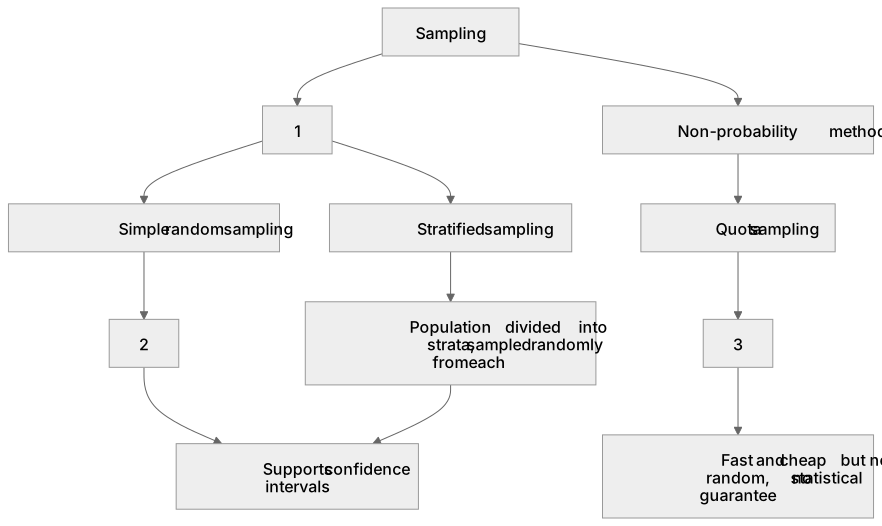
1Box 1
2Box 2
3Box 3
There is more to this lesson
The full lesson goes on to check your understanding and help you earn the marks. Create a free account to carry on, with your progress saved.
A week of Premium from your first lesson · Then the free plan continues · No card, no charge
Test your understanding of Understanding markets and customers: The value of sampling (to include: Sampling methods should include: random, stratified, quota.)
Active recall beats re-reading. Take an instant quiz now to test what you’ve learned and lock it into long-term memory.
A week of Premium from your first lesson · Then the free plan continues · No card, no charge