AQA · A-Level · Business
Course version: 7132 · Version from Sept 2023
The value of the concepts of price and income elasticity of demand to…
Full specification wording
Understanding markets and customers: The value of the concepts of price and income elasticity of demand to marketing decision makers
The worth of these two ratios is that they convert a marketing instinct into a forecast a finance director can use.
- Point 5 of 6
- 4 key terms
Study notes
From the teaching notes for this specification point.
The idea
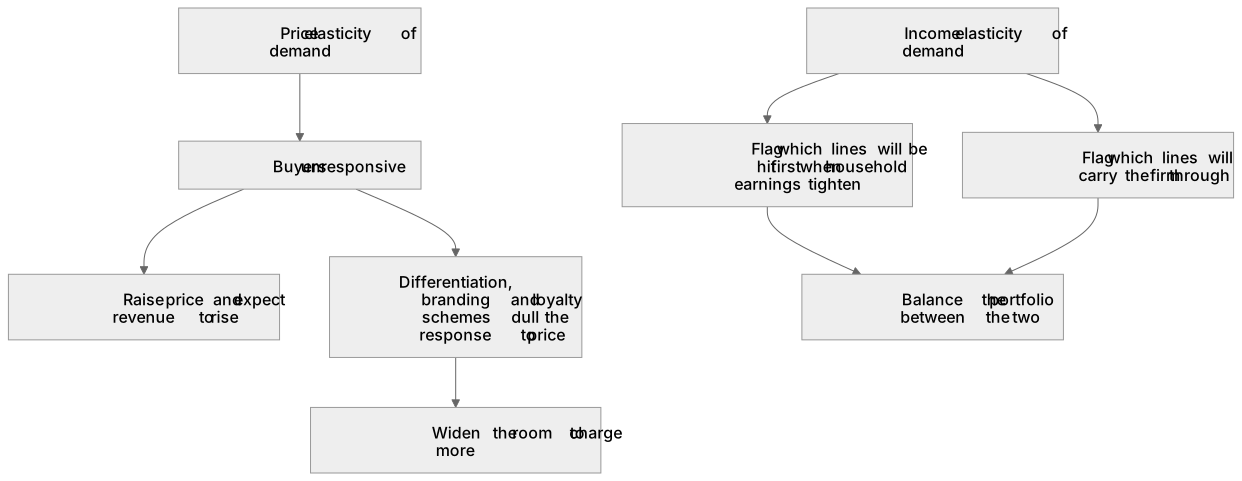
The worth of these two ratios is that they convert a marketing instinct into a forecast a finance director can use. A brand manager who knows buyers are unresponsive can raise price and expect revenue to rise, which is exactly why differentiation, branding and loyalty schemes are worth paying for: each is an attempt to dull the response to price and widen the room to charge more. The income ratio does the planning job instead, flagging which lines will be hit first when household earnings tighten and which will carry the firm through, so a portfolio can be balanced between the two. The limits are where the judgement marks sit. Both numbers come from past behaviour, both assume nothing else moves, and neither says a word about cost, so a price cut that lifts revenue can still cut profit.
What earns the marks
- Using an unresponsive estimate to justify a price rise and showing the consequence for the named firm, in pounds where the case gives the figures.
- Explaining branding, differentiation or a loyalty scheme as a deliberate attempt to make buyers less price sensitive, which ties the marketing mix to the number.
- Applying the income measure to the product portfolio, naming the line that is exposed in a downturn and saying what the firm should do about it.
- Qualifying any recommendation built on these figures by noting that they are estimates from past data and that rivals will respond to whatever the firm does.
Common mistakes and how to put them right
Settling a pricing decision on these figures alone and never mentioning costs, so revenue is quietly treated as profit.
Assuming one figure covers the whole customer base, when a business traveller and a family on holiday respond to the same fare very differently.
Claiming a responsive product must always be priced low, ignoring that a premium position can be the whole reason the brand exists.
Exam tips
- This statement is the evaluative half of elasticity, so questions on it open with assess or evaluate and expect a judgement on how much weight the figure can carry.
- A strong answer names one thing that would change the number, such as a new competitor or a longer time period, and says how that changes the advice.
Try the lesson
The start of the Understanding markets and customers: The value of the concepts of price and income elasticity of demand to marketing decision makers lesson, made from teaching notes for this specification point.
Have a go first
Why is price elasticity of demand useful to a marketing decision maker?
Listen
The worth of these two ratios is that they convert a marketing instinct into a forecast a finance director can use. A brand manager who knows buyers are unresponsive can raise price and expect revenue to rise, which is exactly why differentiation, branding and loyalty schemes are worth paying for: each is an attempt to dull the response to price and widen the room to charge more. The income ratio does the planning job instead, flagging which lines will be hit first when household earnings tighten and which will carry the firm through, so a portfolio can be balanced between the two. The limits are where the judgement marks sit. Both numbers come from past behaviour, both assume nothing else moves, and neither says a word about cost, so a price cut that lifts revenue can still cut profit. A strong answer earns marks for these points. Using an unresponsive estimate to justify a price rise and showing the consequence for the named firm, in pounds where the case gives the figures. Explaining branding, differentiation or a loyalty scheme as a deliberate attempt to make buyers less price sensitive, which ties the marketing mix to the number. Applying the income measure to the product portfolio, naming the line that is exposed in a downturn and saying what the firm should do about it. Qualifying any recommendation built on these figures by noting that they are estimates from past data and that rivals will respond to whatever the firm does. Exam tip: This statement is the evaluative half of elasticity, so questions on it open with assess or evaluate and expect a judgement on how much weight the figure can carry.
See it
Key words
Say what each word means before you turn the card.
pricing decisions
Try answering aloud or in your head before turning the card.
branding and price sensitivity
Try answering aloud or in your head before turning the card.
portfolio planning
Try answering aloud or in your head before turning the card.
limits of estimated data
Try answering aloud or in your head before turning the card.
See every definition
- pricing decisions
- A brand manager who knows buyers are unresponsive can raise price and expect revenue to rise, widening the room to charge more.
- branding and price sensitivity
- Differentiation, branding and loyalty schemes are each an attempt to dull the response to price, which is why they are worth paying for.
- portfolio planning
- The income ratio flags which lines will be hit first when household earnings tighten and which will carry the firm through, so a portfolio can be balanced.
- limits of estimated data
- Both numbers come from past behaviour, assume nothing else moves, and neither says a word about cost, so a price cut that lifts revenue can still cut profit.
Label the diagram
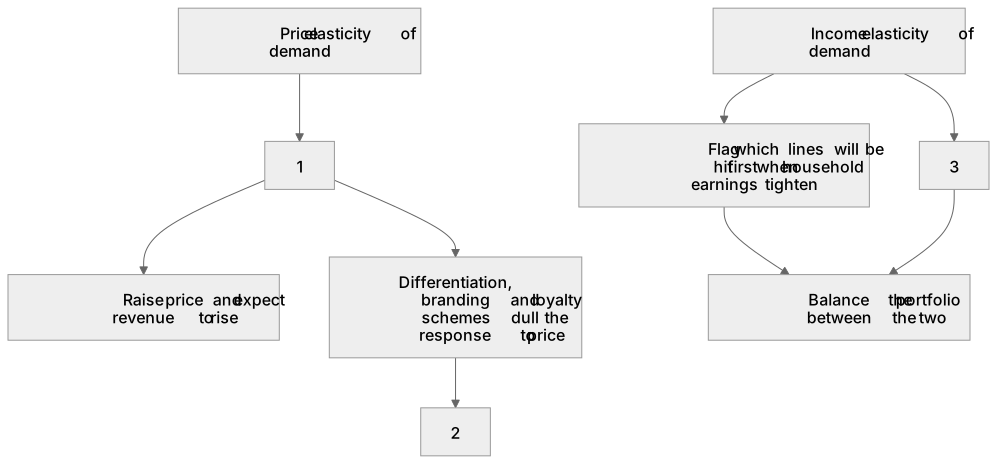
Some boxes have lost their names. Pick the right name for each number.
1Box 1
2Box 2
3Box 3
There is more to this lesson
The full lesson goes on to check your understanding and help you earn the marks. Create a free account to carry on, with your progress saved.
A week of Premium from your first lesson · Then the free plan continues · No card, no charge
Test your understanding of Understanding markets and customers: The value of the concepts of price and income elasticity of demand to marketing decision makers
Active recall beats re-reading. Take an instant quiz now to test what you’ve learned and lock it into long-term memory.
A week of Premium from your first lesson · Then the free plan continues · No card, no charge