AQA · A-Level · Business
Course version: 7132 · Version from Sept 2023
Why businesses exist (to include: Business objectives such as profit,…
Full specification wording
Understanding the nature and purpose of business: Why businesses exist (to include: Business objectives such as profit, growth, survival, cash flow, social and ethical objectives)
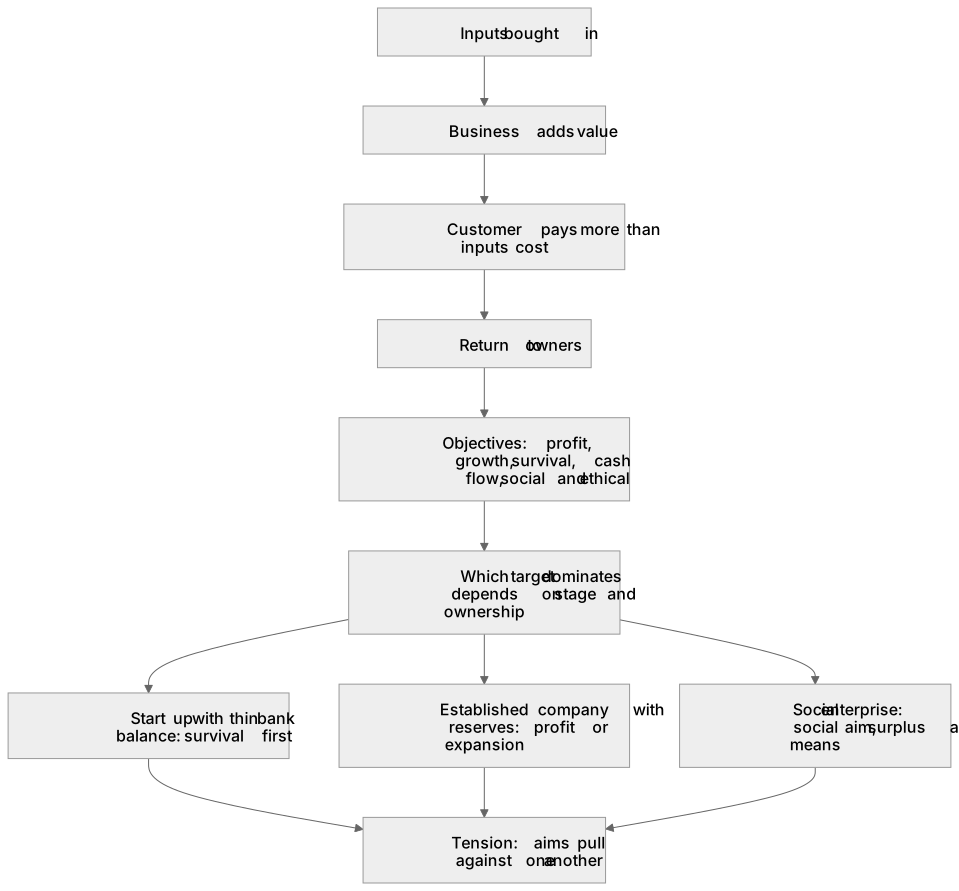
Firms exist to add value, turning inputs into something a customer will pay more for than those inputs cost, and to give a return to whoever owns them.
- Point 1 of 4
- 4 key terms
Study notes
From the teaching notes for this specification point.
The idea
Firms exist to add value, turning inputs into something a customer will pay more for than those inputs cost, and to give a return to whoever owns them. Which target dominates depends on the stage and the ownership. A start up with a thin bank balance puts staying solvent first, because a firm can be profitable on paper and still fail when money leaves before it arrives. An established company with reserves pushes for a higher margin, or for expansion measured in revenue, market share or outlets. A social enterprise sets a social aim and treats any surplus as the means rather than the end. The tension worth arguing is that these pull against one another, since expansion usually swallows cash and ethical commitments raise costs long before they raise sales.
What earns the marks
- Explaining added value as the difference between the price a customer pays and the cost of the bought in inputs, which is the reason the business exists at all.
- Matching the aim to the situation: survival and liquidity for a new or struggling firm, profit and expansion for an established one with reserves.
- Defining profit as total revenue minus total costs, and distinguishing it from cash, which is a matter of timing rather than performance.
- Expressing expansion in a measurable form such as revenue, market share, outlets or employees, rather than the word bigger.
- Recognising that the owners' aims drive the target, so a sole trader may want a comfortable income while a listed company faces pressure for dividends and share price.
- Showing a conflict, for example rapid expansion absorbing cash and raising the risk of overtrading.
Common mistakes and how to put them right
Writing that all firms aim to maximise profit.
Put it right: Many settle for a satisfactory return, and some sacrifice profit to survival, expansion or a social mission.
Treating liquidity and profitability as the same thing, so a business with rising sales is assumed to be safe.
Giving aims with no context, when the marks come from tying them to the size, age and ownership of the business in the stem.
Describing social aims as something only charities hold, ignoring companies with ethical sourcing or emissions targets.
Exam tips
- This appears as a short answer worth a few marks on the first paper and as the opening of a data response, so define in a clause and spend the rest applying.
- If the stem says the firm is new, loss making or short of cash, the expected priority is survival or liquidity, and saying so is a straightforward application mark.
- Where two aims are given, the examiner usually wants the conflict between them, so plan for that rather than describing each in turn.
Try the lesson
The start of the Understanding the nature and purpose of business: Why businesses exist (to include: Business objectives such as profit, growth, survival, cash flow, social and ethical objectives) lesson, made from teaching notes for this specification point.
Have a go first
Which of the following is a financial objective that a business may set?
Listen
Firms exist to add value, turning inputs into something a customer will pay more for than those inputs cost, and to give a return to whoever owns them. Which target dominates depends on the stage and the ownership. A start up with a thin bank balance puts staying solvent first, because a firm can be profitable on paper and still fail when money leaves before it arrives. An established company with reserves pushes for a higher margin, or for expansion measured in revenue, market share or outlets. A social enterprise sets a social aim and treats any surplus as the means rather than the end. The tension worth arguing is that these pull against one another, since expansion usually swallows cash and ethical commitments raise costs long before they raise sales. A strong answer earns marks for these points. Explaining added value as the difference between the price a customer pays and the cost of the bought in inputs, which is the reason the business exists at all. Matching the aim to the situation: survival and liquidity for a new or struggling firm, profit and expansion for an established one with reserves. Defining profit as total revenue minus total costs, and distinguishing it from cash, which is a matter of timing rather than performance. Expressing expansion in a measurable form such as revenue, market share, outlets or employees, rather than the word bigger. Exam tip: This appears as a short answer worth a few marks on the first paper and as the opening of a data response, so define in a clause and spend the rest applying.
See it
Key words
Say what each word means before you turn the card.
Adding value
Try answering aloud or in your head before turning the card.
Profit
Try answering aloud or in your head before turning the card.
Survival
Try answering aloud or in your head before turning the card.
Social and ethical objectives
Try answering aloud or in your head before turning the card.
See every definition
- Adding value
- The difference between the price a customer pays and the cost of the bought in inputs, which is the reason the business exists at all.
- Profit
- Total revenue minus total costs, which is distinguished from cash, a matter of timing rather than performance.
- Survival
- Staying solvent, the aim that comes first for a start up with a thin bank balance, because a firm can be profitable on paper and still fail when money leaves before it arrives.
- Social and ethical objectives
- A social aim, as set by a social enterprise, which treats any surplus as the means rather than the end.
Label the diagram
Some boxes have lost their names. Pick the right name for each number.
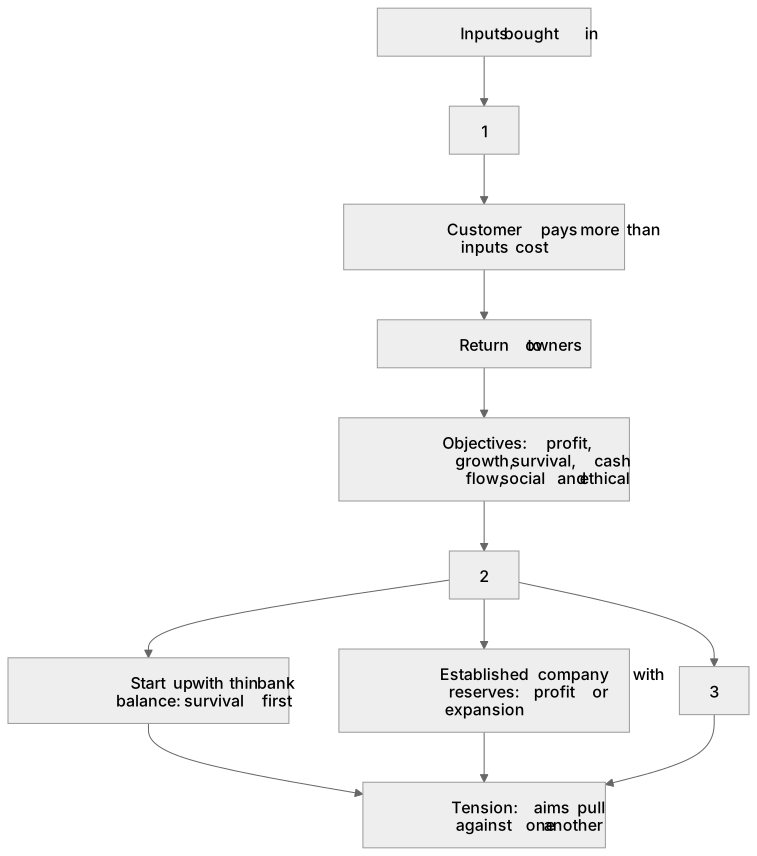
1Box 1
2Box 2
3Box 3
There is more to this lesson
The full lesson goes on to check your understanding and help you earn the marks. Create a free account to carry on, with your progress saved.
A week of Premium from your first lesson · Then the free plan continues · No card, no charge
Test your understanding of Understanding the nature and purpose of business: Why businesses exist (to include: Business objectives such as profit, growth, survival, cash flow, social and ethical objectives)
Active recall beats re-reading. Take an instant quiz now to test what you’ve learned and lock it into long-term memory.
A week of Premium from your first lesson · Then the free plan continues · No card, no charge