AQA · A-Level · Business
Course version: 7132 · Version from Sept 2023
The relationship between mission and objectives
Full specification wording
Understanding the nature and purpose of business: The relationship between mission and objectives
A mission states what the business is for, written in words rather than numbers and with no deadline attached; the targets beneath it are what turn that purpose into something a manager can be…
- Point 2 of 4
- 4 key terms
Study notes
From the teaching notes for this specification point.
The idea
A mission states what the business is for, written in words rather than numbers and with no deadline attached; the targets beneath it are what turn that purpose into something a manager can be held to. The link runs downwards, from purpose to corporate targets such as a profit margin or a share of the market, then to functional targets in marketing, operations, finance and human resources, and finally to day to day tactics. Done well this gives consistent direction and a reason for staff to care, a source of motivation that pay alone does not supply. Done badly it is a poster in reception, because a purpose that nothing measures changes no decision, and a target that contradicts the stated purpose, such as cutting costs by offshoring while claiming local sourcing, costs the firm credibility with customers and staff alike.
What earns the marks
- Defining mission as the qualitative purpose of the business and separating it from the quantified, time bound targets derived from it.
- Setting out the hierarchy from mission to corporate level to functional level, with a concrete example at each level for the business in the stem.
- Explaining the benefits of a clear purpose: consistent decisions, a basis for choosing between options, and motivation through a sense of direction.
- Recognising that a mission only bites when something measures it, so the test is whether the targets reflect the stated purpose.
- Identifying a contradiction between the stated purpose and what the firm actually measures, and explaining the effect on customer trust and staff engagement.
- Judging usefulness in context, since a small owner managed firm can run on an unwritten purpose while a large company needs it in writing to align thousands of decisions.
Common mistakes and how to put them right
Confusing a mission with a target and then criticising it for having no numbers, when being qualitative is the whole point.
Quoting a mission statement without saying what target it should produce, which leaves the answer as pure description.
Claiming a mission statement motivates everybody.
Put it right: Staff on low pay and insecure hours are unlikely to be moved by wording on a website.
Writing the hierarchy upside down, with functional targets producing the mission.
Exam tips
- The link between the levels is where the marks are, so every paragraph should move between levels rather than describe one of them in isolation.
- If the case study prints a mission statement, use its exact wording as the standard against which you judge the firm's decisions.
- Short answer questions here often ask for an explanation with an example, so give one concrete target for the named business each time.
Try the lesson
The start of the Understanding the nature and purpose of business: The relationship between mission and objectives lesson, made from teaching notes for this specification point.
Have a go first
What is the main purpose of a business mission statement?
Listen
A mission states what the business is for, written in words rather than numbers and with no deadline attached; the targets beneath it are what turn that purpose into something a manager can be held to. The link runs downwards, from purpose to corporate targets such as a profit margin or a share of the market, then to functional targets in marketing, operations, finance and human resources, and finally to day to day tactics. Done well this gives consistent direction and a reason for staff to care, a source of motivation that pay alone does not supply. Done badly it is a poster in reception, because a purpose that nothing measures changes no decision, and a target that contradicts the stated purpose, such as cutting costs by offshoring while claiming local sourcing, costs the firm credibility with customers and staff alike. A strong answer earns marks for these points. Defining mission as the qualitative purpose of the business and separating it from the quantified, time bound targets derived from it. Setting out the hierarchy from mission to corporate level to functional level, with a concrete example at each level for the business in the stem. Explaining the benefits of a clear purpose: consistent decisions, a basis for choosing between options, and motivation through a sense of direction. Recognising that a mission only bites when something measures it, so the test is whether the targets reflect the stated purpose. Exam tip: The link between the levels is where the marks are, so every paragraph should move between levels rather than describe one of them in isolation.
See it
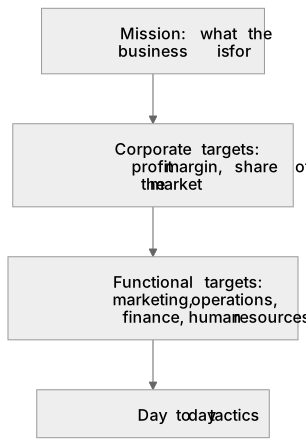
Put it in order
Put these steps in the order they happen.
- 1. Functional targets: marketing, operations, finance, human resources
- 2. Day to day tactics
- 3. Corporate targets: profit margin, share of the market
- 4. Mission: what the business is for
Key words
Say what each word means before you turn the card.
Purpose against measurable targets
Try answering aloud or in your head before turning the card.
The hierarchy of aims
Try answering aloud or in your head before turning the card.
Alignment and consistency
Try answering aloud or in your head before turning the card.
Motivation through purpose
Try answering aloud or in your head before turning the card.
See every definition
- Purpose against measurable targets
- A mission states what the business is for in words rather than numbers, while the targets beneath it turn that purpose into something a manager can be held to.
- The hierarchy of aims
- The link runs downwards from purpose to corporate targets, then to functional targets in marketing, operations, finance and human resources, and finally to day to day tactics.
- Alignment and consistency
- Done well this gives consistent direction and a basis for choosing between options, so the targets reflect the stated purpose.
- Motivation through purpose
- A clear purpose gives staff a reason to care, a source of motivation that pay alone does not supply.
Label the diagram
Some boxes have lost their names. Pick the right name for each number.
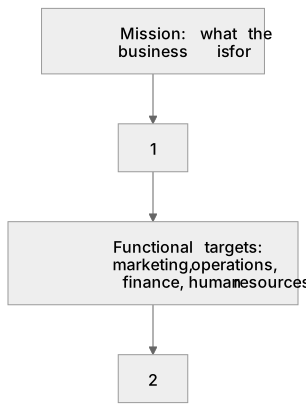
1Box 1
2Box 2
There is more to this lesson
The full lesson goes on to check your understanding and help you earn the marks. Create a free account to carry on, with your progress saved.
A week of Premium from your first lesson · Then the free plan continues · No card, no charge
Test your understanding of Understanding the nature and purpose of business: The relationship between mission and objectives
Active recall beats re-reading. Take an instant quiz now to test what you’ve learned and lock it into long-term memory.
A week of Premium from your first lesson · Then the free plan continues · No card, no charge