AQA · GCSE · Business
Course version: 8132 · Version from Sept 2017
Business location
Business location is one of the most critical, long-term strategic decisions an entrepreneur must make. A poor location choice can fatally undermine an otherwise excellent business model through high costs or lack of footfall.
- Point 2 of 2
- 4 min read
- 3 worked examples
- 5 practice questions
- 3 key terms
Study Notes
Overview
 Open full-size image (opens in a new tab)
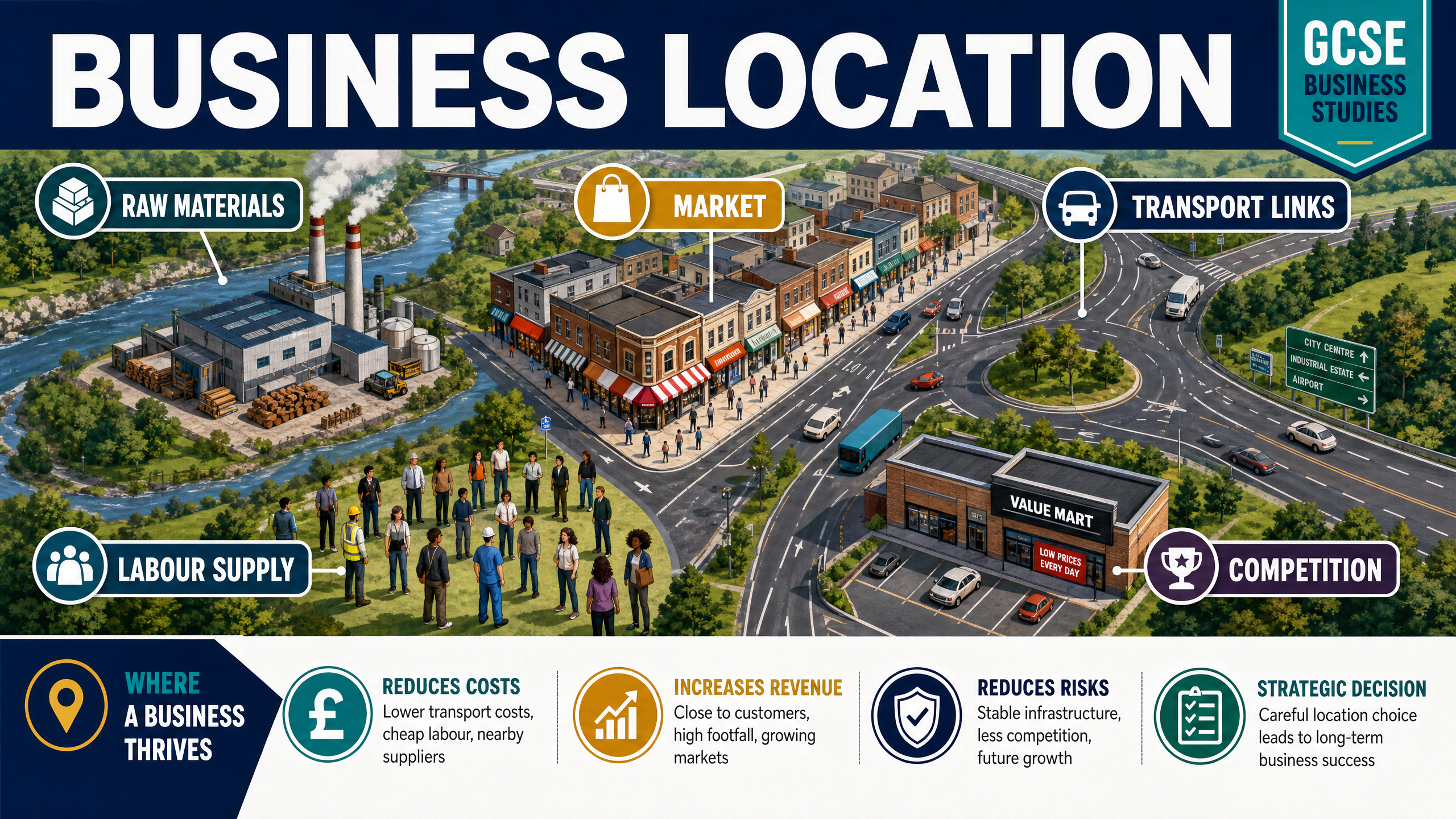
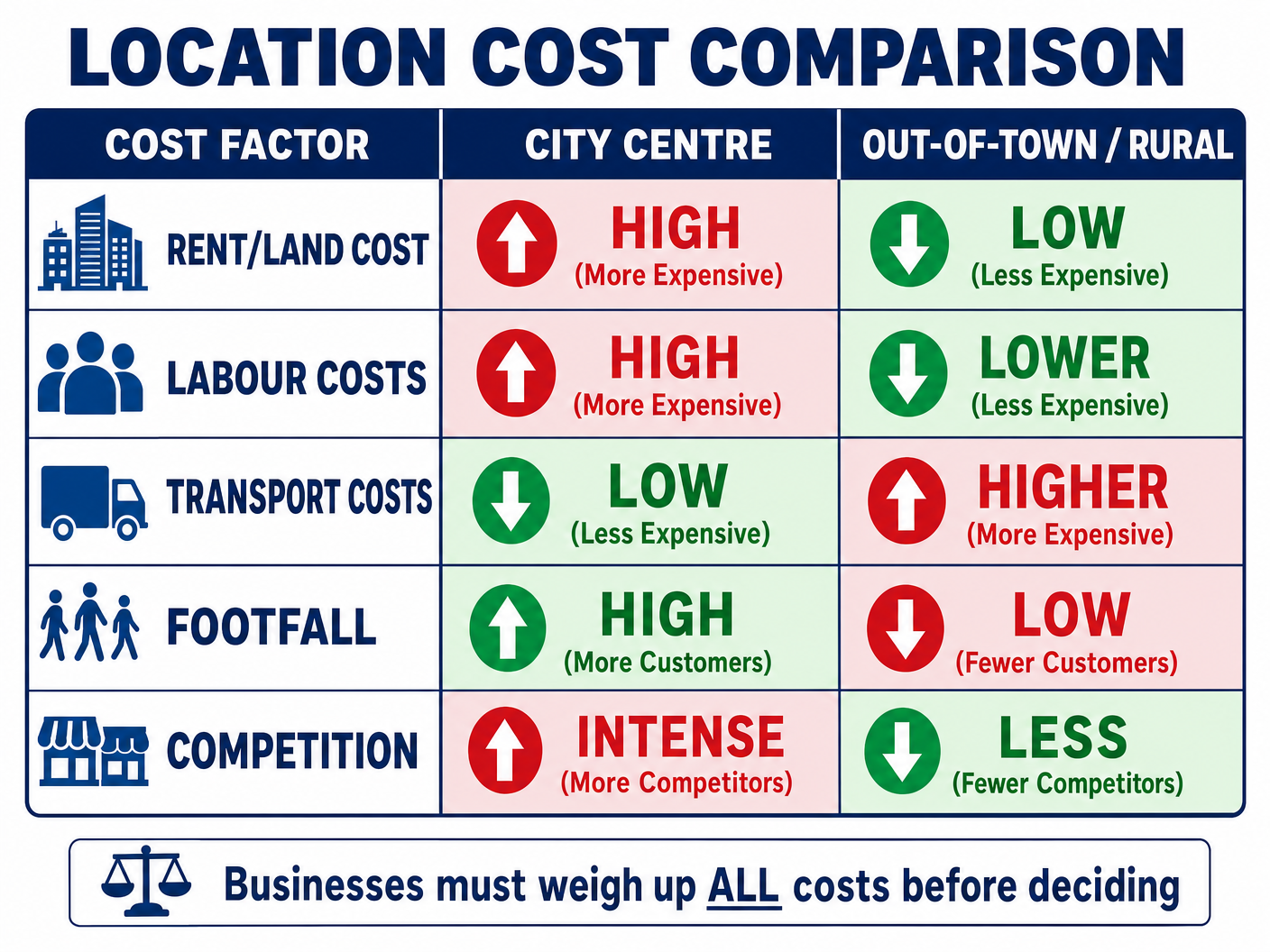
Location is a fundamental business decision that requires a careful balancing act between competing priorities. For examiners, the key concept is trade-off: no location is perfect, and businesses must compromise to find the most suitable site. A city centre offers high footfall but exorbitant rent; a rural industrial estate offers cheap land but poor access to customers.
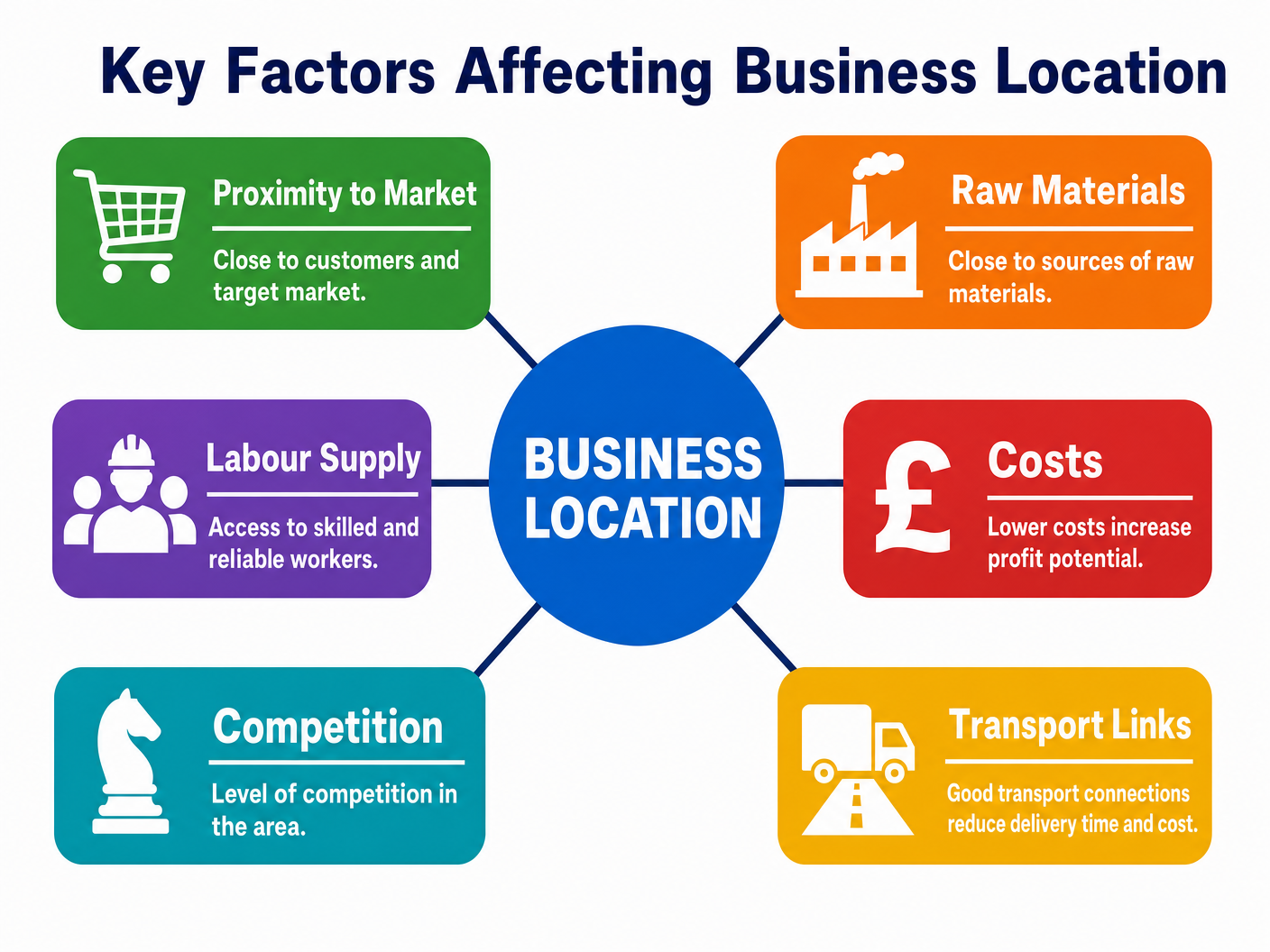
This topic requires candidates to understand the five key factors influencing location decisions: proximity to market, availability of raw materials, availability of labour, proximity to competition, and costs. Crucially, examiners reward candidates who can apply these factors to specific business contexts rather than writing generic lists.
Key Location Factors
 Open full-size image (opens in a new tab)
Proximity to Market
What it means: How close the business is to its target customers.
Why it matters: For retail and service businesses (like cafes or hairdressers), being close to the market is essential. High footfall (passing trade) drives revenue. For manufacturers, proximity to the market reduces transport and distribution costs, which lowers the cost of sales and increases profit margins.
Specific Knowledge: E-commerce businesses are less reliant on proximity to the end customer, but highly reliant on proximity to distribution networks (e.g., motorways).
Availability of Raw Materials
What it means: Being located near the source of necessary inputs.
Why it matters: If raw materials are bulky, heavy, or perishable, transporting them long distances is expensive and risky. Food processing plants often locate near farms, while steelworks historically located near coal and iron ore deposits.
Availability of Labour
What it means: Having access to a workforce with the right skills in the right quantities.
Why it matters: Businesses need workers. Technology firms often cluster near universities (e.g., Cambridge Science Park) to access highly skilled graduates. Conversely, a distribution warehouse might locate in an area with high unemployment to access a large pool of unskilled labour at lower wage rates.
Proximity to Competition
What it means: How close the business is to rival firms.
Why it matters: Sometimes businesses avoid competitors to capture a local monopoly (e.g., the only village shop). However, many businesses actively choose to cluster together (agglomeration) — such as car dealerships or restaurants. This clustering attracts more customers to the area overall, as consumers value choice and comparison.
Costs of Location
 Open full-size image (opens in a new tab)
What it means: The financial implications of the chosen site.
Why it matters: This is often the deciding factor. Prime locations command high rent/leasing costs. Businesses must evaluate whether the increased revenue from a prime location outweighs the higher fixed costs. Additionally, government incentives (like Enterprise Zones) can significantly reduce location costs in certain regions.
Revision Podcast
Listen to our comprehensive 10-minute revision podcast covering all these concepts with examiner tips:
Quantitative Skills
Candidates may be asked to calculate and compare the total costs of two different locations. Always remember: Total Cost = Fixed Costs (Rent) + Variable Costs (Transport, Wages).
Try the lesson
The start of the Business location lesson, made from teaching notes for this specification point.
Have a go first
A bakery wants to open a new shop where customers can buy fresh bread each morning. Which factor would most directly influence the bakery to choose a location close to its customers?
Listen
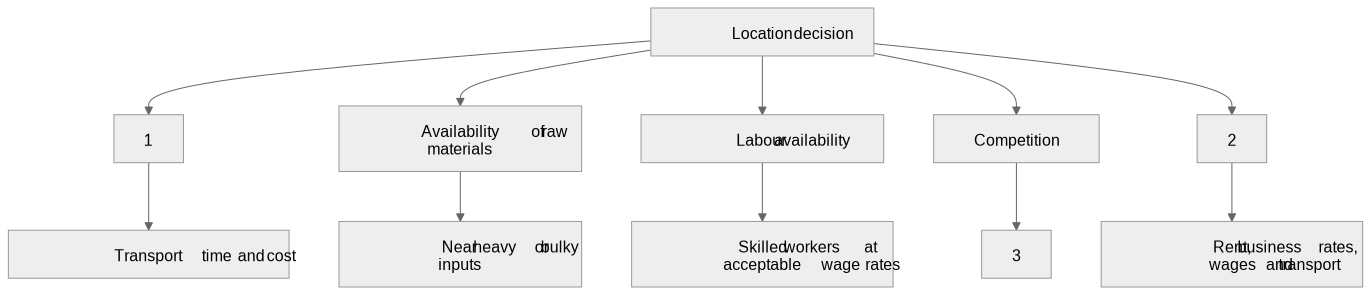
Location decisions affect costs, revenue and competitiveness. Proximity to the market reduces transport time and cost, important for perishable goods or bulky items; for example, a bakery near customers lowers delivery costs. Availability of raw materials matters for manufacturers: a quarry must be near suitable rock. Labour availability means recruiting suitably skilled workers at acceptable wage rates; a software firm may locate near a university. Competition influences location: too many rivals can reduce market share, but clustering can attract customers. Costs include rent, business rates, wages and transport; a low-cost location may be rural, but may increase delivery times. Businesses weigh these factors against each other, and the importance of each factor varies by industry and scale. A strong answer earns marks for these points. Proximity to the market reduces transport costs and delivery times, which is especially important for perishable or bulky products. Availability of raw materials is a key factor for businesses whose production depends on heavy or bulky inputs, such as quarries or food processors. Labour availability includes the supply of workers with the right skills and the local wage rates the business must pay. Competition affects location because a business may avoid areas with many rivals to reduce direct competition, or choose to locate near competitors to benefit from customer footfall. A common slip: Treating all factors as equally important for every business. Instead, explain that a bakery prioritises proximity to market while a quarry prioritises raw materials. Exam tip: Use specific business examples to illustrate each factor, such as a bakery locating near a town centre or a quarry locating near its raw material.
See it

Key words
Say what each word means before you turn the card.
Proximity to the market
Try answering aloud or in your head before turning the card.
Labour availability
Try answering aloud or in your head before turning the card.
Competition
Try answering aloud or in your head before turning the card.
See every definition
- Proximity to the market
- Being near customers, which reduces transport time and cost and is important for perishable goods or bulky items.
- Labour availability
- The supply of workers with the right skills and the local wage rates the business must pay.
- Competition
- A factor that affects location because a business may avoid areas with many rivals to reduce direct competition, or locate near competitors to benefit from customer footfall.
Label the diagram
Some boxes have lost their names. Pick the right name for each number.
1Box 1
2Box 2
3Box 3
There is more to this lesson
The full lesson goes on to check your understanding and help you earn the marks. Create a free account to carry on, with your progress saved.
A week of Premium from your first lesson · Then the free plan continues · No card, no charge
Worked Examples
3 worked examples — open one to explore the question and available guidance.
Practice Questions
Try the question, then reveal an answer plan or example response
State two factors a web-design agency would consider when choosing a location. (2 marks)
Hint: Think about what a digital service business needs most.
Explain how the availability of raw materials influences the location of a manufacturing business. (3 marks)
Hint: Focus on the weight/bulk of materials and the cost of moving them.
A fast-food franchise is looking for a new location. It is considering either a busy high street or a quiet residential area. Recommend which location the franchise should choose. (9 marks)
Hint: Compare footfall against rent costs, and consider the nature of fast food.
Explain why a car dealership might choose to locate next to several other competing car dealerships. (3 marks)
Hint: Think about customer behaviour when buying expensive items.
Analyse two reasons why an e-commerce clothing retailer might choose to locate its main distribution warehouse in the Midlands rather than in London. (6 marks)
Hint: Consider land costs and geographical distribution networks.
Ready to test yourself interactively?
Active recall beats reading alone. Answer questions on Business location with instant AI scoring and mark scheme guidance.
A week of Premium from your first lesson · Then the free plan continues · No card, no charge
Exam technique
How to turn what you know into marks
How to approach the question
Always highlight the TYPE of business in the question before answering.
How to structure your answer
- Explain questions
- Point (Factor) -> Evidence (Context of the specific business) -> Explanation (Business impact like costs/revenue).
- Evaluate questions
- Advantage -> Disadvantage -> Conclusion weighing up which factor is most significant for THAT specific business.
Timing
Approximately 1 minute per mark.
Common pitfalls
- Writing generic answers that don't apply to the specific business mentioned in the case study.
- Stating a location is 'good' without explaining how it impacts costs, revenue, or profit.
- Assuming businesses always want to be far away from competitors.
What the command words want
- Analyse
- Look at impacts/consequences. Often requires looking at both sides.
- Explain
- Requires a linked chain of reasoning. Use 'therefore' or 'this leads to'.
- State/Identify
- One word or short phrase. No explanation needed.
- Evaluate/Recommend
- Must include a justified conclusion that directly answers the question based on the preceding arguments.
Watch or listen (optional)
Test your understanding of Business location
Active recall beats re-reading. Take an instant quiz now to test what you’ve learned and lock it into long-term memory.
A week of Premium from your first lesson · Then the free plan continues · No card, no charge