AQA · GCSE · Business
Course version: 8132 · Version from Sept 2017
Business planning
Business planning is the foundation of commercial success, turning abstract ideas into actionable roadmaps. This guide breaks down how businesses set objectives, secure finance, and manage their costs and revenues to ensure survival and growth.
- Point 8 of 9
- 4 min read
- 3 worked examples
- 5 practice questions
- 4 key terms
Study Notes
Overview
Business planning is a critical process for both new start-ups and established enterprises. At its core, a business plan is a formal document that outlines a firm's objectives and details the strategies required to achieve them. For candidates studying GCSE Business, understanding why businesses plan is just as important as knowing what goes into the plan itself. Examiners consistently award marks for explaining how planning reduces risk, secures external finance, and provides a clear direction for the organisation. Furthermore, the financial aspects of planning—specifically calculating costs, revenue, and profit—are heavily tested. This study guide will walk you through the essential components of business planning and equip you with the knowledge to tackle both calculation and extended-writing questions confidently.
The Purpose of Business Planning
Setting Up a New Business
What it means: When an entrepreneur launches a start-up, they must consider every aspect of the venture before committing capital.
Why it matters: A plan forces the owner to think logically, identify potential pitfalls early, and ultimately reduce risk. Examiners reward candidates who link planning directly to risk reduction.
Raising Finance
What it means: Presenting the plan to potential investors (like venture capitalists) or lenders (like banks).
Why it matters: External stakeholders will not risk their money without evidence that the business is viable. The plan demonstrates that the entrepreneur has researched the market and understands the financial requirements, giving lenders confidence that loans will be repaid.
Setting Objectives
What it means: Establishing clear, measurable goals for the business to achieve over a specific period.
Why it matters: Objectives provide a sense of direction. They motivate staff and allow managers to measure actual performance against the original plan, making it easier to identify when corrective action is needed.
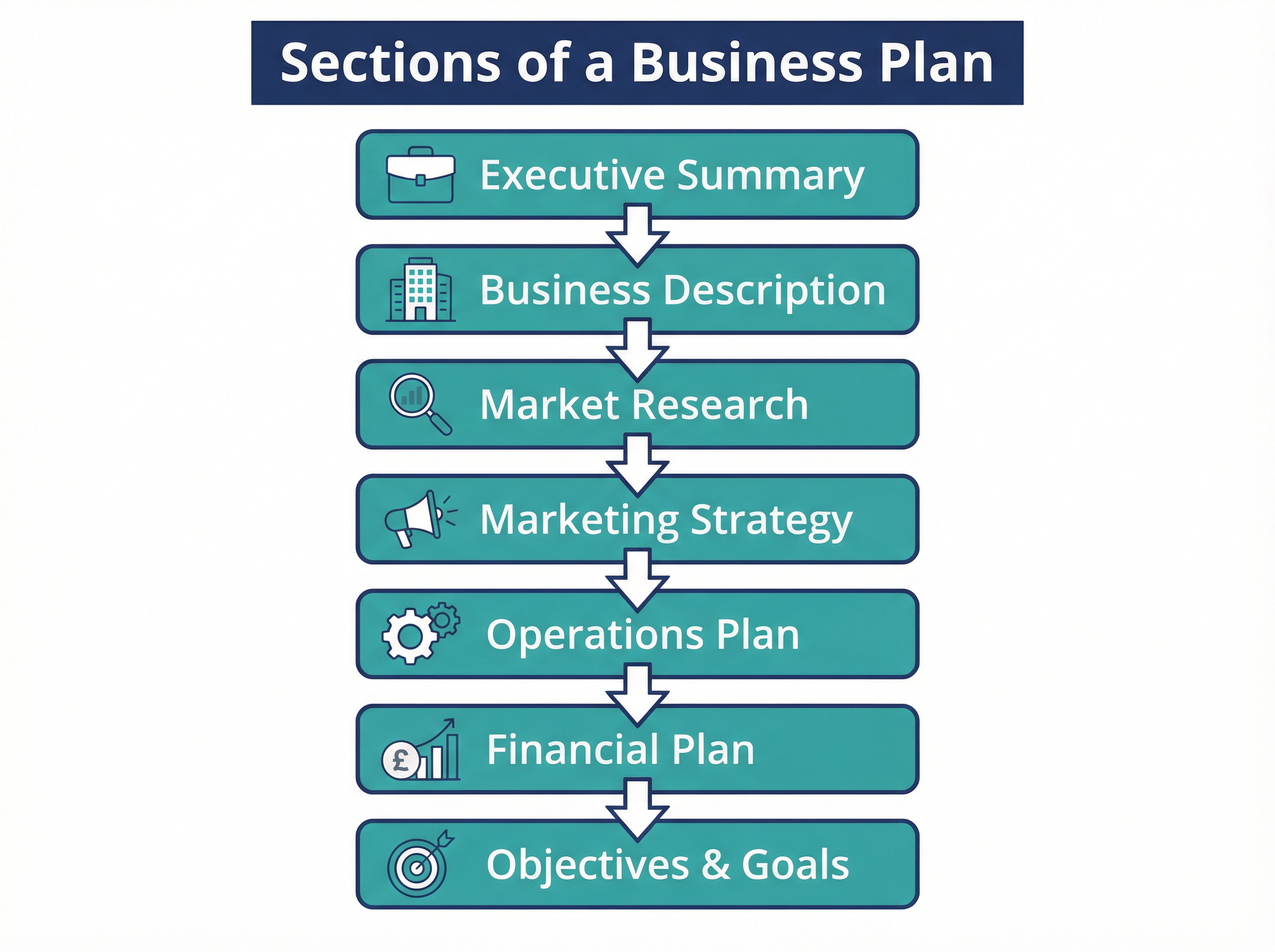
Key Sections of a Business Plan
 Open full-size image (opens in a new tab)
While candidates are not required to write a full business plan in the exam, you must be able to identify its main sections:
- Executive Summary: A brief overview of the entire plan, often written last but placed first.
- Business Description: Details about the product or service, the legal structure (e.g., sole trader, private limited company), and the target market.
- Market Research: Evidence of customer demand, competitor analysis, and market trends.
- Marketing Strategy: How the business intends to sell its product, typically covering the 4 Ps (Product, Price, Place, Promotion).
- Operations Plan: The day-to-day running of the business, including production methods, suppliers, and location.
- Financial Plan: Cash flow forecasts, projected costs, revenue, and profit. This is the section most scrutinised by investors.
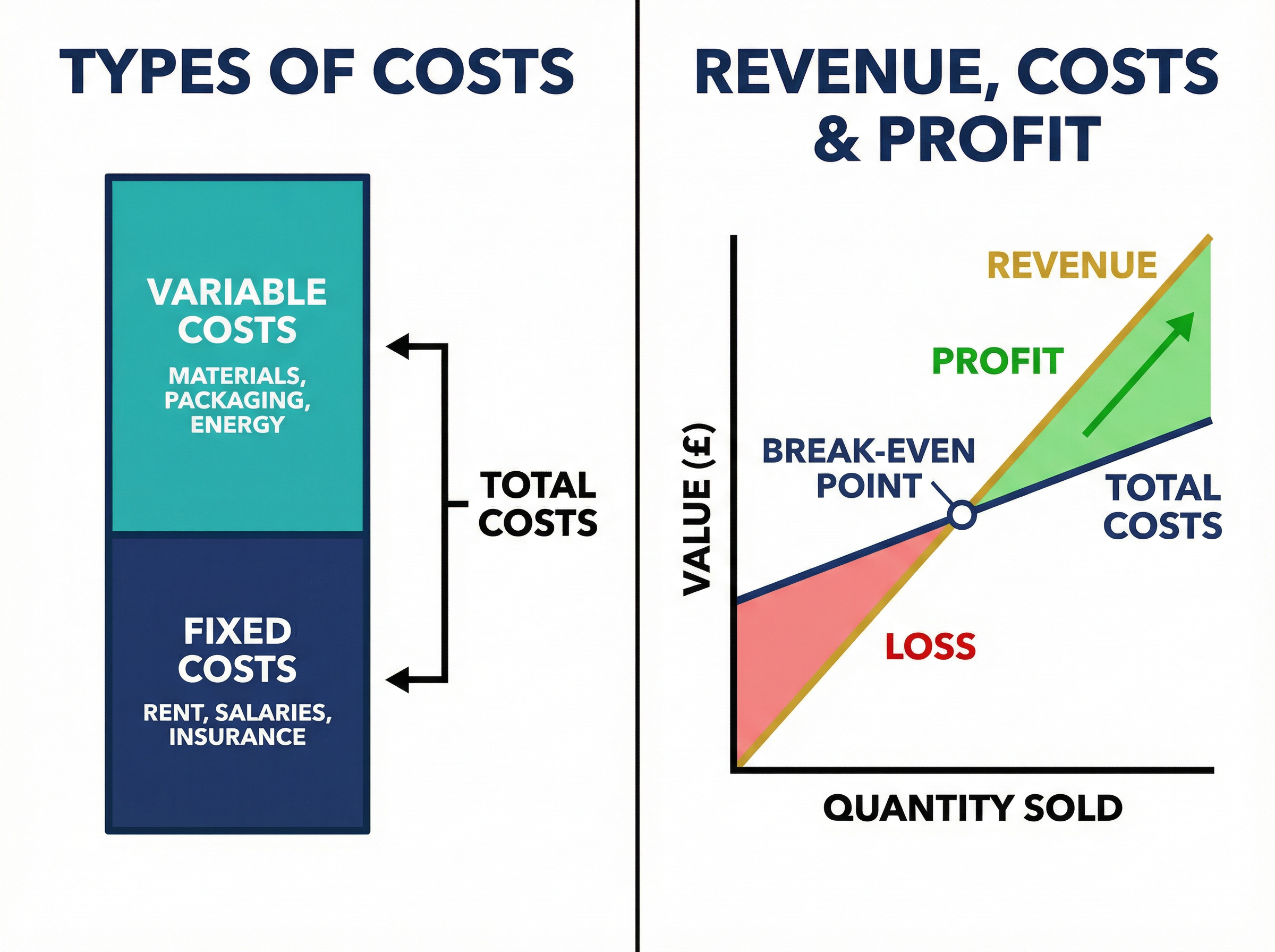
Financial Concepts: Costs, Revenue, and Profit
 Open full-size image (opens in a new tab)
Examiners frequently test your ability to distinguish between different types of costs and to perform basic financial calculations.
Fixed Costs
Costs that do not change with the level of output in the short term. They must be paid even if the business produces nothing.
Examples: Rent, insurance, salaried staff, loan repayments.
Variable Costs
Costs that change directly with the level of output. The more you produce, the higher these costs become.
Examples: Raw materials, packaging, piece-rate labour, energy used in production.
Total Costs
The sum of all costs incurred by the business.
Formula: Total Costs = Fixed Costs + Variable Costs
Revenue
The total income generated from the sale of goods or services.
Formula: Revenue = Price × Quantity Sold
Profit (or Loss)
The financial surplus remaining after all costs have been deducted from revenue. If costs exceed revenue, the business makes a loss.
Formula: Profit = Revenue - Total Costs
Crucial Distinction: Profit is an accounting concept, whereas cash is the actual physical money available to the business. A business can be profitable on paper but still fail due to poor cash flow (e.g., if customers delay paying their invoices).
Try the lesson
The start of the Business planning lesson, made from teaching notes for this specification point.
Have a go first
A bakery pays £800 per month in rent, which does not change with the number of loaves baked. What type of cost is this rent?
Listen
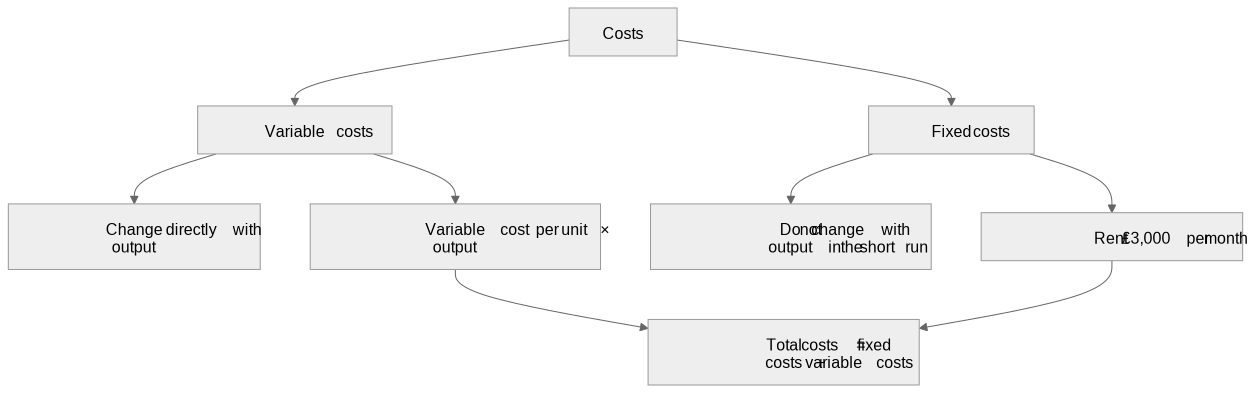
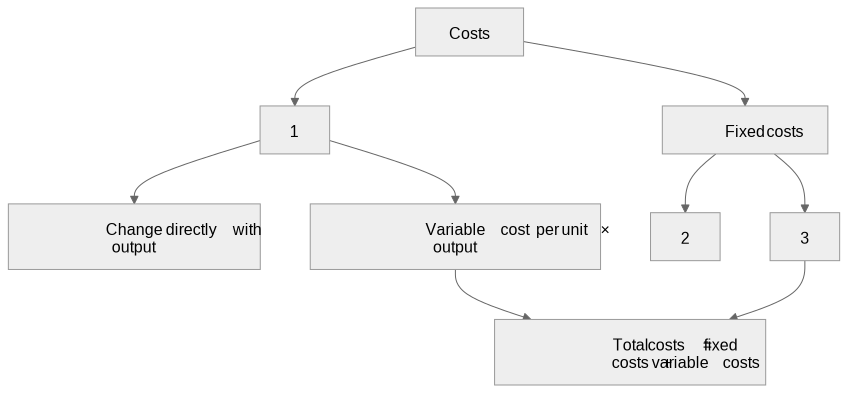
Costs are the payments a business makes to produce and sell its output. Variable costs change directly with output: each extra unit made adds more cost, for example raw materials at £4 per unit, so 500 units cost £2,000 and 600 units cost £2,400. Fixed costs do not change with output in the short run, such as rent of £3,000 per month, which stays the same whether output is 500 or 600 units. Total costs combine both: total costs = fixed costs + variable costs. At 500 units, total costs are £3,000 + £2,000 = £5,000; at 600 units they are £3,000 + £2,400 = £5,400. The difference between the three lies in how they respond to changes in output, so a student should classify each cost correctly, calculate variable costs as variable cost per unit × output, then add fixed costs to find total costs. A strong answer earns marks for these points. Defines variable costs as costs that vary directly with the level of output, giving a relevant example such as raw materials or packaging. Defines fixed costs as costs that do not change with output in the short run, giving a relevant example such as rent, insurance or salaried staff. States and applies the relationship total costs = fixed costs + variable costs. Calculates variable costs by multiplying variable cost per unit by the number of units produced. A common slip: Treating all costs as variable: the error is assuming every cost rises with output. Instead, recognise that fixed costs such as rent stay constant in the short run. Exam tip: Read the data in the case carefully and label each cost as fixed or variable before doing any arithmetic.
See it
Key words
Say what each word means before you turn the card.
Variable costs
Try answering aloud or in your head before turning the card.
Fixed costs
Try answering aloud or in your head before turning the card.
Total costs
Try answering aloud or in your head before turning the card.
Cost classification
Try answering aloud or in your head before turning the card.
See every definition
- Variable costs
- Costs that change directly with output, so each extra unit made adds more cost.
- Fixed costs
- Costs that do not change with output in the short run.
- Total costs
- Fixed costs plus variable costs combined.
- Cost classification
- Deciding whether each cost is variable or fixed by how it responds to changes in output.
Label the diagram
Some boxes have lost their names. Pick the right name for each number.
1Box 1
2Box 2
3Box 3
There is more to this lesson
The full lesson goes on to check your understanding and help you earn the marks. Create a free account to carry on, with your progress saved.
A week of Premium from your first lesson · Then the free plan continues · No card, no charge
Worked Examples
3 worked examples — open one to explore the question and available guidance.
Practice Questions
Try the question, then reveal an answer plan or example response
State two sections that are typically included in a business plan. (2 marks)
Hint: Think about what an investor would want to know about the market and the finances.
Explain one way a business plan can help an entrepreneur reduce the risk of starting a new business. (3 marks)
Hint: Focus on how planning forces the entrepreneur to look ahead and spot problems.
A café sells 200 coffees a day at £3.00 each. The variable cost per coffee is £0.50. The café's daily fixed costs are £150. Calculate the café's daily profit. (4 marks)
Hint: Calculate revenue first, then total variable costs, then total costs, then profit.
Explain the difference between fixed costs and variable costs. (3 marks)
Hint: Define both terms clearly and relate them to the level of output.
Evaluate the usefulness of a business plan to a newly established local bakery. (9 marks)
Hint: Discuss why the bakery needs a plan (e.g., bank loan for ovens), why it might be a waste of time, and conclude with a judgement.
Ready to test yourself interactively?
Active recall beats reading alone. Answer questions on Business planning with instant AI scoring and mark scheme guidance.
A week of Premium from your first lesson · Then the free plan continues · No card, no charge
Exam technique
How to turn what you know into marks
How to approach the question
Always identify the command word first. 'State' means a simple fact (1 mark). 'Explain' requires a point and a linked consequence (3 marks). 'Assess' or 'Evaluate' requires a balanced argument and a final judgement (9-12 marks).
How to structure your answer
- Essay questions
- One paragraph for benefits, one paragraph for drawbacks, and a final paragraph for your overall judgement.
- Explain questions
- Use the BLT structure: Because, Leading to, Therefore. Make your point, explain why it happens, and state the impact on the business.
- Calculation questions
- Always write the formula first, then substitute the numbers, then state the final answer with the correct units (e.g., £ sign).
Timing
Approximately 1 minute per mark. For a 9-mark question, spend 1-2 minutes planning and 7-8 minutes writing.
Common pitfalls
- Confusing fixed and variable costs (e.g., stating that salaries are variable).
- Confusing profit with cash flow.
- Writing a long list of points in an 'explain' question instead of developing one or two points in depth.
What the command words want
- Explain
- Make a point and develop it showing cause and effect. Use connective words like 'which means that' or 'therefore'.
- Calculate
- Show all working out. Ensure units are correct.
- State / Identify
- Provide a simple, concise answer. No explanation needed.
- Assess / Evaluate
- Provide a balanced argument (pros and cons) in context, followed by a supported conclusion.
Watch or listen (optional)
Test your understanding of Business planning
Active recall beats re-reading. Take an instant quiz now to test what you’ve learned and lock it into long-term memory.
A week of Premium from your first lesson · Then the free plan continues · No card, no charge