AQA · GCSE · Business
Course version: 8132 · Version from Sept 2017
The purpose of human resources, its role within business and how it…
Full specification wording
Human resources: The purpose of human resources, its role within business and how it influences business activity.
Human resources (HR) is the function that manages the people a business employs.
- Point 2 of 2
Study notes
From the teaching notes for this specification point.
The idea
Human resources (HR) is the function that manages the people a business employs. Its purpose is to ensure the business has the right number of suitably skilled, motivated and legally compliant staff to meet its objectives. HR's role includes recruitment and selection, training and development, managing pay and contracts, handling discipline and grievances, and looking after staff welfare and legal duties such as health and safety and equality. HR influences business activity because staffing decisions shape costs, productivity, quality and customer service. For example, a manufacturer that invests in training may raise output per worker, while poor recruitment can increase staff turnover and waste. HR also affects reputation and legal risk, so its decisions feed directly into competitiveness and profitability.
What earns the marks
- Defines HR as the function responsible for managing employees and their relationship with the business.
- Explains the purpose of HR: supplying the right people, with the right skills, at the right time, legally and affordably.
- Identifies HR activities such as recruitment, selection, training, pay, contracts, discipline, welfare and compliance.
- Explains how HR decisions influence business activity, for example through labour costs, productivity, motivation, quality and customer service.
- Uses a business example to show a link between an HR choice and a business outcome such as turnover, output or reputation.
Common mistakes and how to put them right
Treating HR as only hiring and firing.
Put it right: Include training, pay, welfare, discipline and legal compliance.
Assuming HR decisions affect only staff and not business performance.
Put it right: Link HR choices to costs, productivity, quality and reputation.
Confusing HR with the whole workforce.
Put it right: Describe HR as a management function that supports and regulates employees.
Exam tips
- Use the command word to decide depth: describe HR activities for lower-tariff questions and explain influences for higher-tariff ones.
- Anchor each point in a named or realistic business context so the link to business activity is explicit.
- Build chains of reasoning such as training → skill → productivity → lower unit costs → higher profit rather than listing activities.
Try the lesson
The start of the Human resources: The purpose of human resources, its role within business and how it influences business activity. lesson, made from teaching notes for this specification point.
Have a go first
Which task is normally carried out by the human resources function of a business?
Listen
Human resources (HR) is the function that manages the people a business employs. Its purpose is to ensure the business has the right number of suitably skilled, motivated and legally compliant staff to meet its objectives. HR's role includes recruitment and selection, training and development, managing pay and contracts, handling discipline and grievances, and looking after staff welfare and legal duties such as health and safety and equality. HR influences business activity because staffing decisions shape costs, productivity, quality and customer service. For example, a manufacturer that invests in training may raise output per worker, while poor recruitment can increase staff turnover and waste. HR also affects reputation and legal risk, so its decisions feed directly into competitiveness and profitability. A strong answer earns marks for these points. Defines HR as the function responsible for managing employees and their relationship with the business. Explains the purpose of HR: supplying the right people, with the right skills, at the right time, legally and affordably. Identifies HR activities such as recruitment, selection, training, pay, contracts, discipline, welfare and compliance. Explains how HR decisions influence business activity, for example through labour costs, productivity, motivation, quality and customer service. A common slip: Treating HR as only hiring and firing. Instead, include training, pay, welfare, discipline and legal compliance. Exam tip: Use the command word to decide depth: describe HR activities for lower-tariff questions and explain influences for higher-tariff ones.
See it
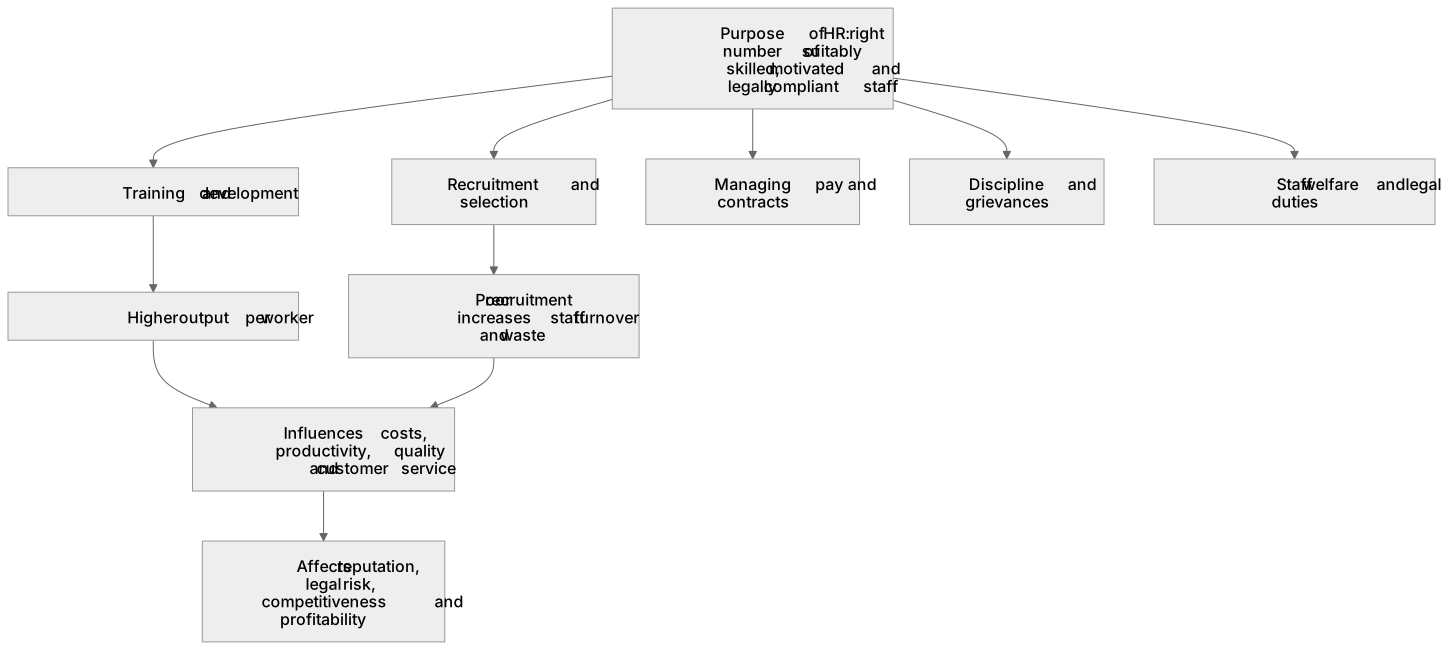
Label the diagram
Some boxes have lost their names. Pick the right name for each number.
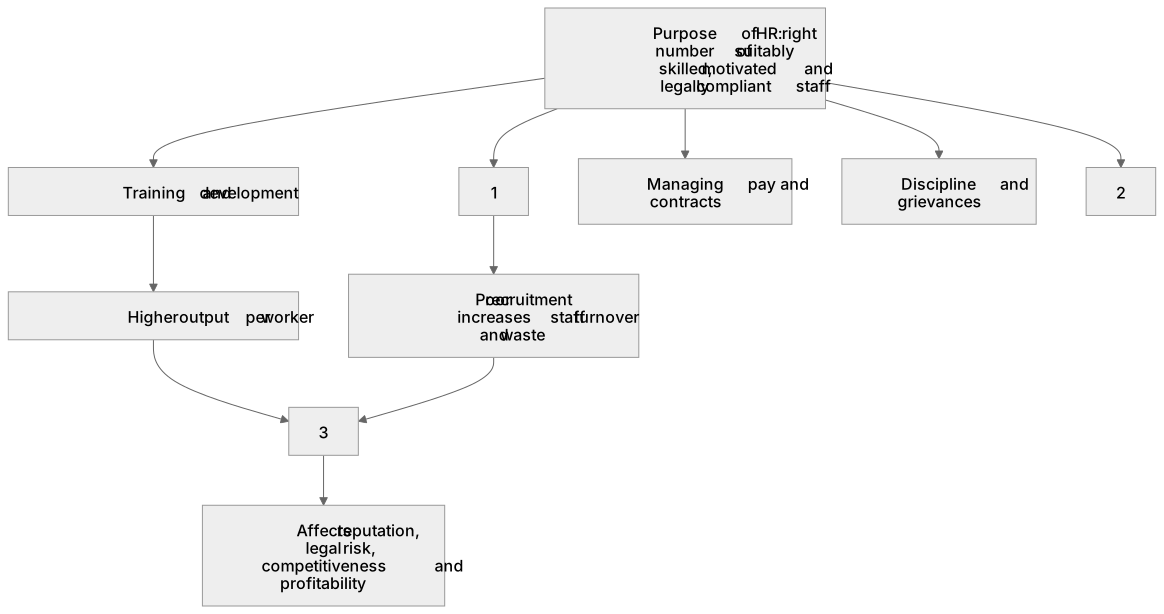
1Box 1
2Box 2
3Box 3
There is more to this lesson
The full lesson goes on to check your understanding and help you earn the marks. Create a free account to carry on, with your progress saved.
A week of Premium from your first lesson · Then the free plan continues · No card, no charge
Test your understanding of Human resources: The purpose of human resources, its role within business and how it influences business activity.
Active recall beats re-reading. Take an instant quiz now to test what you’ve learned and lock it into long-term memory.
A week of Premium from your first lesson · Then the free plan continues · No card, no charge