AQA · GCSE · Business
Course version: 8132 · Version from Sept 2017
Stakeholders
Master the dynamic world of business stakeholders, understanding exactly who influences a business and how a business impacts them. This essential topic is a massive mark-winner in GCSE Business exams when you learn to analyse the inevitable conflicts between different groups.
- Point 2 of 7
- 4 min read
- 3 worked examples
- 5 practice questions
- 2 key terms
Study Notes
Overview
Stakeholders are the beating heart of any business. This topic explores the crucial two-way relationship between a business and the individuals or groups that have an interest in its activities. Examiners frequently test your ability to not only identify these groups but to analyse the complex web of conflicting objectives between them. Candidates who can accurately evaluate which stakeholder is most important in a given context, and how businesses manage these conflicts, consistently access the highest mark bands.
Internal Stakeholders
Internal stakeholders are those who are part of the business itself.
Owners (Shareholders)
Role: The individuals who have invested capital into the business.
Objectives: They seek a return on their investment (profit/dividends), business growth, and long-term financial stability.
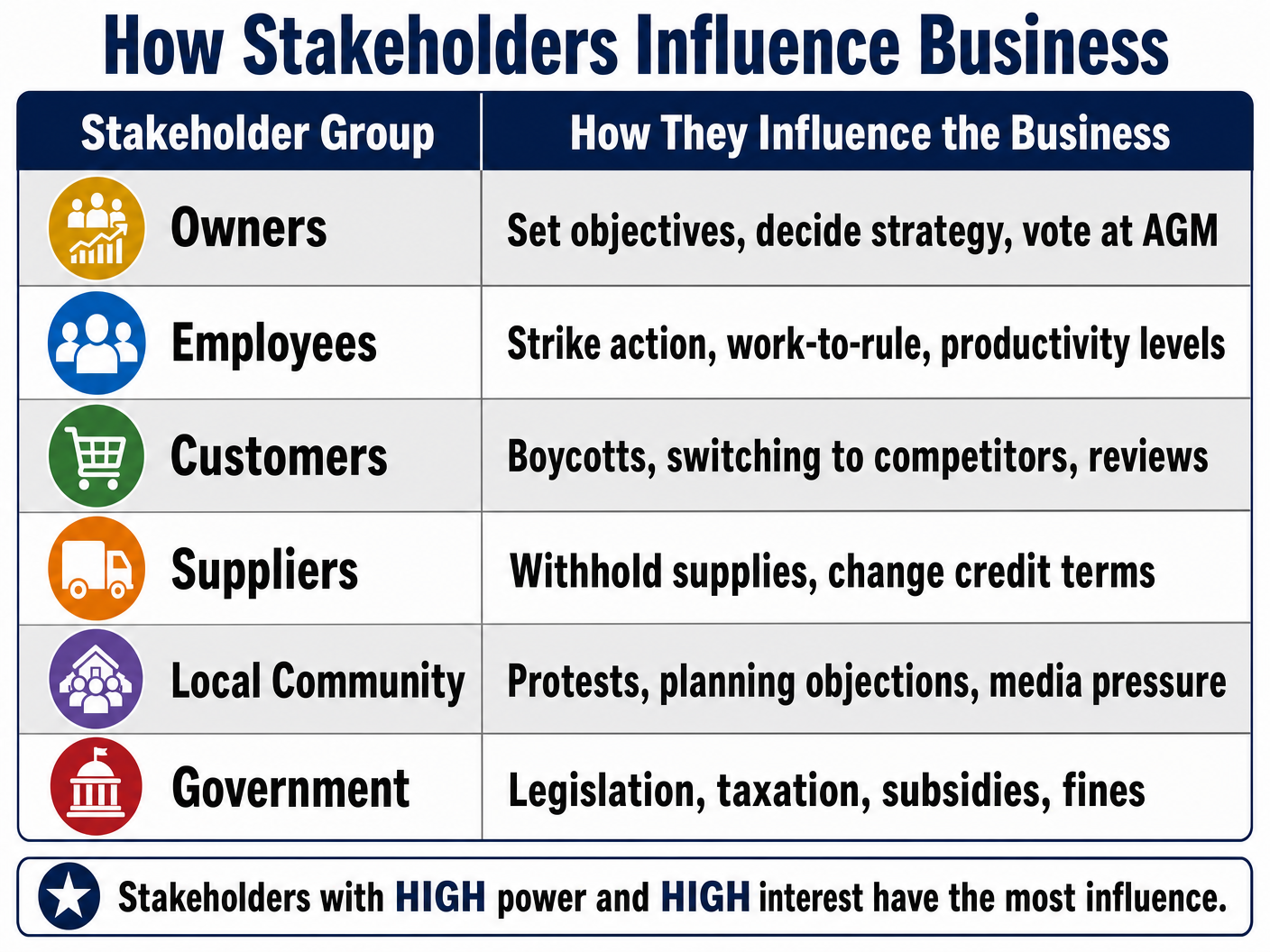
Influence: Owners make strategic decisions, vote at AGMs (Annual General Meetings), and can inject more capital or sell their shares.
Employees
Role: The workforce who carry out the day-to-day operations of the business.
Objectives: They want job security, fair wages, good working conditions, and opportunities for promotion.
Influence: Employees impact productivity, quality of customer service, and can take industrial action (e.g., strikes) if unhappy.
External Stakeholders
External stakeholders are outside the business but are still affected by or can affect it.
Customers
Role: The people who buy the goods or services provided by the business.
Objectives: They desire value for money, high-quality products, excellent customer service, and increasingly, ethical business practices.
Influence: Customers provide revenue. They can boycott a business, switch to competitors, or leave damaging reviews online.
Suppliers
Role: The businesses that provide the raw materials or components needed for production.
Objectives: They want prompt payment, fair prices for their goods, and regular, reliable orders.
Influence: Suppliers can change their prices, alter credit terms, or withhold supplies, directly impacting the business's ability to operate.
Local Community
Role: The people living in the area where the business operates.
Objectives: They want local employment opportunities, minimal disruption (noise, traffic, pollution), and positive contributions to the area.
Influence: The community can object to planning permissions, organise protests, or generate negative local media coverage.
Government
Role: The local and national authorities that regulate business activity.
Objectives: They want businesses to create jobs, generate tax revenue (e.g., Corporation Tax), and comply with legislation.
Influence: The government can pass new laws, change tax rates, offer subsidies, or issue fines for non-compliance.
 Open full-size image (opens in a new tab)
Stakeholder Conflicts
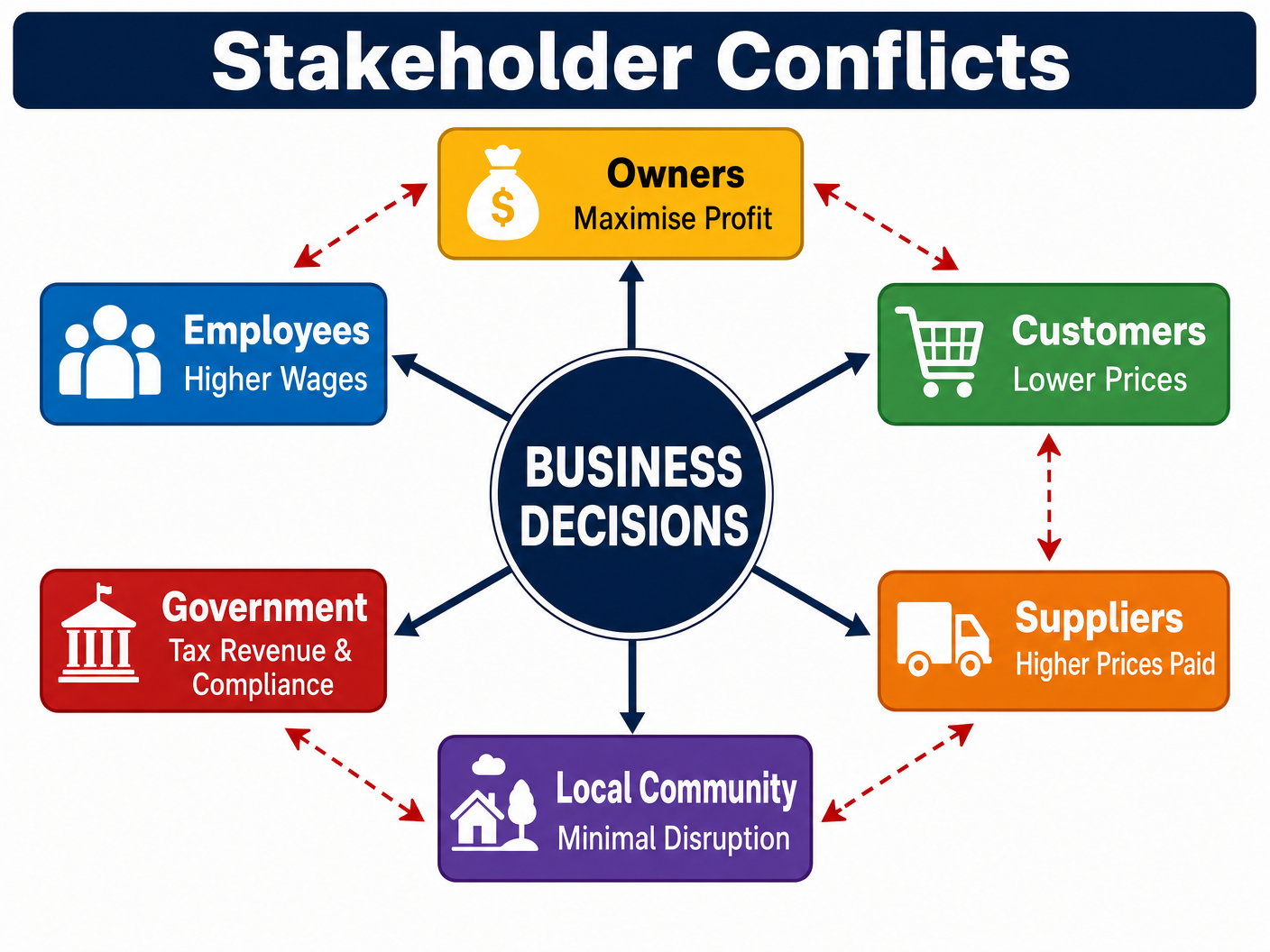
Because different stakeholders have different objectives, conflict is inevitable. This is a major focus for examiners.
 Open full-size image (opens in a new tab)
Owners vs. Employees
Owners want to maximise profit, which often involves keeping costs low. Employees want higher wages, which increases costs and reduces short-term profit.
Customers vs. Owners
Customers want lower prices and higher quality, which can squeeze profit margins. Owners want to maximise profit margins, which might mean raising prices or using cheaper materials.
Local Community vs. Owners
Owners might want to expand operations (e.g., build a new factory) to increase output and profit. The local community might oppose this due to concerns over increased traffic, noise, and environmental damage.
Managing Conflicts
Businesses cannot always please everyone. They must manage these conflicts by prioritising certain stakeholders depending on their power and interest (often analysed using Mendelow's Matrix, though not always explicitly named at GCSE). Strategies include profit-sharing schemes, community engagement, and transparent communication.
Try the lesson
The start of the Stakeholders lesson, made from teaching notes for this specification point.
Have a go first
Which objective is most closely associated with the shareholders of a business?
Listen
Stakeholder objectives are the goals that different groups aim to achieve from a business's activities. Owners and shareholders typically seek profit, dividends and growth in the value of their investment. Employees aim for fair pay, job security, safe working conditions and opportunities for progression. Customers want good-quality products, value for money, reliable service and ethical behaviour. Suppliers aim for regular orders, prompt payment and long-term trading relationships. The local community seeks employment opportunities, minimal environmental damage and support for local causes. The government aims to collect tax, maintain employment and ensure businesses comply with legislation. These objectives often conflict, so businesses must balance them when making decisions. A strong answer earns marks for these points. States that owners and shareholders aim for profit, dividends and capital growth. Explains that employees seek fair pay, job security and safe working conditions. Describes customers' objectives as value for money, quality and reliable service. Outlines that suppliers want regular orders, prompt payment and long-term relationships. A common slip: Treating all stakeholder objectives as identical. Instead, recognise that each group has distinct and often conflicting aims. Exam tip: Link each objective to the specific stakeholder group to show clear understanding.
See it

Key words
Say what each word means before you turn the card.
Stakeholder objectives
Try answering aloud or in your head before turning the card.
Conflicting objectives
Try answering aloud or in your head before turning the card.
See every definition
- Stakeholder objectives
- The goals that different groups aim to achieve from a business's activities.
- Conflicting objectives
- Objectives that often conflict, so businesses must balance them when making decisions.
Label the diagram
Some boxes have lost their names. Pick the right name for each number.

1Box 1
2Box 2
3Box 3
There is more to this lesson
The full lesson goes on to check your understanding and help you earn the marks. Create a free account to carry on, with your progress saved.
A week of Premium from your first lesson · Then the free plan continues · No card, no charge
Worked Examples
3 worked examples — open one to explore the question and available guidance.
Practice Questions
Try the question, then reveal an answer plan or example response
State two external stakeholders of a business. (2 marks)
Hint: Think of groups that are outside the day-to-day running of the business.
Explain how the local community might influence the decisions of a business planning to expand its factory. (3 marks)
Hint: What power does the community have to stop or alter the plans?
Analyse how a decision to switch to cheaper, lower-quality suppliers might cause a conflict between owners and customers. (6 marks)
Hint: Identify the objective of the owners, the objective of the customers, and explain why the action satisfies one but angers the other.
Evaluate whether suppliers are the most important stakeholder for a fast-food restaurant chain. (9 marks)
Hint: Argue why suppliers are crucial, then argue for another group (e.g., customers or employees), and make a final judgement.
Explain one way the government can influence the objectives of a business. (3 marks)
Hint: Think about laws, taxes, or minimum wage.
Ready to test yourself interactively?
Active recall beats reading alone. Answer questions on Stakeholders with instant AI scoring and mark scheme guidance.
A week of Premium from your first lesson · Then the free plan continues · No card, no charge
Exam technique
How to turn what you know into marks
How to approach the question
Always identify the specific stakeholder, state their exact objective, and show the two-way impact on the business.
How to structure your answer
- Essay questions
- Argue for one stakeholder, argue for another, then provide a justified conclusion weighing up which is more important based on the case study context.
- Source questions
- Read the case study carefully to identify which stakeholders are most powerful in that specific scenario.
- Explain questions
- Point (identify stakeholder/objective), Evidence (context), Explanation (how it impacts the business).
Timing
Approximately 1 minute per mark, plus planning time for longer 9 or 12 mark questions.
Common pitfalls
- Using the word 'stakeholders' generally without naming a specific group.
- Confusing 'stakeholders' with 'shareholders' (shareholders are just one type of stakeholder).
- Failing to explain the impact on the business (e.g., saying 'employees will strike' but not adding 'which stops production and reduces revenue').
What the command words want
- Analyse
- Show a chain of reasoning linking a stakeholder action to a business outcome.
- Explain
- Make a point and develop it with a consequence ('This means that...').
- Evaluate
- Look at both sides of an argument and reach a supported judgement based on context.
- State/Identify
- One-word or short phrase answers (e.g., 'Customers').
Watch or listen (optional)
Test your understanding of Stakeholders
Active recall beats re-reading. Take an instant quiz now to test what you’ve learned and lock it into long-term memory.
A week of Premium from your first lesson · Then the free plan continues · No card, no charge