AQA · GCSE · Business
Course version: 8132 · Version from Sept 2017
The elements of the marketing mix: price, product, promotion and place (4Ps)
Master the Marketing Mix (4Ps) to understand how businesses strategically combine Price, Product, Promotion, and Place to achieve their objectives. This integrated framework is essential for analysing how companies respond to market changes and outmanoeuvre competitors.
- Point 72 of 80
- 4 min read
- 3 worked examples
- 5 practice questions
- 4 key terms
Study Notes
Overview
 Open full-size image (opens in a new tab)
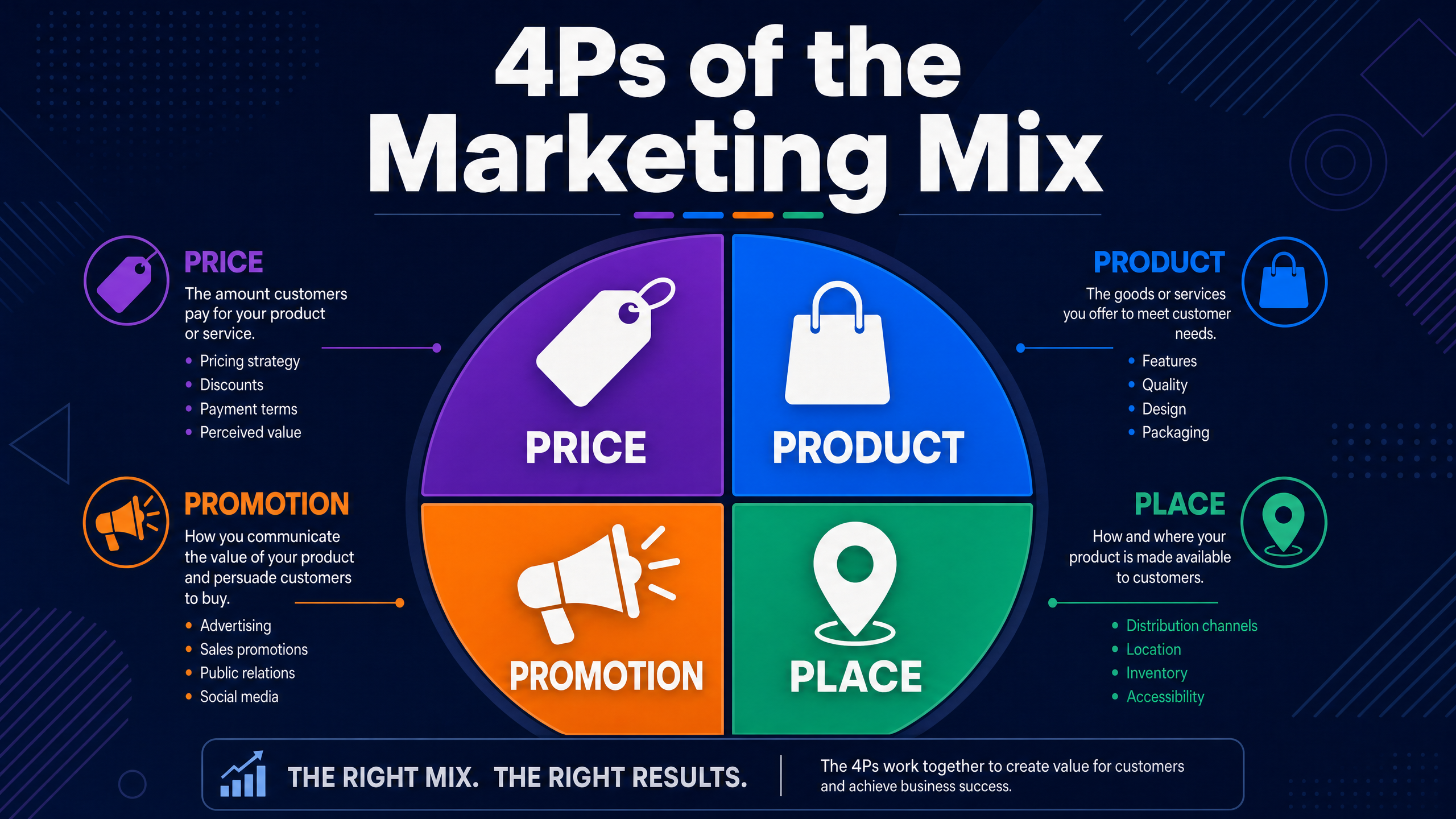
The marketing mix, commonly known as the 4Ps, is the foundation of business strategy. It represents the combination of decisions a business makes about its Product, its Price, how it Promotes that product, and where it sells it (Place). Examiners frequently test your ability to understand that these elements do not operate in isolation; they must work together as an integrated strategy to meet customer needs and achieve business objectives. For instance, a premium pricing strategy must be supported by a high-quality product, exclusive distribution channels, and sophisticated promotion.
The Four Elements of the Marketing Mix
Product
Definition: The good or service the business is selling to meet customer needs.
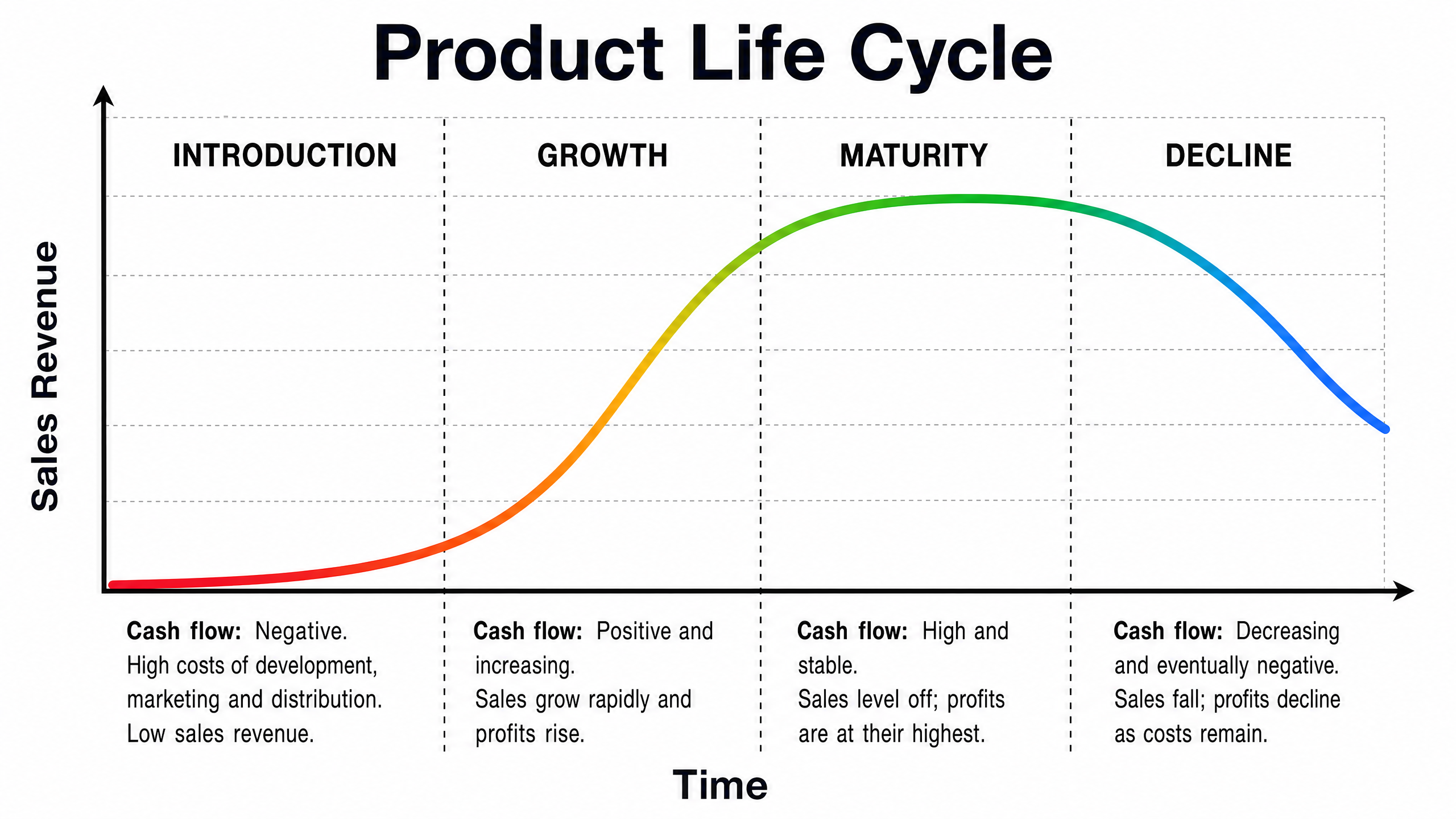
Key Concepts: It encompasses design, quality, branding, and packaging. A crucial element is the Unique Selling Point (USP), which differentiates the product from competitors. Products also move through a Product Life Cycle (Introduction, Growth, Maturity, Decline), and businesses use extension strategies (like new packaging or features) to prolong the maturity phase and delay decline.
Specific Knowledge: The Boston Matrix categorises products into Stars, Cash Cows, Question Marks, and Dogs to help manage a product portfolio.
 Open full-size image (opens in a new tab)
Price
Definition: The amount customers pay for the product or service.
Key Concepts: Pricing must reflect the product's positioning and the target market. There is generally an inverse relationship between price and demand. However, a price increase does not always lead to lower revenue if the percentage drop in demand is smaller than the percentage increase in price.
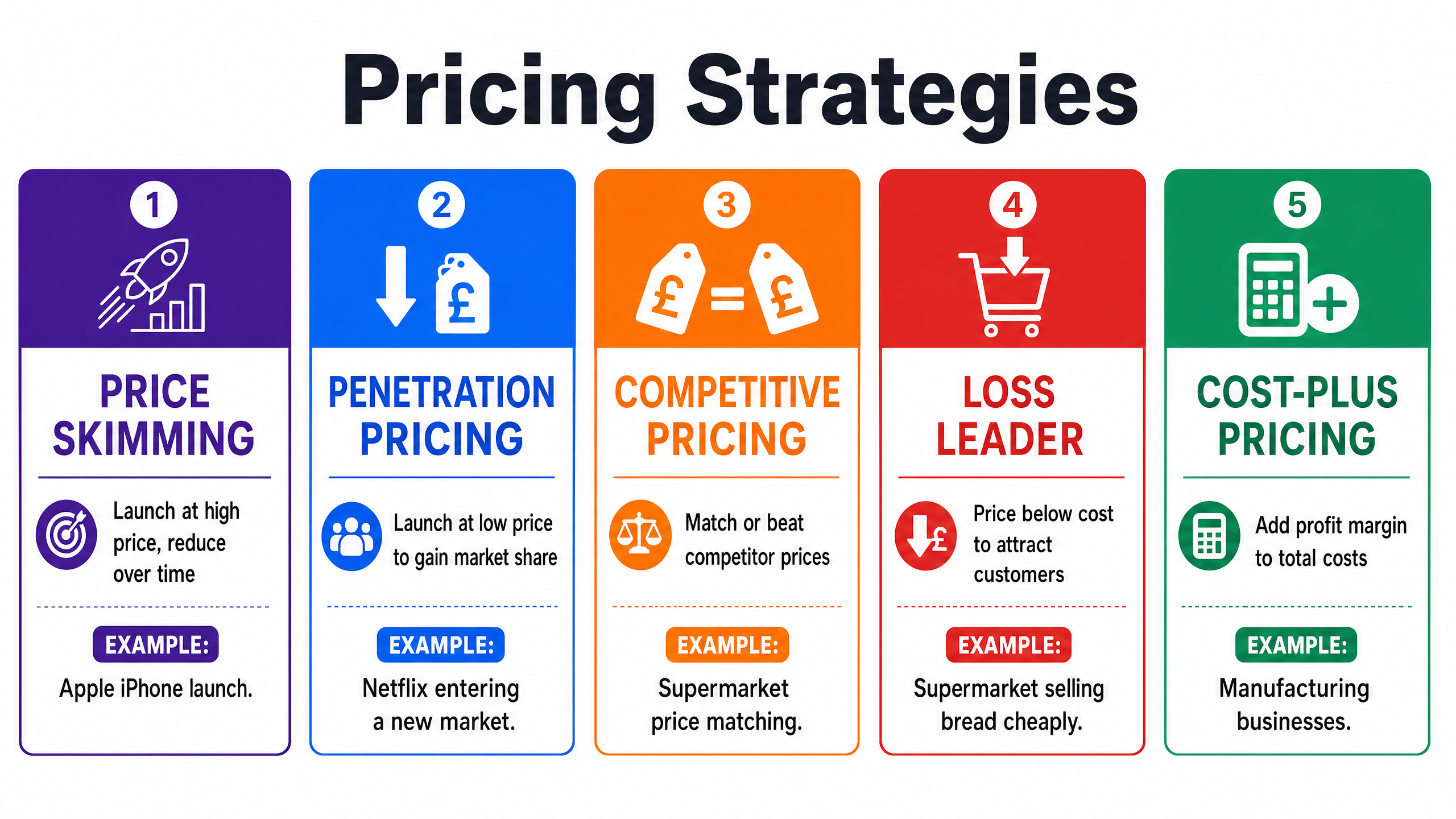
Specific Knowledge: Five key pricing strategies: Price Skimming (high initial price), Penetration Pricing (low initial price to gain market share), Competitive Pricing (matching rivals), Loss Leader (selling below cost to attract customers), and Cost-Plus Pricing (adding a margin to costs).
 Open full-size image (opens in a new tab)
Promotion
Definition: How the business communicates the value of the product and persuades customers to buy.
Key Concepts: Promotional methods must match the target audience and the brand image. Methods include advertising (TV, online), public relations (PR), sales promotions (discounts, BOGOF), sponsorship, and social media marketing.
Specific Knowledge: Social media is highly cost-effective for reaching younger demographics but requires constant management to protect brand reputation.
Place
Definition: How and where the product is made available to customers.
Key Concepts: Distribution channels include direct selling (e.g., e-commerce) and using intermediaries (wholesalers, retailers). The rise of e-commerce and m-commerce has revolutionised distribution, lowering physical costs but increasing delivery logistics.
Specific Knowledge: The choice of place must align with the product's image; exclusive products require exclusive retail environments.
Integration of the Marketing Mix
The most important concept for high marks is integration. If a business launches a luxury watch (Product), it must use price skimming or premium pricing (Price), advertise in high-end magazines or sponsor elite sports (Promotion), and sell through exclusive boutiques (Place). Any inconsistency (e.g., selling a luxury watch in a discount supermarket) will confuse customers and damage the brand.
Audio Resource
Listen to the comprehensive podcast summary of this topic below:
Try the lesson
The start of the The elements of the marketing mix: price, product, promotion and place (4Ps) lesson, made from teaching notes for this specification point.
Have a go first
Which element of the marketing mix is a business using when its staff telephone customers to persuade them to buy a product?
Listen
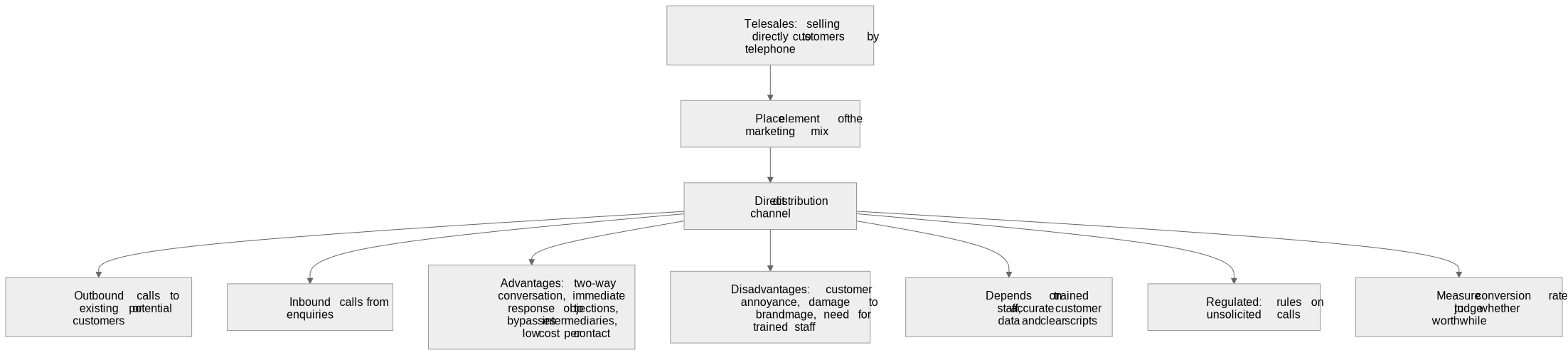
Telesales involves selling products directly to customers by telephone, and it sits within the place (distribution) element of the marketing mix. A business may make outbound calls to existing or potential customers, or handle inbound calls from enquiries. Telesales acts as a direct distribution channel, allowing two-way conversation so staff can answer questions, overcome objections and close a sale immediately without intermediaries. It can reach many customers at a relatively low cost per contact. However, it can annoy customers, damage brand image if poorly handled, and is regulated by rules on unsolicited calls. Its success depends on trained staff, accurate customer data and clear scripts. A business might use telesales to renew subscriptions, and it should measure conversion rates to judge whether the channel is worthwhile. A strong answer earns marks for these points. Defines telesales as selling products directly to customers by telephone. Identifies telesales as a direct distribution channel within the place element of the marketing mix. Explains advantages such as direct two-way communication, immediate response to objections and bypassing intermediaries. Explains disadvantages such as customer annoyance, possible damage to brand image and the need for trained staff. A common slip: Classifying telesales as part of promotion. Instead, AQA specifies telesales as a distribution channel under 'place', because it is a method of selling directly to the customer. Exam tip: State clearly that telesales is a distribution channel (place), then explain how it allows direct sales to customers.
See it
Watch it explained
What is the one idea the video explains? Say it in a sentence.
Read the described scene instead
Telesales means selling products directly to customers over the telephone. In the marketing mix, it sits in the place element — distribution. A business might make outbound calls to existing or potential customers, or handle inbound calls from enquiries. Either way, the phone call is the channel through which the sale happens. The marketing mix has four elements: product, price, promotion and place. Telesales is one distribution channel inside place. Because it is direct, staff talk to the customer with no intermediary in between — a two-way conversation where questions are answered, objections handled, and the sale closed on the spot. It can also reach many customers at a relatively low cost per contact. Telesales has real drawbacks. It can annoy customers, and if calls are poorly handled it can damage brand image. Unsolicited calls are regulated, so businesses must follow the rules and respect customer preferences. Success also depends on trained staff, accurate customer data and clear scripts. Take a broadband provider whose customer contracts are ending. Staff call to offer a renewal. That is telesales: a direct channel, immediate objection handling, no intermediary. Is it worth it? Pause and think how you would judge the channel. Compare it with another channel using cost, reach and conversion. Telesales gives personal contact, but it costs staff time, training and data management — so the business should measure conversion rates to judge whether the channel is worthwhile. Three mistakes to avoid. First, classifying telesales as promotion. AQA treats it as a distribution channel under place, because it is a method of selling directly to the customer. Second, assuming it is always cheap: training, call time and data management create costs, so consider cost per sale. Third, ignoring regulation and consent — unsolicited calls are restricted, so follow the rules and respect customer preferences. To sum up. Telesales is selling directly by phone, and it belongs to place as a direct distribution channel. It offers two-way conversation, immediate objection handling and wide reach at low cost per contact. It risks annoying customers, damaging brand image and breaking rules on unsolicited calls. Judge it with cost, reach and conversion — for example when renewing subscriptions.
Key words
Say what each word means before you turn the card.
Telesales
Try answering aloud or in your head before turning the card.
Direct distribution channel
Try answering aloud or in your head before turning the card.
Cost, reach and conversion
Try answering aloud or in your head before turning the card.
Customer consent and regulation
Try answering aloud or in your head before turning the card.
See every definition
- Telesales
- Selling products directly to customers by telephone, sitting within the place element of the marketing mix.
- Direct distribution channel
- A method of selling directly to the customer without intermediaries, allowing two-way conversation so staff can answer questions and close a sale immediately.
- Cost, reach and conversion
- Criteria for judging whether the channel is worthwhile, since it can reach many customers at a relatively low cost per contact and conversion rates should be measured.
- Customer consent and regulation
- Rules on unsolicited calls restrict telesales, so businesses must follow the rules and respect customer preferences.
Label the diagram
Some boxes have lost their names. Pick the right name for each number.
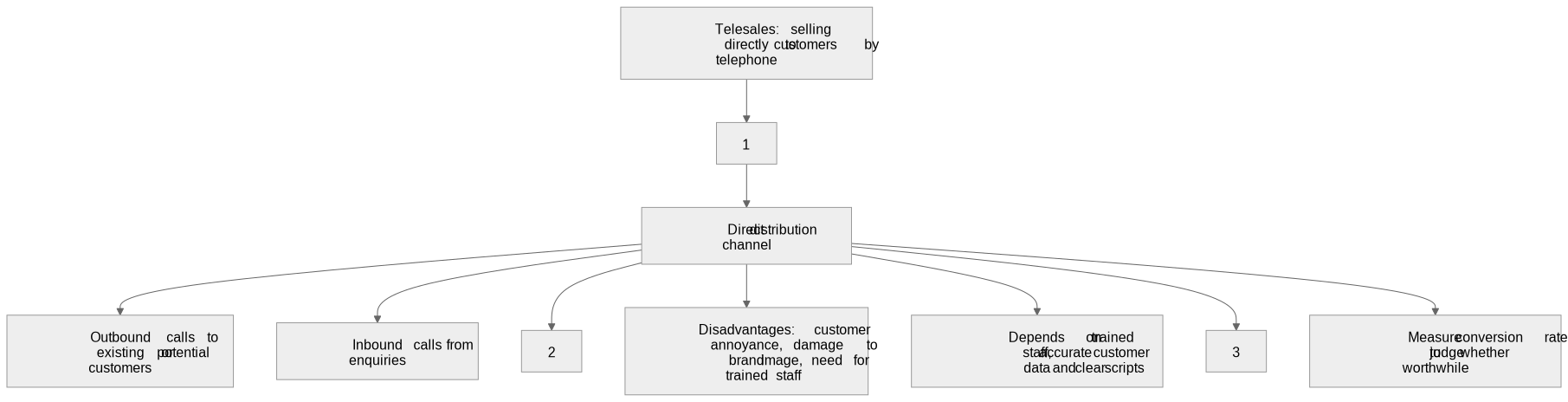
1Box 1
2Box 2
3Box 3
There is more to this lesson
The full lesson goes on to check your understanding and help you earn the marks. Create a free account to carry on, with your progress saved.
A week of Premium from your first lesson · Then the free plan continues · No card, no charge
Worked Examples
3 worked examples — open one to explore the question and available guidance.
Practice Questions
Try the question, then reveal an answer plan or example response
A premium chocolate brand is launching a new range of organic truffles. Recommend the most appropriate pricing strategy for this new product. (9 marks)
Hint: Consider the brand's existing image and the nature of the product (organic/premium).
Explain two stages of the product life cycle. (4 marks)
Hint: Name the stage and explain what happens to sales or cash flow during that stage.
State two methods of promotion a business could use. (2 marks)
Hint: Just name the methods, do not explain them.
Explain how e-commerce has affected the 'Place' element of the marketing mix for a clothing retailer. (6 marks)
Hint: Think about physical stores vs online stores, costs, and market reach.
Analyse the benefits to a business of having a strong Unique Selling Point (USP). (6 marks)
Hint: How does being different help a business with its pricing and its competitors?
Ready to test yourself interactively?
Active recall beats reading alone. Answer questions on The elements of the marketing mix: price, product, promotion and place (4Ps) with instant AI scoring and mark scheme guidance.
A week of Premium from your first lesson · Then the free plan continues · No card, no charge
Exam technique
How to turn what you know into marks
How to approach the question
Always read the case study first and highlight details about the target market, budget, and product type. Use these details in your answer.
How to structure your answer
- Analyse questions
- Point → Contextual Explanation → Chain of Analysis (leading to consequence)
- Explain questions
- Point → Explanation → Business Impact (PEB)
- Evaluate questions
- Contextualised Advantage → Contextualised Disadvantage → Justified Judgement based on the specific business.
Timing
Approximately 1 minute per mark, allowing time to read the case study carefully.
Common pitfalls
- Treating the 4Ps in isolation rather than showing how they integrate.
- Confusing extension strategies with new product development.
- Giving generic answers that don't apply to the specific business in the question.
What the command words want
- Analyse
- Examine the impacts or consequences in detail, showing a chain of reasoning.
- Explain
- Give a reason and develop it with a consequence.
- State/Identify
- A simple factual answer, no explanation needed.
- Evaluate/Recommend
- Weigh up both sides (pros/cons) and make a clear, supported decision.
Test your understanding of The elements of the marketing mix: price, product, promotion and place (4Ps)
Active recall beats re-reading. Take an instant quiz now to test what you’ve learned and lock it into long-term memory.
A week of Premium from your first lesson · Then the free plan continues · No card, no charge