AQA · GCSE · Business
Course version: 8132 · Version from Sept 2017
The purpose and methods of market research
Master the fundamentals of market research, a cornerstone topic in GCSE Business. Discover how businesses gather vital data to identify opportunities, outsmart competitors, and make profitable decisions.
- Point 17 of 19
- 5 min read
- 3 worked examples
- 5 practice questions
- 4 key terms
Study Notes
Overview
Market research is the foundation of successful business planning. It involves collecting, analysing, and interpreting data about a market, including information about the target audience, competitors, and the industry as a whole. Examiners consistently test candidates' understanding of why businesses conduct research and their ability to evaluate which methods are most appropriate in given scenarios. This guide covers the core purposes of market research, the critical distinctions between primary/secondary and qualitative/quantitative data, and the application of these concepts to real-world business decisions.
The Purpose of Market Research
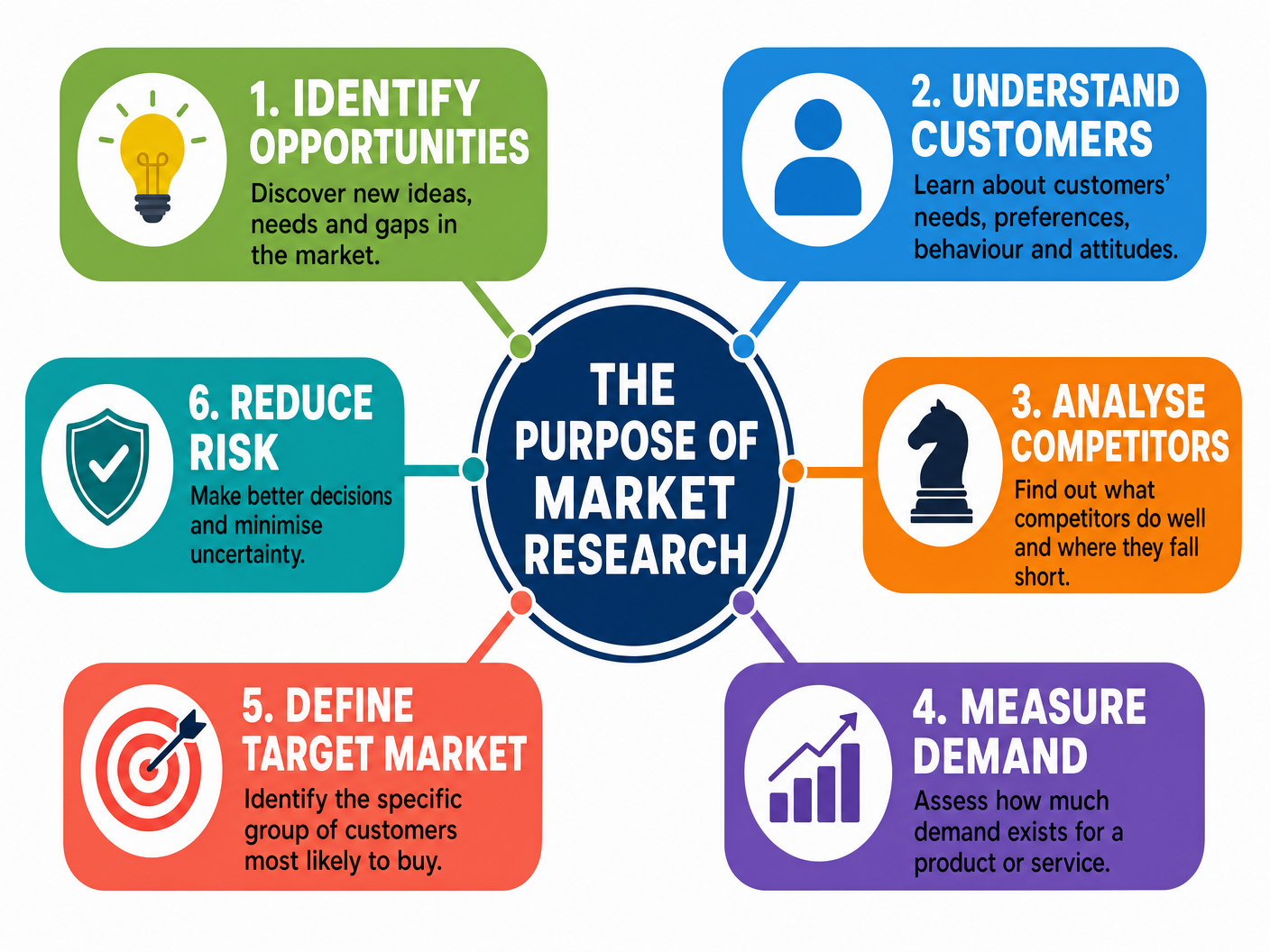
Businesses do not operate in a vacuum. They must understand their environment to survive and thrive. The key purposes of market research include:
1. Identifying Market OpportunitiesResearch helps businesses spot gaps in the market—areas where customer needs are not currently being met. For instance, noticing a lack of plant-based options in a local area presents an opportunity for a new vegan cafe.
2. Understanding CustomersBy researching consumer behaviour, businesses can tailor their products, pricing, and promotions to match customer preferences. This leads to higher satisfaction and brand loyalty.
3. Analysing CompetitorsUnderstanding what rival firms are doing allows a business to develop a competitive advantage. This might involve undercutting their prices or offering superior quality.
4. Measuring DemandBefore launching a product, a business needs to estimate how many units it is likely to sell. This informs production planning and helps secure finance from banks or investors.
5. Defining the Target MarketResearch helps segment the market, allowing the business to focus its marketing budget on the specific group of consumers most likely to buy the product.
6. Reducing RiskPerhaps the most crucial purpose. Launching a new product is expensive and risky. Good research minimises uncertainty and prevents costly mistakes.
 Open full-size image (opens in a new tab)
Methods of Market Research
Examiners frequently ask candidates to distinguish between primary and secondary research, and to evaluate their suitability.
Primary Research (Field Research)
This is original data collected first-hand by the business for a specific purpose.
Methods include:
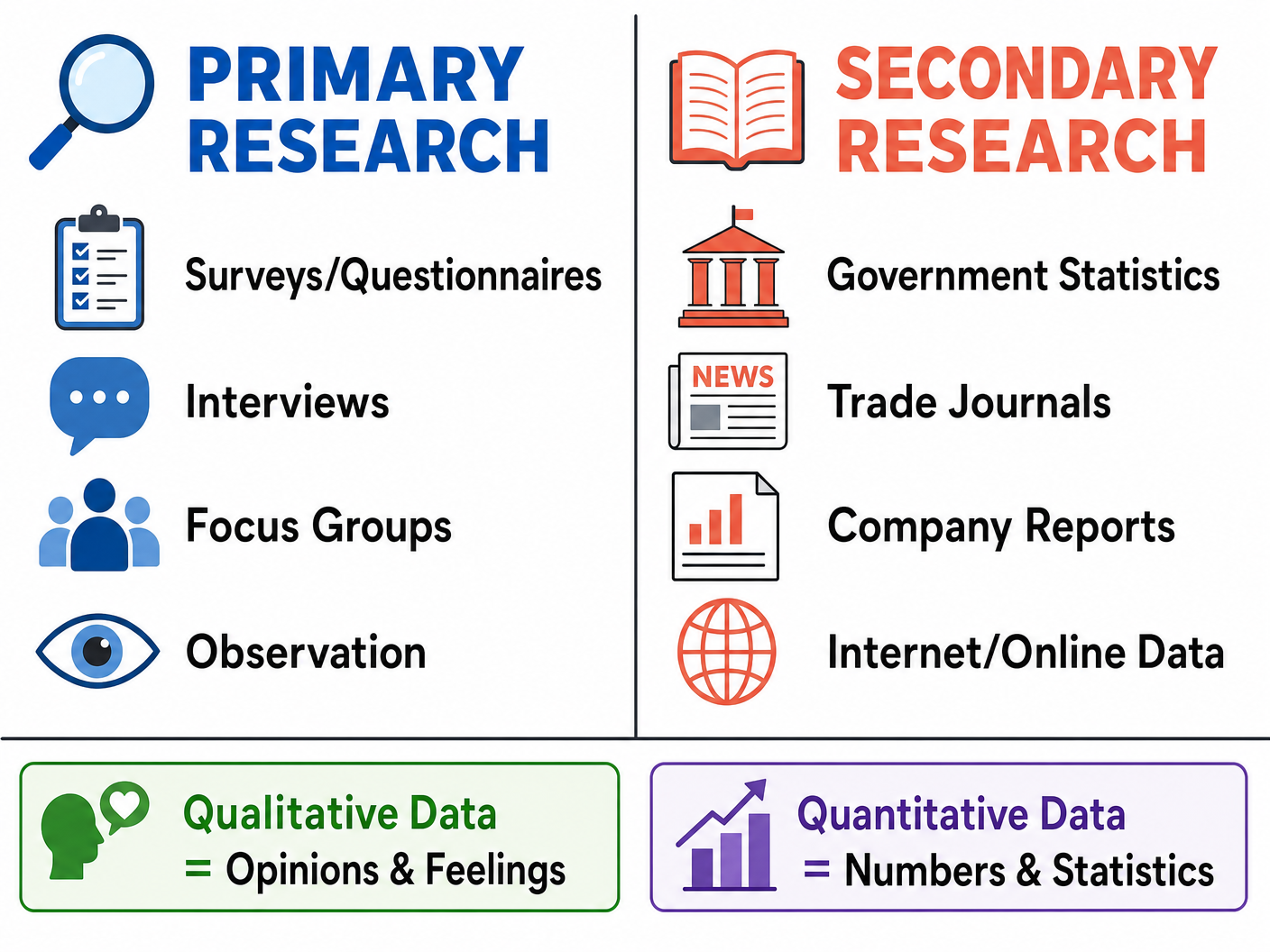
- Surveys and Questionnaires: Can be conducted online, face-to-face, or by post. They gather a large amount of data but rely heavily on well-designed questions.
- Interviews: One-on-one conversations that provide deep, qualitative insights but are time-consuming and expensive to conduct.
- Focus Groups: Small groups of consumers discussing a product. They generate rich feedback but may be influenced by dominant personalities.
- Observation: Watching consumer behaviour (e.g., how they navigate a store). It shows what people actually do, rather than what they say they do.
Pros: Data is up-to-date, relevant, and exclusive to the business (competitors cannot access it).
Cons: Expensive and time-consuming to collect.
Secondary Research (Desk Research)
This involves using data that has already been collected by someone else for a different purpose.
Methods include:
- Internal Data: Past sales figures, customer records.
- External Data: Government statistics (e.g., Census), trade journals, competitor websites, market reports.
Pros: Quick and cheap (often free) to access. Provides a good overview of the whole market.
Cons: May be out-of-date, not specific to the business's exact needs, and available to competitors.
 Open full-size image (opens in a new tab)
Types of Data
Candidates must also understand the difference between qualitative and quantitative data.
Qualitative Data
This is non-numerical information based on opinions, feelings, and attitudes. It answers the 'why' questions.
- Example: "I buy this brand because the packaging feels premium."
- Benefit: Provides deep insight into consumer motivations.
- Drawback: Difficult to analyse statistically and compare.
Quantitative Data
This is numerical information that can be counted or measured. It answers the 'what', 'who', and 'how many' questions.
- Example: "75% of customers rated the product 5 stars."
- Benefit: Easy to analyse, present in charts, and use for identifying trends.
- Drawback: Does not explain the reasons behind the numbers.
Key Calculations
Examiners will expect you to calculate and interpret market data.
Market Size: The total value or volume of sales in a market.
- Formula: Number of units sold x Price per unit (for value).
Market Share: The proportion of total market sales held by one business.
- Formula: (Business Sales / Total Market Sales) x 100
Try the lesson
The start of the The purpose and methods of market research lesson, made from teaching notes for this specification point.
Have a go first
A business has quantitative market research showing that 80% of surveyed customers bought its product online. What does this finding tell the business?
Listen
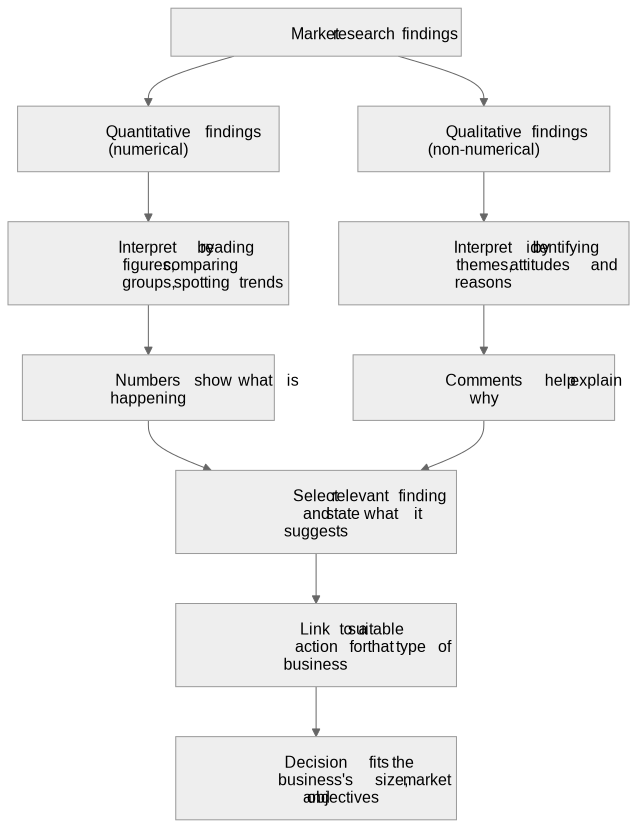
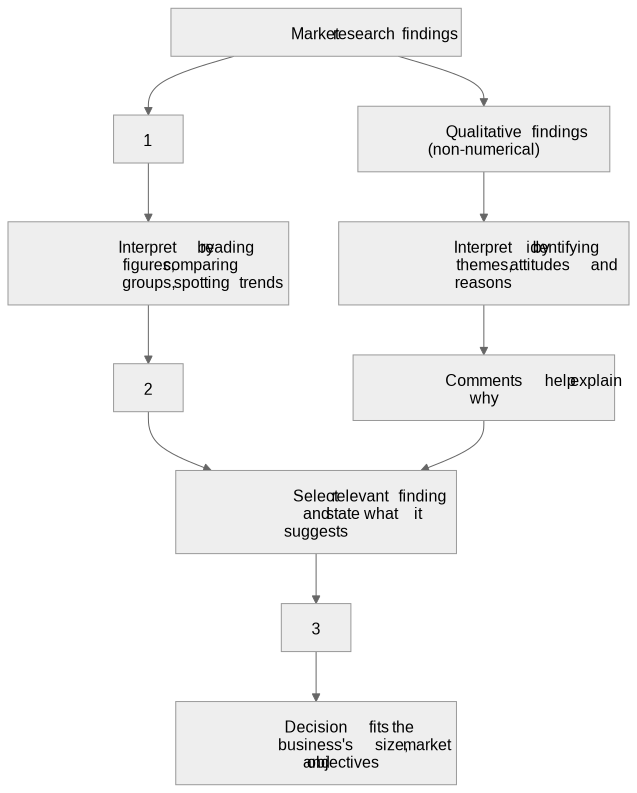
Quantitative findings are numerical, such as 62% of respondents willing to pay £5, and are interpreted by reading the figures, comparing groups and spotting trends. Qualitative findings are non-numerical, such as interview comments about why customers find a product confusing, and are interpreted by identifying themes, attitudes and reasons. Using both together is powerful: the numbers show what is happening, while the comments help explain why. To make an appropriate decision, a student should select the relevant finding, state what it suggests, and link it to a suitable action for that type of business. A small local café might use feedback to change its menu, while a large manufacturer might use survey data to justify production volumes. Decisions should fit the business's size, market and objectives. A strong answer earns marks for these points. Defines quantitative findings as numerical data, such as percentages, averages or sales figures, and qualitative findings as non-numerical data, such as opinions, reasons and attitudes. Interprets quantitative findings by reading values, comparing groups and identifying trends or patterns in the figures. Interprets qualitative findings by identifying themes, attitudes and the reasons behind customer behaviour. Uses findings together, recognising that numerical data show what is happening while qualitative data help explain why. A common slip: Treating qualitative data as inferior or unusable. Instead, recognising that opinions and reasons explain customer behaviour and guide decisions. Exam tip: Quote or summarise the finding briefly, then spend your marks on what it means for the business.
See it
Key words
Say what each word means before you turn the card.
Quantitative findings
Try answering aloud or in your head before turning the card.
Qualitative findings
Try answering aloud or in your head before turning the card.
Interpretation of findings
Try answering aloud or in your head before turning the card.
Decision making across different business types
Try answering aloud or in your head before turning the card.
See every definition
- Quantitative findings
- Numerical data, such as percentages, averages or sales figures, interpreted by reading values, comparing groups and identifying trends or patterns in the figures.
- Qualitative findings
- Non-numerical data, such as opinions, reasons and attitudes, interpreted by identifying themes, attitudes and the reasons behind customer behaviour.
- Interpretation of findings
- Reading quantitative values, comparing groups and spotting trends, and identifying themes, attitudes and reasons in qualitative data, so that the numbers show what is happening while the comments help explain why.
- Decision making across different business types
- Linking an interpreted finding to an appropriate decision, such as changing price, product, promotion or location, and adapting it to the business's size, market and objectives.
Label the diagram
Some boxes have lost their names. Pick the right name for each number.
1Box 1
2Box 2
3Box 3
There is more to this lesson
The full lesson goes on to check your understanding and help you earn the marks. Create a free account to carry on, with your progress saved.
A week of Premium from your first lesson · Then the free plan continues · No card, no charge
Worked Examples
3 worked examples — open one to explore the question and available guidance.
Practice Questions
Try the question, then reveal an answer plan or example response
State two methods of primary market research. (2 marks)
Hint: Think of methods where the business gathers original data themselves.
Explain one reason why a business might choose to use secondary research rather than primary research. (3 marks)
Hint: Think about the cost and time involved in gathering data.
A clothing retailer wants to find out why sales of their winter coats have fallen. Recommend whether they should use qualitative or quantitative research. Justify your answer. (6 marks)
Hint: They need to find out *why* something is happening, not just *how many* sales were lost.
Calculate the market size if 50,000 units are sold at an average price of £15. (2 marks)
Hint: Multiply the volume by the price.
Evaluate the use of social media as a method of market research for a new, small business. (9 marks)
Hint: Consider the costs, the reach, and the potential bias of social media users.
Ready to test yourself interactively?
Active recall beats reading alone. Answer questions on The purpose and methods of market research with instant AI scoring and mark scheme guidance.
A week of Premium from your first lesson · Then the free plan continues · No card, no charge
Exam technique
How to turn what you know into marks
How to approach the question
Always read the case study carefully. Highlight the type of business, its size, and its budget. Your answers must link back to these specific details.
How to structure your answer
- Essay questions
- State advantages of option A, state disadvantages/advantages of option B, provide a justified conclusion stating which is better and *why*.
- Source questions
- Not typically applicable in standard Business papers, but data interpretation requires referencing specific figures from the provided charts.
- Explain questions
- State the point, then use connective words like 'because', 'leading to', or 'therefore' to develop the explanation in context.
Timing
Approximately 1 minute per mark.
Common pitfalls
- Defining terms without applying them to the business scenario.
- Confusing primary and secondary research.
- Forgetting to include the % sign when calculating market share.
What the command words want
- Explain
- Give reasons for your answer, showing cause and effect.
- Describe
- Give a clear account of the main features.
- Evaluate
- Look at both sides of an argument (pros and cons) and make a reasoned judgement.
- Calculate
- Use the numbers provided to work out the answer. Always show workings.
Test your understanding of The purpose and methods of market research
Active recall beats re-reading. Take an instant quiz now to test what you’ve learned and lock it into long-term memory.
A week of Premium from your first lesson · Then the free plan continues · No card, no charge