AQA · A-Level · Chemistry
Course version: 7405 · Version from Sept 2016
These equations and the gas constant, R, will be given when required.
Full specification wording
Rate equations (A-level only): These equations and the gas constant, R, will be given when required.
The Arrhenius equation, in which the rate constant k equals A multiplied by an exponential factor containing −Eₐ/RT, and its logarithmic form ln k = −Eₐ/RT + ln A, are both supplied in the exam…
Checked against the AQA 7405 specification (opens in a new tab) on .
- Point 2 of 2
- 4 key terms
Study notes
From the checked teaching notes for this specification point.
The idea
The Arrhenius equation, in which the rate constant k equals A multiplied by an exponential factor containing −Eₐ/RT, and its logarithmic form ln k = −Eₐ/RT + ln A, are both supplied in the exam along with the gas constant R, so no recall is needed; what is tested is the handling. The equation says that k, and so the rate, rises steeply as the temperature rises or as the activation energy falls, because Eₐ and T sit inside that exponent. The logarithmic form is the usable one: plotting ln k against 1/T gives a straight line of gradient −Eₐ/R and intercept ln A, so the activation energy comes from multiplying the gradient by −R. Keep the units consistent, since R is in J K⁻¹ mol⁻¹, so an activation energy found this way is in J mol⁻¹ and usually needs dividing by 1000.
What earns the marks
- Selecting the correct given form of the equation for the data supplied.
- A plot of ln k against 1/T with a line of best fit.
- A gradient value read from the drawn line of best fit, within the accepted range.
- Eₐ obtained as the gradient multiplied by −R, converted to kJ mol⁻¹.
Common mistakes and how to put them right
Plotting k against T and expecting a straight line.
Forgetting the minus sign, so a negative gradient yields a negative activation energy.
Leaving Eₐ in J mol⁻¹ when the answer is required in kJ mol⁻¹.
Reading the gradient from two plotted data points rather than from the line of best fit.
Using a temperature in degrees Celsius inside 1/T.
Exam tips
- Locate the equation and the value of R on the data sheet before you begin, then substitute carefully.
- An activation energy must come out positive; a negative answer means the sign of the gradient was mishandled.
- Take gradient points from opposite ends of the drawn line to reduce the uncertainty.
Try the lesson
The start of the Rate equations (A-level only): These equations and the gas constant, R, will be given when required. lesson, made from checked teaching notes for this specification point.
Have a go first
The Arrhenius equation is given as k = Ae^{-E_a/RT}. Which of the following is the correct rearrangement to calculate the activation energy, E_a?
Listen
The Arrhenius equation, in which the rate constant k equals A multiplied by an exponential factor containing −Eₐ/RT, and its logarithmic form ln k = −Eₐ/RT + ln A, are both supplied in the exam along with the gas constant R, so no recall is needed; what is tested is the handling. The equation says that k, and so the rate, rises steeply as the temperature rises or as the activation energy falls, because Eₐ and T sit inside that exponent. The logarithmic form is the usable one: plotting ln k against 1/T gives a straight line of gradient −Eₐ/R and intercept ln A, so the activation energy comes from multiplying the gradient by −R. Keep the units consistent, since R is in J K⁻¹ mol⁻¹, so an activation energy found this way is in J mol⁻¹ and usually needs dividing by 1000. A strong answer earns marks for these points. selecting the correct given form of the equation for the data supplied. a plot of ln k against 1/T with a line of best fit. a gradient value read from the drawn line of best fit, within the accepted range. Eₐ obtained as the gradient multiplied by −R, converted to kJ mol⁻¹. Exam tip: Locate the equation and the value of R on the data sheet before you begin, then substitute carefully.
See it
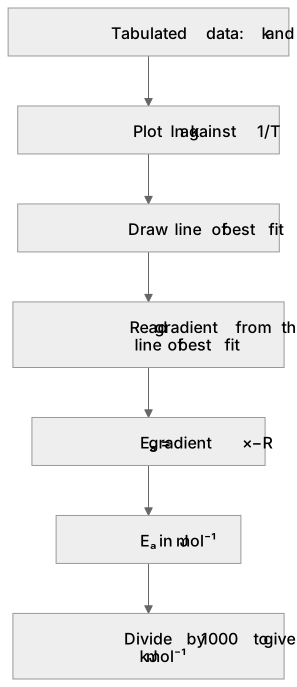
Put it in order
Put these steps in the order they happen.
- 1. Divide by 1000 to give kJ mol⁻¹
- 2. Eₐ in J mol⁻¹
- 3. Draw line of best fit
- 4. Eₐ = gradient × −R
- 5. Tabulated data: k and T
- 6. Plot ln k against 1/T
- 7. Read gradient from the line of best fit
Key words
Say what each word means before you turn the card.
Arrhenius equation
Try answering aloud or in your head before turning the card.
logarithmic form
Try answering aloud or in your head before turning the card.
ln k against 1/T
Try answering aloud or in your head before turning the card.
gradient and activation energy
Try answering aloud or in your head before turning the card.
See every definition
- Arrhenius equation
- An equation in which the rate constant k equals A multiplied by an exponential factor containing −Eₐ/RT.
- logarithmic form
- The equation ln k = −Eₐ/RT + ln A, which is the usable form of the Arrhenius equation.
- ln k against 1/T
- A plot that gives a straight line of gradient −Eₐ/R and intercept ln A.
- gradient and activation energy
- The activation energy comes from multiplying the gradient by −R.
Label the diagram
Some boxes have lost their names. Pick the right name for each number.
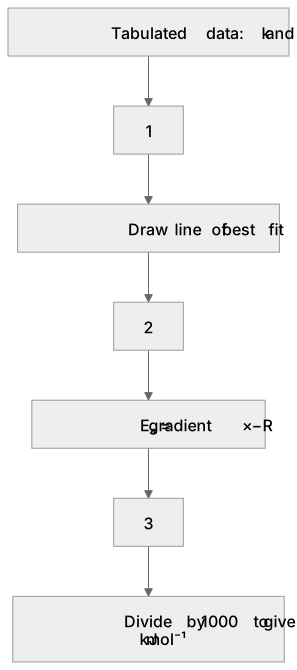
1Box 1
2Box 2
3Box 3
There is more to this lesson
The full lesson goes on to check your understanding and help you earn the marks. Create a free account to carry on, with your progress saved.
A week of Premium from your first lesson · Then the free plan continues · No card, no charge
Test your understanding of Rate equations (A-level only): These equations and the gas constant, R, will be given when required.
Active recall beats re-reading. Take an instant quiz now to test what you’ve learned and lock it into long-term memory.
A week of Premium from your first lesson · Then the free plan continues · No card, no charge