AQA · A-Level · Chemistry
Course version: 7405 · Version from Sept 2016
The Avogadro constant as the number of particles in a mole.
Full specification wording
The mole and the Avogadro constant: The Avogadro constant as the number of particles in a mole.
A mole is a counted amount: it contains as many particles as the Avogadro constant, 6.022 × 10²³ mol⁻¹.
Checked against the AQA 7405 specification (opens in a new tab) on .
- Point 1 of 2
- 4 key terms
Study notes
From the checked teaching notes for this specification point.
The idea
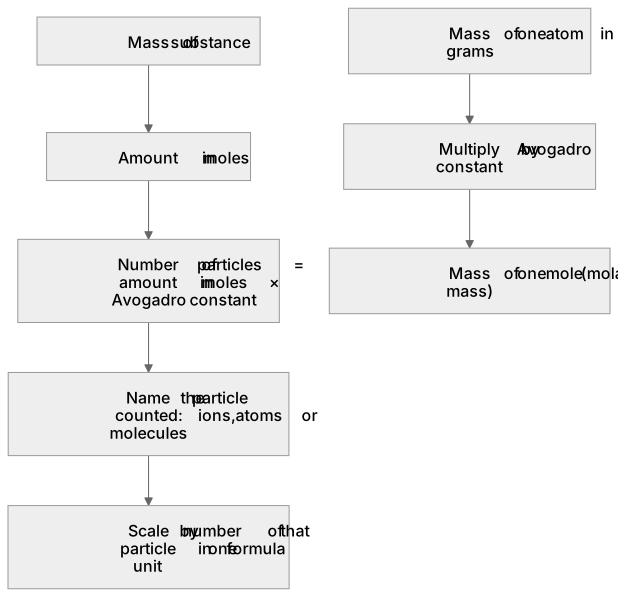
A mole is a counted amount: it contains as many particles as the Avogadro constant, 6.022 × 10²³ mol⁻¹. The link is number of particles = amount in moles × the Avogadro constant, which rearranges to give the amount from a count. It also converts between the scale of a single particle and the scale of the laboratory: the mass of one atom in grams multiplied by the Avogadro constant gives the mass of one mole, which is how a time of flight calculation turns a measured ion mass of 1.396 × 10⁻²² g into a molar mass of 84.0 g mol⁻¹. State which particle you are counting, because one mole of calcium chloride contains one mole of calcium ions but two moles of chloride ions.
What earns the marks
- Number of particles obtained as amount in moles multiplied by the Avogadro constant.
- Converting a mass to an amount in moles before counting particles.
- Scaling by the number of that particle in one formula unit.
- Naming the particle counted, such as ions, atoms or molecules.
Common mistakes and how to put them right
Dividing by the Avogadro constant when the number of particles is required.
Leaving a mass in kilograms when the molar mass is in grams per mole.
Counting formula units when the question asks for ions, so ignoring the subscripts.
Treating the Avogadro constant as a mass rather than a count per mole.
Exam tips
- Write down what is being counted before you calculate; the word ions or atoms in the question changes the answer.
- Check the direction of the conversion by asking whether the answer should be a huge number or a small one.
- Carry the units through: mol multiplied by mol⁻¹ leaves a pure number of particles.
Try the lesson
The start of the The mole and the Avogadro constant: The Avogadro constant as the number of particles in a mole. lesson, made from checked teaching notes for this specification point.
Have a go first
What does the Avogadro constant represent?
Listen
A mole is a counted amount: it contains as many particles as the Avogadro constant, 6.022 × 10²³ mol⁻¹. The link is number of particles = amount in moles × the Avogadro constant, which rearranges to give the amount from a count. It also converts between the scale of a single particle and the scale of the laboratory: the mass of one atom in grams multiplied by the Avogadro constant gives the mass of one mole, which is how a time of flight calculation turns a measured ion mass of 1.396 × 10⁻²² g into a molar mass of 84.0 g mol⁻¹. State which particle you are counting, because one mole of calcium chloride contains one mole of calcium ions but two moles of chloride ions. A strong answer earns marks for these points. number of particles obtained as amount in moles multiplied by the Avogadro constant. converting a mass to an amount in moles before counting particles. scaling by the number of that particle in one formula unit. naming the particle counted, such as ions, atoms or molecules. Exam tip: Write down what is being counted before you calculate; the word ions or atoms in the question changes the answer.
See it
Key words
Say what each word means before you turn the card.
Avogadro constant
Try answering aloud or in your head before turning the card.
the mole as a count
Try answering aloud or in your head before turning the card.
mass to moles
Try answering aloud or in your head before turning the card.
scaling to molar quantities
Try answering aloud or in your head before turning the card.
See every definition
- Avogadro constant
- The number of particles in a mole, 6.022 × 10²³ mol⁻¹.
- the mole as a count
- A counted amount that contains as many particles as the Avogadro constant.
- mass to moles
- Converting a mass to an amount in moles before counting particles.
- scaling to molar quantities
- Multiplying the mass of one atom in grams by the Avogadro constant to give the mass of one mole.
Label the diagram
Some boxes have lost their names. Pick the right name for each number.
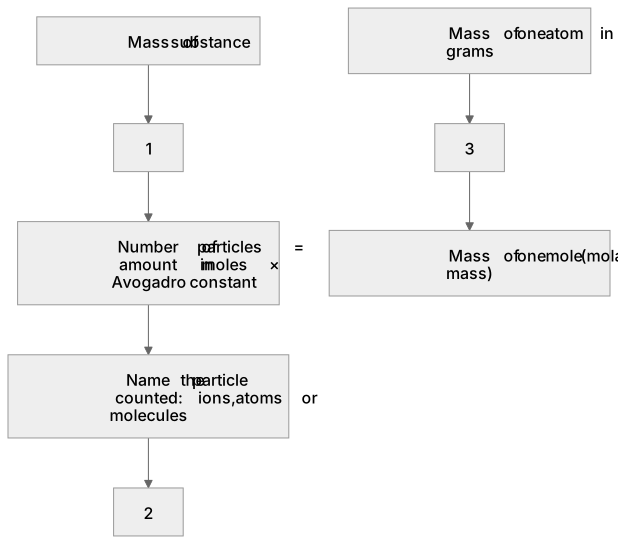
1Box 1
2Box 2
3Box 3
There is more to this lesson
The full lesson goes on to check your understanding and help you earn the marks. Create a free account to carry on, with your progress saved.
A week of Premium from your first lesson · Then the free plan continues · No card, no charge
Test your understanding of The mole and the Avogadro constant: The Avogadro constant as the number of particles in a mole.
Active recall beats re-reading. Take an instant quiz now to test what you’ve learned and lock it into long-term memory.
A week of Premium from your first lesson · Then the free plan continues · No card, no charge