AQA · A-Level · Chemistry
Course version: 7405 · Version from Sept 2016
The mole as applied to electrons, atoms, molecules, ions, formulas and…
Full specification wording
The mole and the Avogadro constant: The mole as applied to electrons, atoms, molecules, ions, formulas and equations.
The mole is the bridge between what you can weigh and what the equation counts.
Checked against the AQA 7405 specification (opens in a new tab) on .
- Point 2 of 2
Study notes
From the checked teaching notes for this specification point.
The idea
The mole is the bridge between what you can weigh and what the equation counts. Three routes give an amount: n = mass ÷ molar mass for a solid, n = concentration × volume in dm³ for a solution, and n = pV/RT for a gas. Once you have an amount, the coefficients in the balanced equation give the ratio to any other species, including electrons in a half-equation, where the number in front of the electron sets how many moles of charge flow per mole of reactant. Amounts also scale within a formula: one mole of sulfuric acid supplies two moles of hydrogen ions. Every multi-step calculation follows the same shape: get to moles, use the ratio, convert back.
What earns the marks
- An amount calculated as mass divided by molar mass.
- An amount in solution calculated as concentration multiplied by volume in cubic decimetres.
- Applying the stoichiometric ratio taken from the balanced equation.
- Converting the final amount back into the quantity the question asks for.
Common mistakes and how to put them right
Using a volume in cubic centimetres directly with a concentration in mol dm⁻³.
Inverting the mole ratio so the answer is out by the stoichiometric factor.
Using the relative atomic mass of an element when the substance is diatomic, such as using 16.0 for oxygen gas.
Forgetting that one mole of a compound supplies more than one mole of some of its ions.
Exam tips
- Write the balanced equation at the top of the working and ring the two species you are converting between.
- Label every amount with its species, for example n(hydrochloric acid), so ratios cannot be applied to the wrong substance.
- Keep full calculator precision until the final line, then round.
Try the lesson
The start of the The mole and the Avogadro constant: The mole as applied to electrons, atoms, molecules, ions, formulas and equations. lesson, made from checked teaching notes for this specification point.
Have a go first
How many moles of oxygen atoms are present in 1 mol of oxygen molecules, O₂?
Listen
The mole is the bridge between what you can weigh and what the equation counts. Three routes give an amount: n = mass ÷ molar mass for a solid, n = concentration × volume in dm³ for a solution, and n = pV/RT for a gas. Once you have an amount, the coefficients in the balanced equation give the ratio to any other species, including electrons in a half-equation, where the number in front of the electron sets how many moles of charge flow per mole of reactant. Amounts also scale within a formula: one mole of sulfuric acid supplies two moles of hydrogen ions. Every multi-step calculation follows the same shape: get to moles, use the ratio, convert back. A strong answer earns marks for these points. an amount calculated as mass divided by molar mass. an amount in solution calculated as concentration multiplied by volume in cubic decimetres. applying the stoichiometric ratio taken from the balanced equation. converting the final amount back into the quantity the question asks for. Exam tip: Write the balanced equation at the top of the working and ring the two species you are converting between.
See it
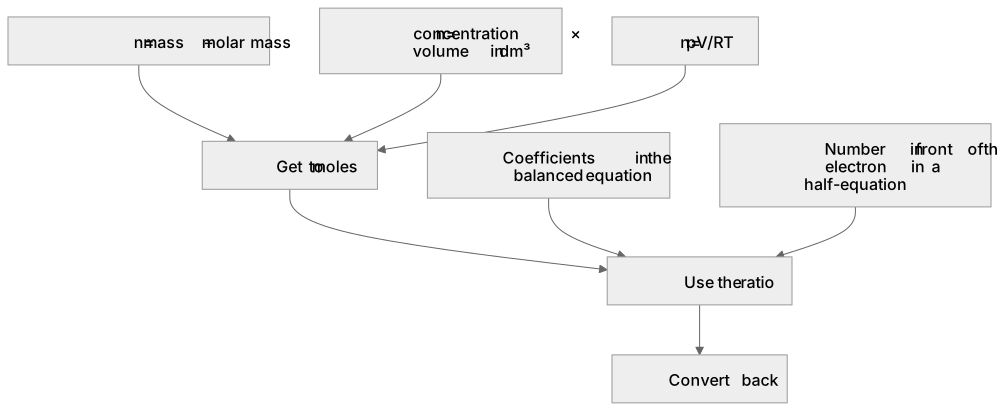
Label the diagram
Some boxes have lost their names. Pick the right name for each number.
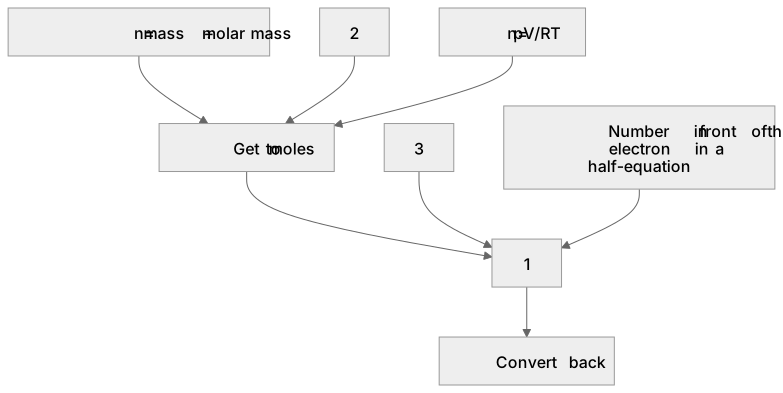
1Box 1
2Box 2
3Box 3
There is more to this lesson
The full lesson goes on to check your understanding and help you earn the marks. Create a free account to carry on, with your progress saved.
A week of Premium from your first lesson · Then the free plan continues · No card, no charge
Test your understanding of The mole and the Avogadro constant: The mole as applied to electrons, atoms, molecules, ions, formulas and equations.
Active recall beats re-reading. Take an instant quiz now to test what you’ve learned and lock it into long-term memory.
A week of Premium from your first lesson · Then the free plan continues · No card, no charge