OCR · GCSE · Economics
Elasticity of Supply
This study guide provides a comprehensive overview of Price Elasticity of Supply (PES) for OCR GCSE Economics. It is designed to help students master the calculations, analysis, and evaluation skills required to achieve top marks by focusing on key determinants and common exam pitfalls.
- 4 min read
- 3 worked examples
- 5 practice questions
- 6 key terms
Study Notes

Overview
Price Elasticity of Supply (PES) is a fundamental concept in economics that measures the responsiveness of quantity supplied to a change in price. For the OCR J205 specification, candidates are expected not only to calculate PES but also to provide detailed analysis of its determinants in various market contexts. Examiners award significant credit for the ability to construct clear chains of reasoning, linking factors like spare capacity and stock levels to the resulting elasticity. This guide will equip you with the necessary formula, analytical frameworks, and exam techniques to confidently tackle PES questions. We will explore the distinction between short-run and long-run supply, apply the concept to real-world industries like agriculture and manufacturing, and highlight the evaluation skills needed to access the highest mark bands. Mastering PES is crucial as it frequently appears in both calculation and extended-answer questions, and provides a strong foundation for understanding market dynamics.
Key Concepts
The PES Formula and Interpretation
What it is: The formula is the essential starting point for any PES question. Marks are consistently awarded for stating it correctly.
Why it matters: It provides the quantitative measure from which all analysis flows. The resulting value tells you whether supply is elastic, inelastic, or unitary.
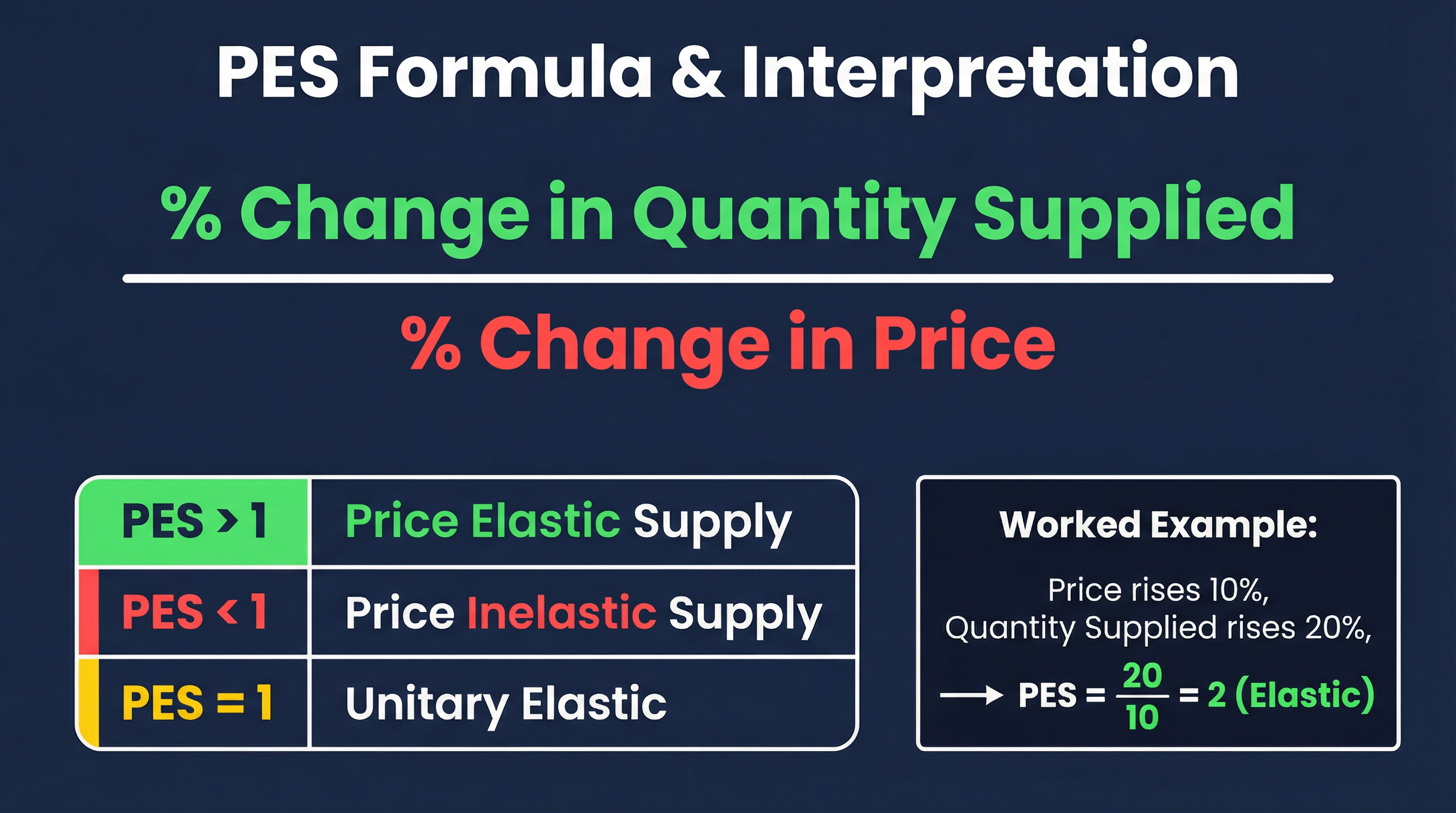
Specific Knowledge: Candidates must know the formula: % Change in Quantity Supplied / % Change in Price. A result > 1 is Price Elastic, < 1 is Price Inelastic, and = 1 is Unitary Elastic.

Determinants of PES
What they are: These are the factors that determine whether a firm can respond quickly or slowly to a change in price. Understanding these is key to analytical questions.
Why it matters: Examiners require candidates to go beyond definitions and analyse why supply is elastic or inelastic in a given scenario. Using these determinants provides the structure for your answer.
Specific Knowledge: The main determinants can be remembered with the mnemonic TEASS: Time, Economy (Spare Capacity), Availability of Factors, Stocks, Substitutability of Factors.

Second-Order Concepts
Causation
The primary cause of a change in the elasticity of supply is the time period. In the short run, at least one factor of production is fixed, making supply more inelastic. In the long run, all factors are variable, allowing firms to expand production and making supply more elastic.
Consequence
The consequence of inelastic supply is that firms cannot easily respond to increases in demand and price, potentially missing out on higher revenue. For consumers, it can mean sharp price hikes for essential goods after a supply shock. Elastic supply, conversely, leads to greater price stability.
Change & Continuity
Change: A firm's PES can change over time. For example, a manufacturing firm might invest in new, flexible machinery, increasing its PES. Continuity: The PES for agricultural goods, like fresh fruit, will likely always remain low in the short run due to the biological time lags in production.
Significance
Understanding PES is significant for government policy. For example, if the government wants to tax a good, knowing its PES helps predict the impact on producers and the final market price. It is also significant for firms making production decisions.

Worked Examples
3 worked examples — open one to explore the question and available guidance.
Practice Questions
Test your understanding — click to reveal model answers
Explain two reasons why the supply of new housing in the UK is likely to be price inelastic. (6 marks)
Hint: Think about the time and resources needed to build a house. Use the TEASS mnemonic.
The price of a handmade wooden chair increases from £200 to £250. As a result, a small furniture maker increases their weekly output from 10 chairs to 12 chairs. Calculate the PES. (4 marks)
Hint: First, calculate the percentage change for price and quantity separately. Then, use the PES formula.
Explain why a firm with large amounts of unsold stock is likely to have elastic supply. (4 marks)
Hint: How quickly can the firm get products to market if they are already made?
Explain why the PES for a rock band giving a concert is likely to be perfectly inelastic on the day of the show. (3 marks)
Hint: Think about the capacity of the venue.
A firm has a PES of 2.5. If the market price increases by 10%, what will be the percentage change in the quantity supplied? (2 marks)
Hint: Rearrange the PES formula to solve for the unknown.
Test your understanding of Elasticity of Supply
Active recall beats re-reading. Take an instant quiz now to test what you’ve learned and lock it into long-term memory.
7 days Premium · Then free forever · No card, no charge