Market Equilibrium and Price Determination — OCR GCSE Study Guide
Exam Board: OCR | Level: GCSE
This study guide provides a comprehensive overview of Market Equilibrium and Price Determination for OCR GCSE Economics (J205). It covers the core concepts of demand and supply, the mechanism of price determination, and the analysis of market changes, all tailored to maximise exam performance.
## Overview
Market equilibrium is one of the most fundamental concepts in economics. It describes the state where the supply of a product perfectly matches the demand from consumers. For the OCR GCSE Economics exam, candidates must not only understand this concept but also be able to illustrate it with precision using supply and demand diagrams. This topic, a core part of Component 01, requires a clear understanding of how the 'invisible hand' of the market works to set prices and allocate resources. Examiners expect candidates to explain the process of adjustment towards equilibrium, analysing how shortages and surpluses are eliminated through the price mechanism. A key area where marks are won or lost is the ability to distinguish between a movement along a curve (caused by a price change) and a shift of an entire curve (caused by a non-price factor). Mastery of this distinction is crucial for achieving high grades.

## The Core Concepts: Demand and Supply
### The Law of Demand
**What it is**: The law of demand states that, ceteris paribus (meaning 'all other things being equal'), as the price of a good falls, the quantity demanded will increase. This is an inverse relationship.
**Why it matters**: This explains the downward-sloping shape of the demand curve. Candidates must be able to explain that at lower prices, more consumers are willing and able to buy the product.
**Specific Knowledge**: A change in the price of the good itself causes a **movement along** the demand curve (an extension or contraction). A change in a non-price factor causes a **shift** in the entire demand curve. These factors include:
- **I**ncome (for normal goods, higher income means more demand)
- **P**rices of related goods (substitutes and complements)
- **A**dvertising and tastes
- **P**opulation size
- **S**easons
### The Law of Supply
**What it is**: The law of supply states that, ceteris paribus, as the price of a good rises, the quantity supplied will increase. This is a positive relationship.
**Why it matters**: This explains the upward-sloping shape of the supply curve. For the exam, candidates should explain that higher prices provide a greater profit incentive for firms to produce and sell more.
**Specific Knowledge**: A change in the price of the good itself causes a **movement along** the supply curve. A change in a non-price factor causes a **shift**. These factors include:
- **P**roduction costs (e.g., wages, raw materials)
- **I**nnovation and technology
- **N**atural factors (e.g., weather for crops)
- **T**axes and subsidies
## Market Equilibrium in Detail
### Finding Equilibrium
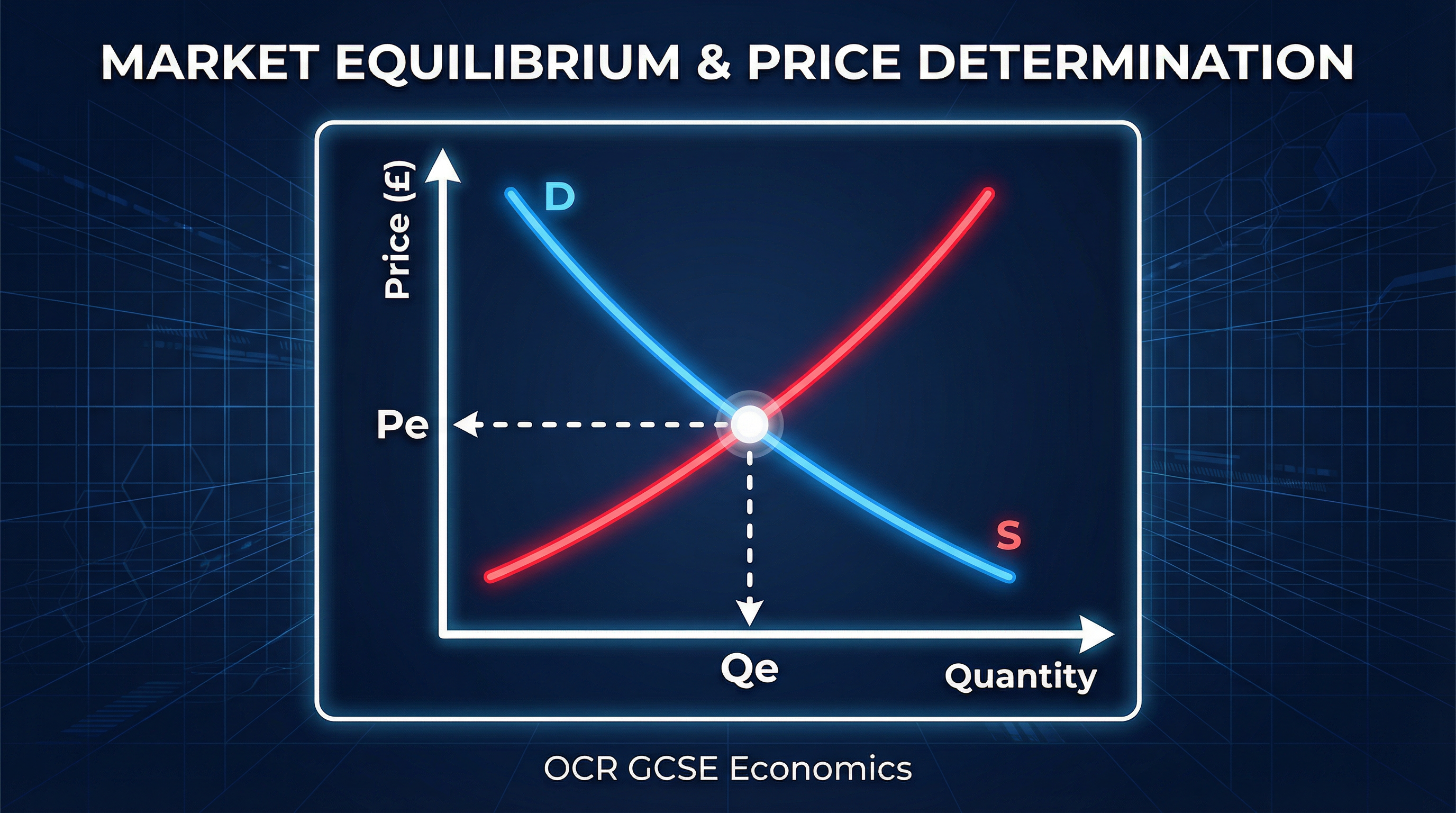
The market is in equilibrium where the demand curve and supply curve intersect. At this point, the quantity demanded by consumers is exactly equal to the quantity supplied by producers. There is no tendency for the price or quantity to change. This is the market-clearing price.
### Disequilibrium: Shortages and Surpluses
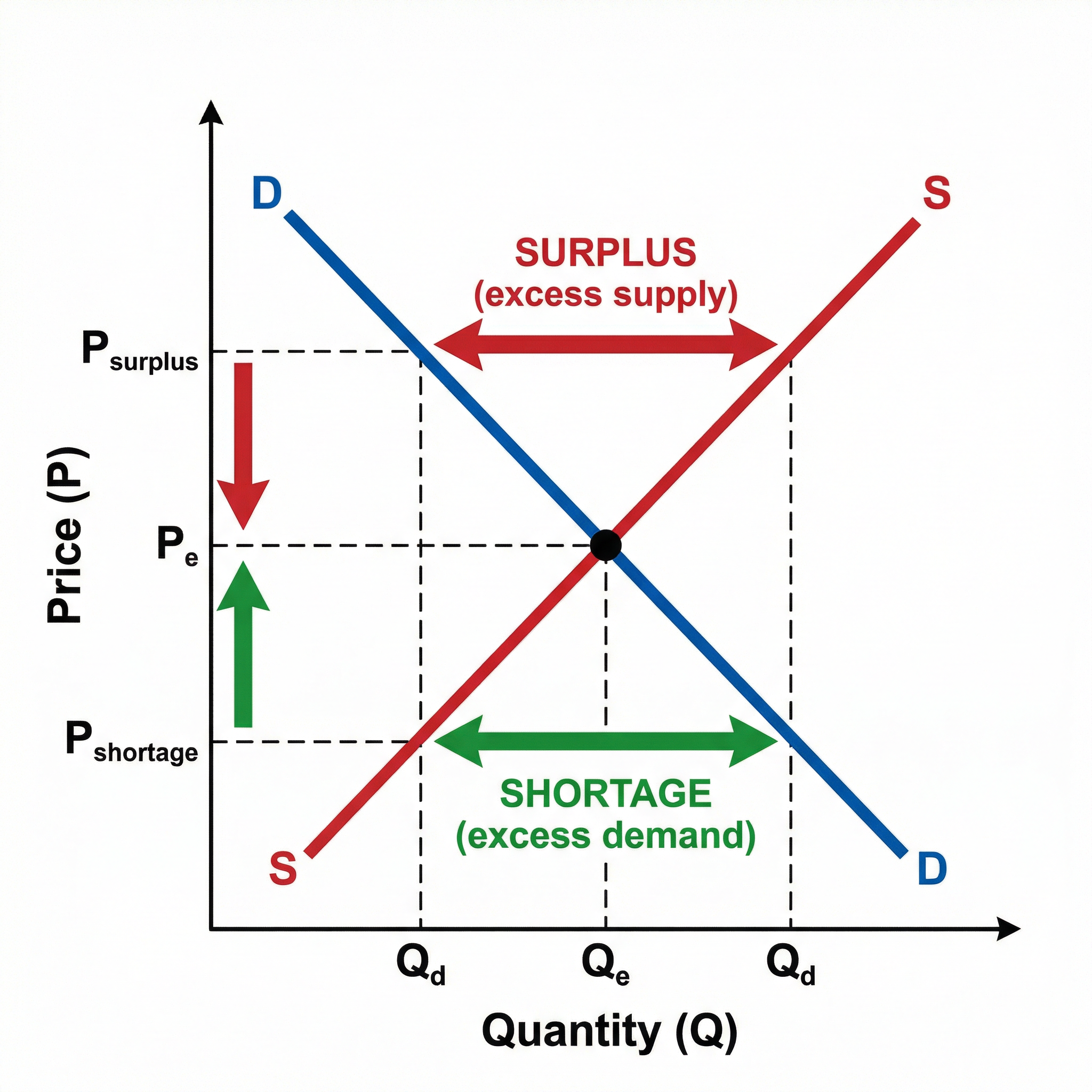
**Excess Demand (Shortage)**: If the price is set below the equilibrium price (like at P_shortage in the diagram), quantity demanded will exceed quantity supplied. There are too many consumers chasing too few goods. This puts **upward pressure** on the price. As the price rises:
- Producers are incentivised to supply more (extension of supply).
- Consumers' willingness to buy decreases (contraction of demand).
- This continues until the market returns to equilibrium.
**Excess Supply (Surplus)**: If the price is set above the equilibrium price (like at P_surplus), quantity supplied will exceed quantity demanded. Producers have unsold stock. This puts **downward pressure** on the price. As the price falls:
- Producers reduce their supply (contraction of supply).
- Consumers are more willing to buy (extension of demand).
- This continues until the market clears and returns to equilibrium.
## Shifts in Demand and Supply
### A Shift in Demand
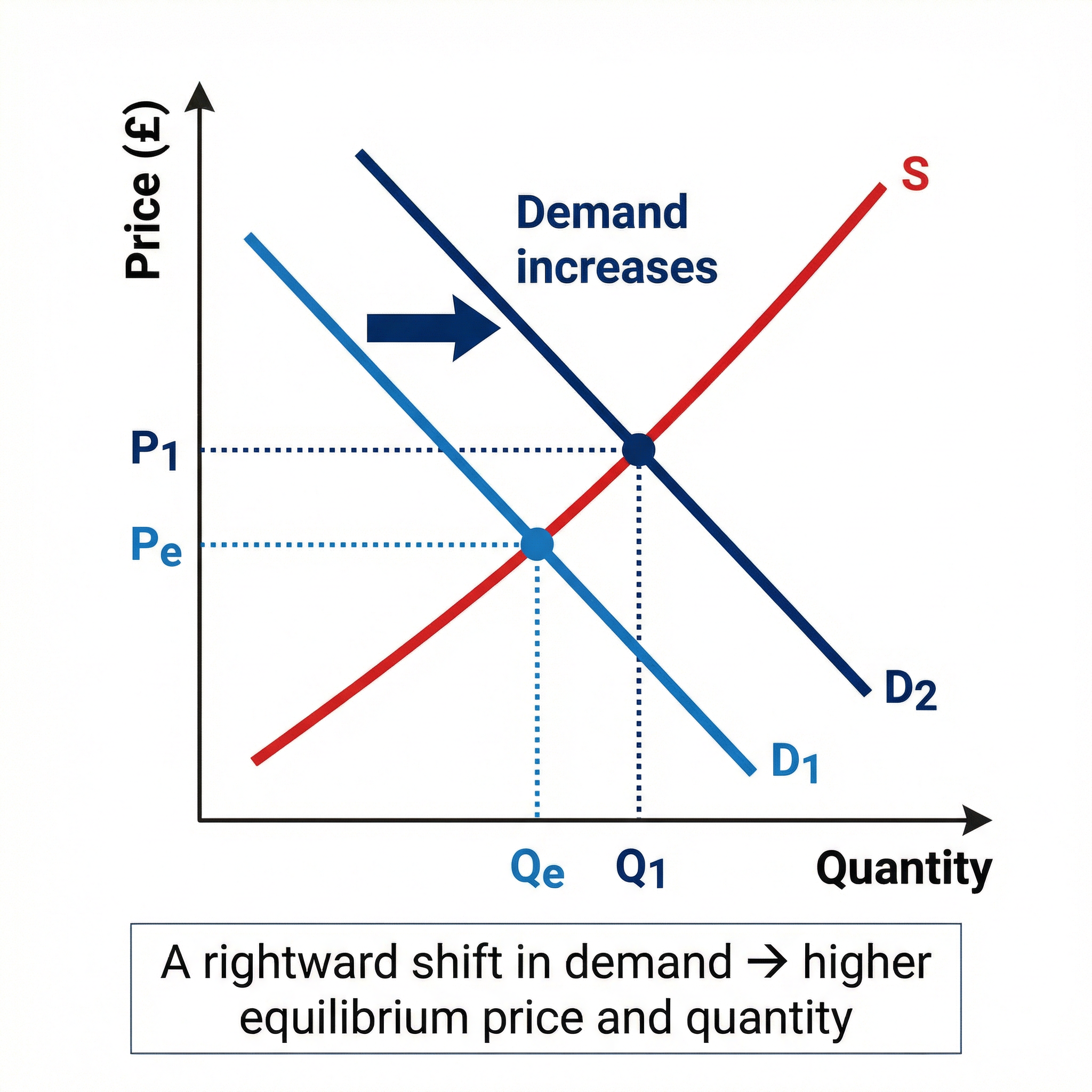
**What happened**: An external factor, such as a successful advertising campaign or a rise in consumer incomes, has increased the demand for the product at every price level. This shifts the demand curve to the right from D1 to D2.
**Why it matters**: At the original price Pe, there is now a shortage (excess demand). This bids the price up. The market moves to a new, higher equilibrium at P1, with a higher quantity traded at Q1. Candidates must be able to explain this chain of reasoning.
### A Shift in Supply
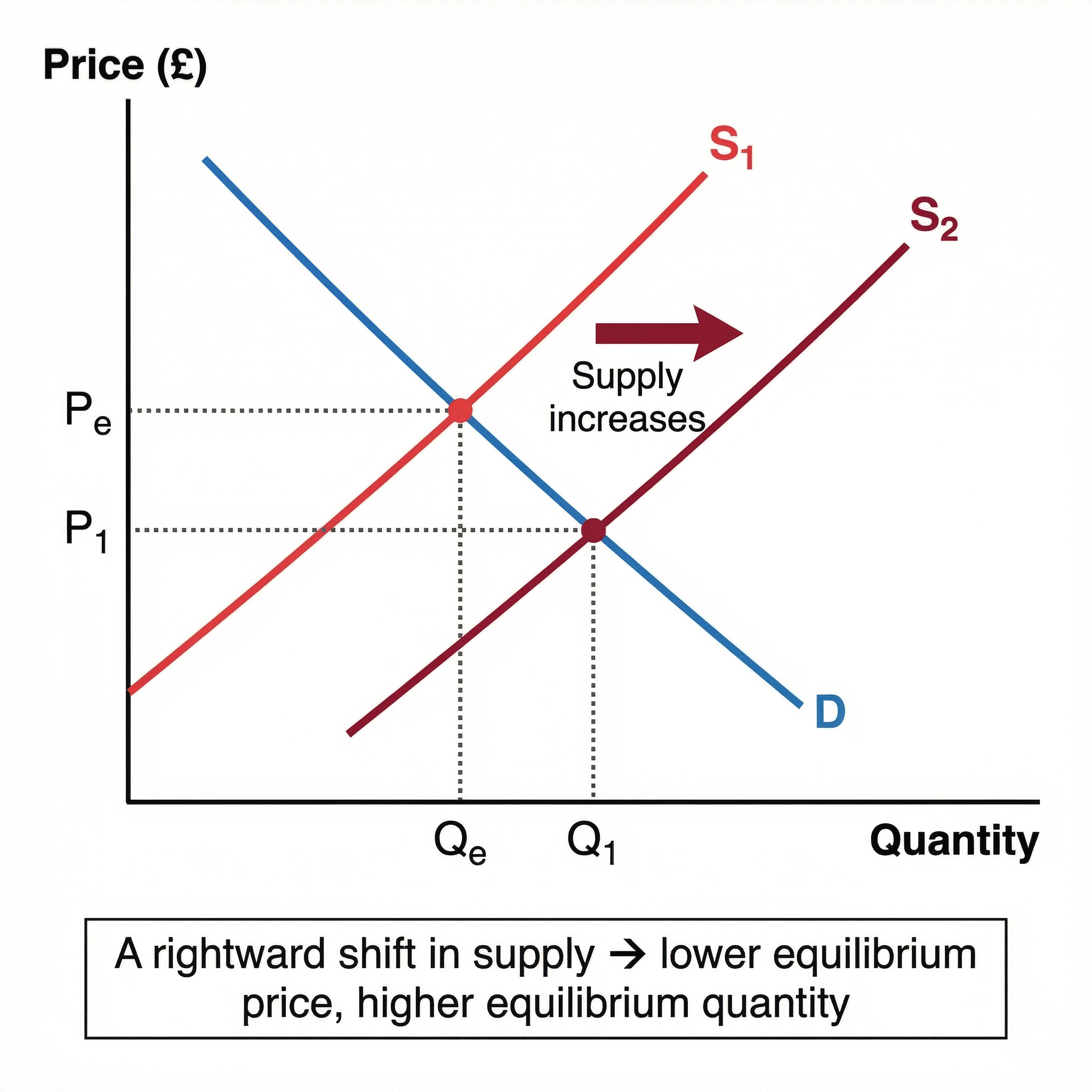
**What happened**: An external factor, such as a new technology that lowers production costs, has increased the supply of the product at every price level. This shifts the supply curve to the right from S1 to S2.
**Why it matters**: At the original price Pe, there is now a surplus (excess supply). This forces the price down. The market moves to a new, lower equilibrium at P1, with a higher quantity traded at Q1. Again, explaining this process is key to gaining marks.