OCR · GCSE · English Literature
Anita and Me
Meera Syal's 'Anita and Me' is a vibrant, semi-autobiographical novel that offers a profound exploration of bicultural identity, racism, and the challenges of growing up in 1970s Britain. For GCSE students, it provides a rich opportunity to analyse how a writer uses a dual narrative voice and vivid characterisation to tackle complex social issues with both humour and pathos, securing top marks in AO2 and AO3."
- 11 min read
- 2 worked examples
- 4 practice questions
Study Notes
Overview
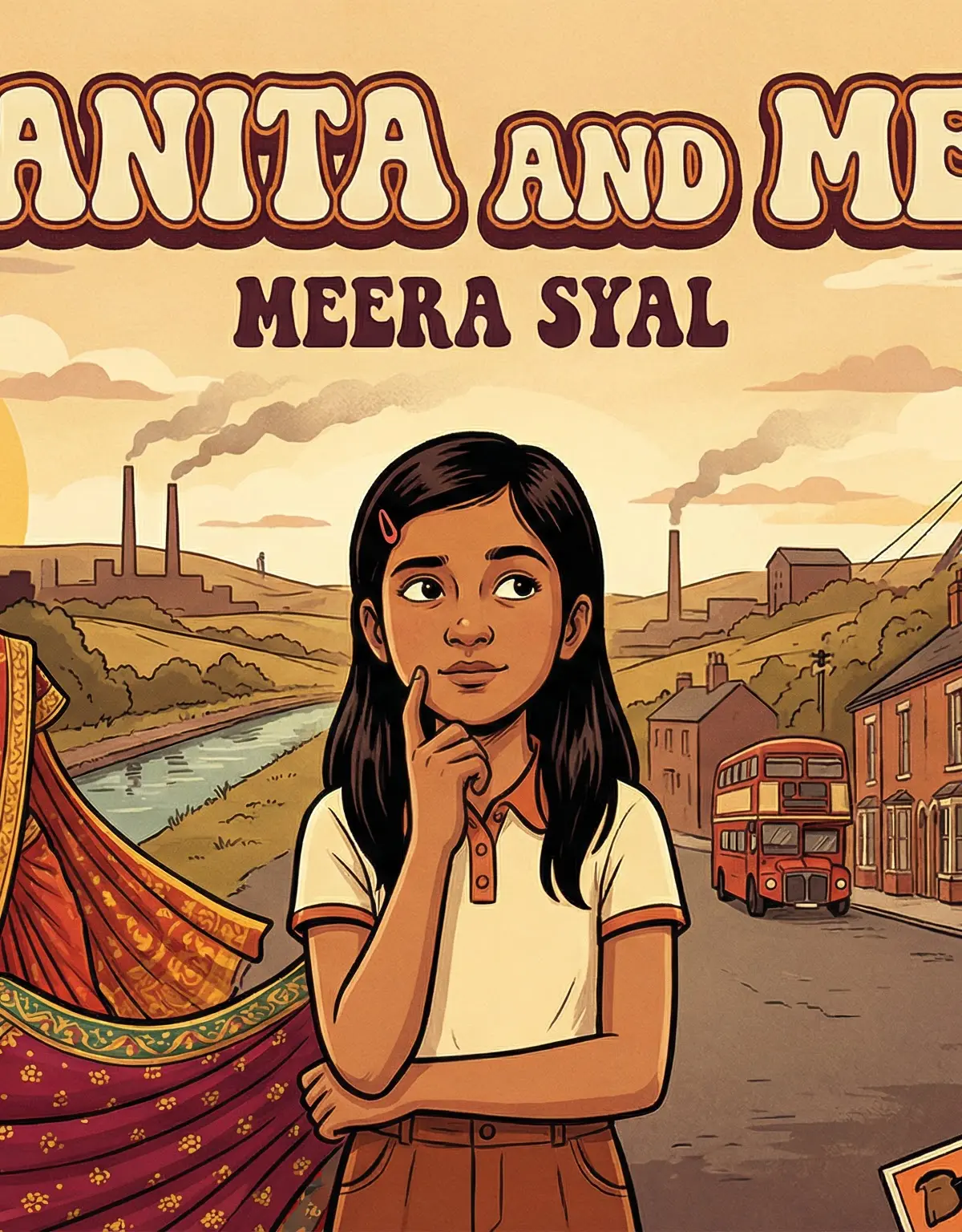
'Anita and Me' is a bildungsroman, or coming-of-age novel, that charts the journey of nine-year-old Meena Kumar, the daughter of Indian immigrants, growing up in the fictional Midlands mining village of Tollington in the early 1970s. As the only Punjabi family in a white, working-class community, the Kumars navigate the complexities of assimilation and cultural preservation. The novel is a masterful blend of comedy and tragedy, using the innocent-yet-mischievous voice of young Meena, contrasted with the reflective tone of her older self, to explore deep-seated social prejudices. Examiners credit candidates who can move beyond a simple plot summary to analyse this sophisticated dual narrative. A top-band response will explore how Syal uses Meena's adoration of the rebellious, charismatic Anita Rutter to expose the tensions between her desire for belonging and the need to forge her own unique identity. Marks are awarded for a clear understanding of how the novel's social and historical context—specifically the decline of industrial communities and the rise of racial tensions following Enoch Powell's 'Rivers of Blood' speech—shapes the characters' lives and motivations.
Plot/Content Overview
Part 1: Innocence and IdolisationThe novel opens with Meena's family moving to Tollington. Meena, a lively and imaginative child, is immediately captivated by the anarchic energy of the village children, particularly the beautiful and defiant Anita Rutter. She spends her days trying to win Anita's approval, often lying and exaggerating to make herself seem more interesting. This first section establishes Meena's internal conflict: the pull of her family's traditional Punjabi values versus her desperate yearning to be part of Anita's world.
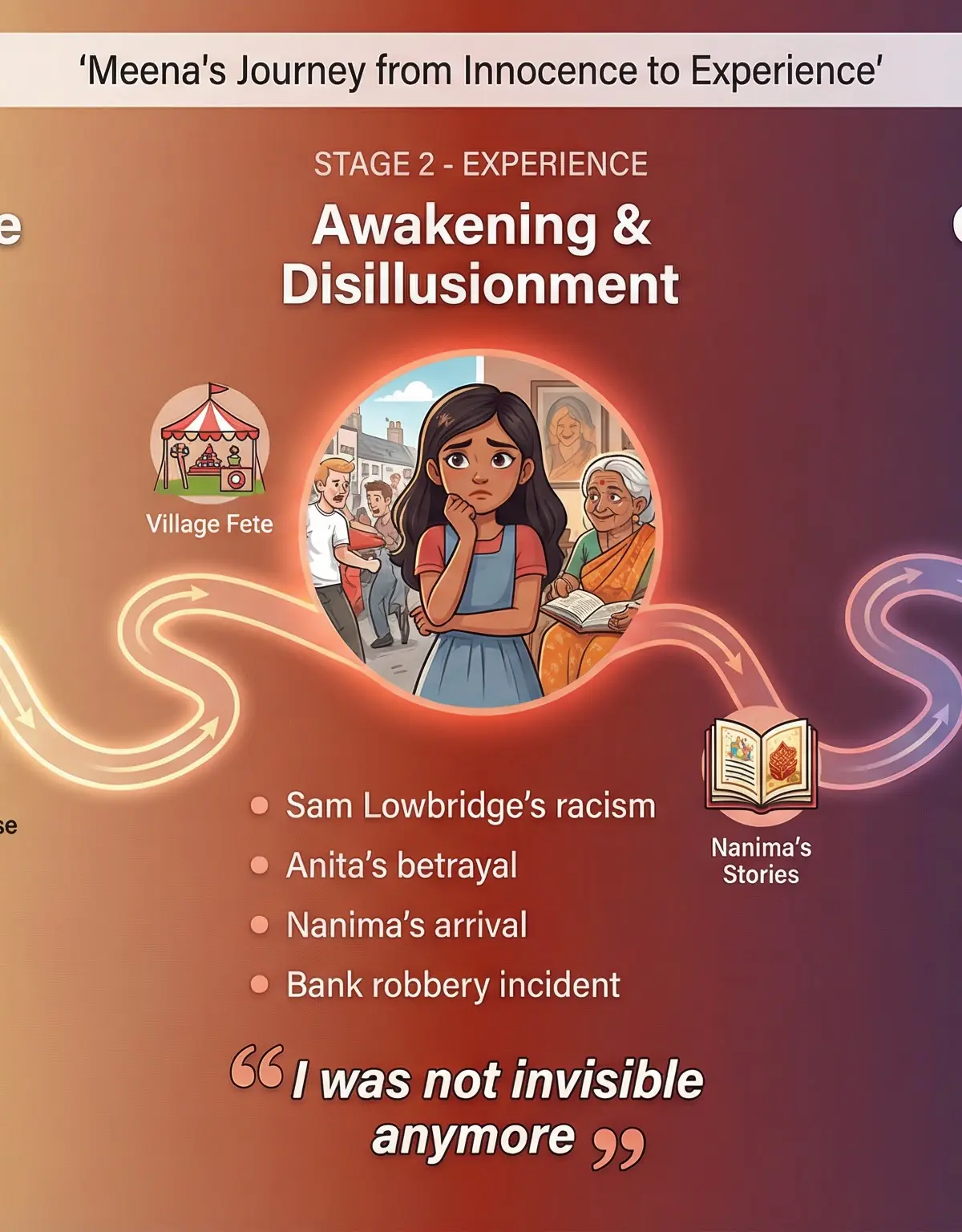
Part 2: The Cracks AppearAs Meena gets older, she begins to see the darker side of Tollington. The casual racism she once ignored becomes more overt, particularly with the presence of Sam Lowbridge, a local youth who becomes involved with the racist National Front. A key turning point is the village fete, where a racist remark shatters Meena's sense of belonging. Her grandmother, Nanima, arrives from India, bringing with her a wealth of stories and a strong connection to Meena's heritage, forcing Meena to confront the identity she has been trying to suppress. Anita's behaviour also becomes more cruel and manipulative, leading to a growing disillusionment in Meena.
Part 3: Maturity and Self-AcceptanceThe climax occurs when Meena, after a series of betrayals, finally rejects Anita. This act signifies her liberation from the need for external validation. She begins to embrace her dual identity, finding strength in her family and her heritage. Having passed her eleven-plus exam, the novel ends with Meena preparing to leave Tollington for a new life at grammar school, no longer a confused child but a young woman who understands where she comes from and is ready to forge her own path.
Themes
Theme 1: Identity and Belonging
This is the central theme of the novel. Meena's journey is a quest to understand who she is in a world that constantly tries to define her. She is caught between two cultures: the traditional, loving, but sometimes stifling world of her Punjabi family, and the exciting, rebellious, but ultimately exclusionary world of white, working-class Tollington. Syal uses the dual narrative to show how Meena's perspective on her identity shifts from childhood shame to adult acceptance. Credit is given for analysing how symbols like food, clothing, and language are used to represent this cultural negotiation.
Key Quotes:
- "I just wanted to be a part of this, this noisy, messy, naughty world." (Chapter 2) - This quote, from early in the novel, perfectly encapsulates Meena's initial desire to escape her own culture and assimilate into the dominant white culture represented by Anita.
- "I had been cast as the Indian in this village drama, and I was not going to shy away from my role." (Chapter 10) - This marks a significant shift in Meena's self-perception. After experiencing overt racism, she begins to understand that her identity is not something she can simply discard.
- "And I knew, with a certainty that was new to me, that I was not and never would be a part of their world." (Chapter 13) - Meena's final realisation that she cannot fully belong in Anita's world is a moment of painful but necessary self-discovery, paving the way for her to accept her own unique identity.
Theme 2: Racism and Prejudice
Syal explores racism in its various forms, from the overt and violent bigotry of Sam Lowbridge to the more subtle, insidious prejudice of characters who see Meena as an exotic curiosity. The novel is set against the backdrop of Enoch Powell's anti-immigrant rhetoric, and examiners expect candidates to connect the events of the novel to this specific historical context (AO3). The text demonstrates how casual racism can be just as damaging as overt hatred, as it creates a constant sense of 'otherness' for Meena.
Key Quotes:
- "'It's the wogs,' he said, and his voice was full of a glee I had never heard before." (Chapter 10) - Sam Lowbridge's use of a racial slur during the fete is a moment of shocking clarity for Meena, forcing her to confront the reality of racism in her community.
- "'Oh, you are a cheeky little monkey!'" (Chapter 4) - This seemingly harmless comment from a neighbour reveals a common microaggression, where Meena is infantilized and exoticized, reducing her to a stereotype rather than seeing her as an individual.
- "Because we were the only Punjabis in the village, and so, despite the fact that I was born in Tollington, I was still the 'Indian'." (Chapter 1) - This highlights the inescapable nature of prejudice; regardless of her birthplace, Meena is defined by her ethnicity.
Theme 3: Class and Social Division
Beyond race, the novel is deeply concerned with class. The Kumars are educated and middle-class, which sets them apart from the working-class community of Tollington. Meena is fascinated by the perceived freedom and authenticity of the working-class lifestyle, but she also benefits from the social mobility that her parents' education affords her. Syal critiques the limitations that class can impose, particularly on characters like Anita, whose lack of opportunities contributes to her bitterness and cruelty.
Key Quotes:
- "The Big House, as it was known, was a symbol of everything we could have, and everything they couldn't." (Chapter 3) - The Big House represents the aspirations of the Kumar family and the stark class divide in Tollington.
- "Anita was the queen of our yard, the undisputed leader of our gang." (Chapter 2) - Anita's social power is derived from her confidence and her position within the working-class hierarchy of the village.
- "I was going to be a writer. I was going to be a star. I was going to get out." (Chapter 13) - Meena's ambition, fuelled by her education, contrasts sharply with the limited horizons of many of the other children in Tollington, highlighting the role of class in shaping life chances.
Character Analysis
Meena Kumar
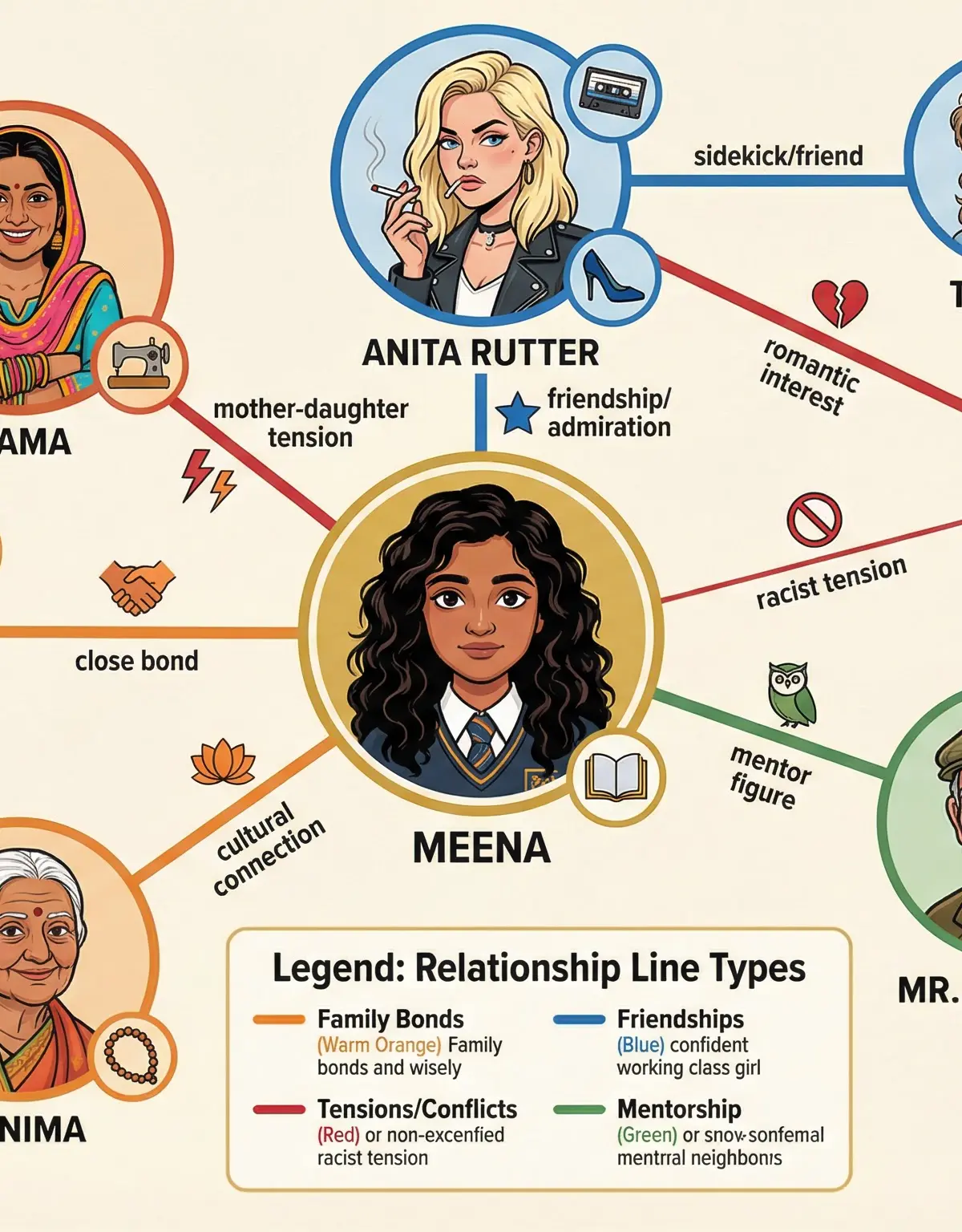
Role: Protagonist and narrator. Her journey from a naive nine-year-old to a self-aware adolescent forms the core of the novel.
Key Traits: Imaginative, mischievous, observant, and a compulsive liar in her youth. She is torn between her desire to fit in and her loyalty to her family.
Character Arc: Meena's arc is a classic bildungsroman journey. She begins by idolising Anita and rejecting her own culture. Through a series of painful experiences with racism and betrayal, she learns to value her heritage and develops a stronger sense of self. Her academic success at the end of the novel symbolises her ability to forge a future that integrates both her British and Indian identities.
Essential Quotes:
- "I was a liar. A filthy, rotten, pathological liar." (Chapter 1)
- "I felt the first stirrings of what I would come to recognise as my social conscience." (Chapter 10)
- "I had a place in the world now. It was not a big place, but it was mine." (Chapter 13)
Anita Rutter
Role: Antagonist and foil to Meena. She represents the allure and the danger of the white, working-class culture that Meena initially idealises.
Key Traits: Confident, rebellious, charismatic, but also cruel, manipulative, and ultimately limited by her circumstances.
Character Arc: Anita's character arc is largely static. She remains trapped in the small world of Tollington, her early promise curdling into bitterness. Her relationship with the racist Sam Lowbridge and her casual cruelty towards Meena reveal her moral weaknesses. By the end of the novel, she has become a tragic figure, a product of her environment with little hope of escape.
Essential Quotes:
- "She had a face that could make you do anything." (Chapter 2)
- "She was my passport to acceptance." (Chapter 5)
- "She just looked tired. And old." (Chapter 13)
Mama and Papa (Mrs and Mr Kumar)
Role: Represent the first-generation immigrant experience and the cultural tensions Meena navigates.
Key Traits: Mama is traditional, proud, and often frustrated by her life in England. Papa is educated, gentle, and optimistic, believing in the promise of a better life for his children.
Character Arc: While their individual characters don't change dramatically, their role in Meena's life does. Initially, they are figures of authority and tradition that Meena rebels against. As she matures, she comes to appreciate their sacrifices and the cultural richness they have given her.
Essential Quotes:
- (Mama) "You can't have two lives, Meena. You have to choose." (Chapter 8)
- (Papa) "We must be the best, Meena. Then they will respect us." (Chapter 6)
Writer's Methods
Dual Narrative Voice: This is arguably the most important technique to analyse. Syal masterfully switches between the naive, humorous perspective of young Meena and the ironic, reflective voice of the adult narrator. This allows for a complex exploration of themes. For example, young Meena might describe a racist comment without fully understanding its implications, while the adult narrator's tone makes the prejudice clear to the reader. Marks are awarded for explaining the effect of this technique.
Humour and Irony: The novel is very funny, but the humour often has a serious purpose. Syal uses irony to expose the absurdities of prejudice and cultural misunderstandings. For example, the scene where the family tries to explain Diwali to their neighbours is both comical and poignant.
Bildungsroman Structure: The novel follows a clear coming-of-age structure, moving from innocence to experience. Candidates should be able to trace Meena's development through the key events of the plot, linking her personal growth to the wider themes of the novel.
Language and Dialect: Syal incorporates both Black Country dialect and Punjabi words into the narrative. This linguistic code-switching reflects Meena's hybrid identity and the multicultural world she inhabits. Analysing how and why characters use different forms of language is a key way to access AO2 marks.
Context
Social and Historical Context: To achieve high marks for AO3, candidates MUST integrate contextual understanding. Key points include:
- The 1970s in Britain: A period of economic decline, industrial unrest, and social change.
- Enoch Powell's 'Rivers of Blood' Speech (1968): This speech dramatically increased racial tensions and gave a voice to anti-immigrant sentiment. Sam Lowbridge's character is a direct product of this political climate.
- The Immigrant Experience: The novel explores the challenges faced by first and second-generation immigrants, including the pressure to assimilate, the experience of racism, and the preservation of cultural heritage.
- The Black Country: The specific setting is crucial. It was a traditional, white, working-class area dominated by heavy industry. The arrival of a Punjabi family would have been a significant event.
Literary Context: As a semi-autobiographical bildungsroman, 'Anita and Me' can be compared to other coming-of-age stories or novels that explore the immigrant experience. A postcolonial reading of the text would focus on the power dynamics between the white British majority and the South Asian minority, and how Meena internalises and then challenges colonial attitudes."
Worked Examples
2 worked examples — open one to explore the question and available guidance.
Practice Questions
Test your understanding — click to reveal model answers
Explore how Syal uses the character of Nanima to influence Meena's sense of identity.
Hint: Consider what Meena's life was like before Nanima's arrival and what changes afterwards. Focus on the role of storytelling and cultural heritage.
How does Syal present the theme of friendship in 'Anita and Me'?
Hint: Compare and contrast Meena's friendship with Anita with other relationships in the novel. Is friendship always a positive force?
'Syal's humour in 'Anita and Me' only serves to hide the seriousness of racism.' To what extent do you agree?
Hint: This is an 'evaluate' question. You need to argue for and against the statement. Does humour make the racism easier to digest, or does it make it even more shocking?
Explore the significance of the setting of Tollington in the novel.
Hint: Think about how the village itself is a character. Consider its physical environment, its social structure, and how it changes over the course of the novel.
Test your understanding of Anita and Me
Active recall beats re-reading. Take an instant quiz now to test what you’ve learned and lock it into long-term memory.
7 days Premium · Then free forever · No card, no charge