OCR · GCSE · English Literature
Jane Eyre
Master Charlotte Brontë's Jane Eyre for your OCR GCSE exam with this comprehensive guide. We dissect the Bildungsroman structure, explore key themes of independence and social justice, and analyse the Gothic conventions that make this novel a timeless classic. This guide is designed to help you secure top marks by focusing on examiner expectations and providing you with the tools to write a conceptualised, integrated response.
- 10 min read
- 2 worked examples
- 4 practice questions
- 8 key terms
Study Notes
Overview
Jane Eyre, written by Charlotte Brontë and published in 1847 under the pseudonym 'Currer Bell', is a seminal work of English literature that charts the moral and psychological growth of its eponymous protagonist. For the OCR J352 GCSE specification, this text is a cornerstone of Component 01, Section B, where candidates are required to produce a sustained, integrated essay response. Your task will be to use a given extract as a starting point to explore a theme or character across the entire novel. Examiners are looking for a balance between close language analysis (AO2), a conceptualised understanding of the novel's development (AO1), and the seamless integration of Victorian context (AO3). This guide will equip you with the knowledge and skills to navigate the text's complexities, from its Gothic elements like the mysterious Thornfield Hall and the 'madwoman in the attic', to its powerful critique of social and gender inequality in the 19th century. Credit is consistently awarded to candidates who can move beyond plot summary and analyse Brontë's authorial methods with precision.
Plot/Content Overview
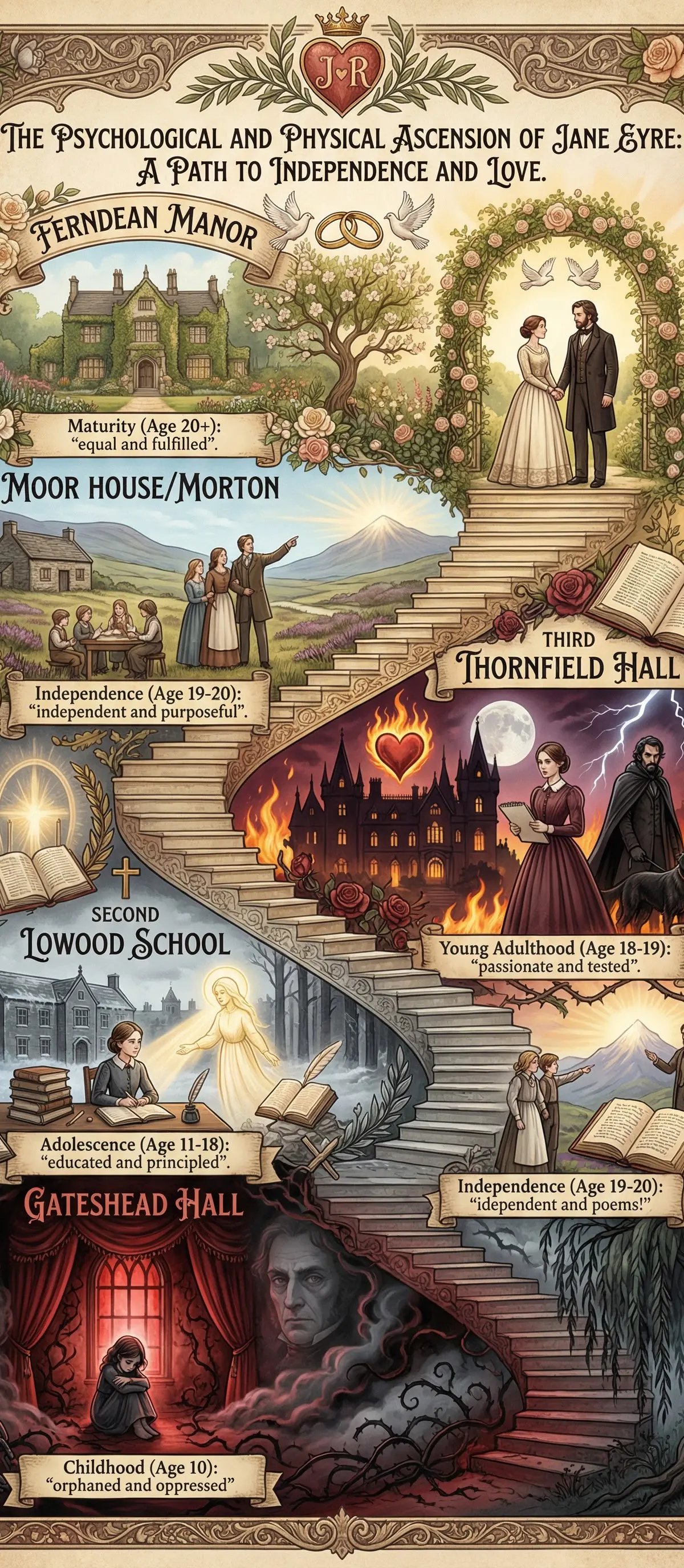
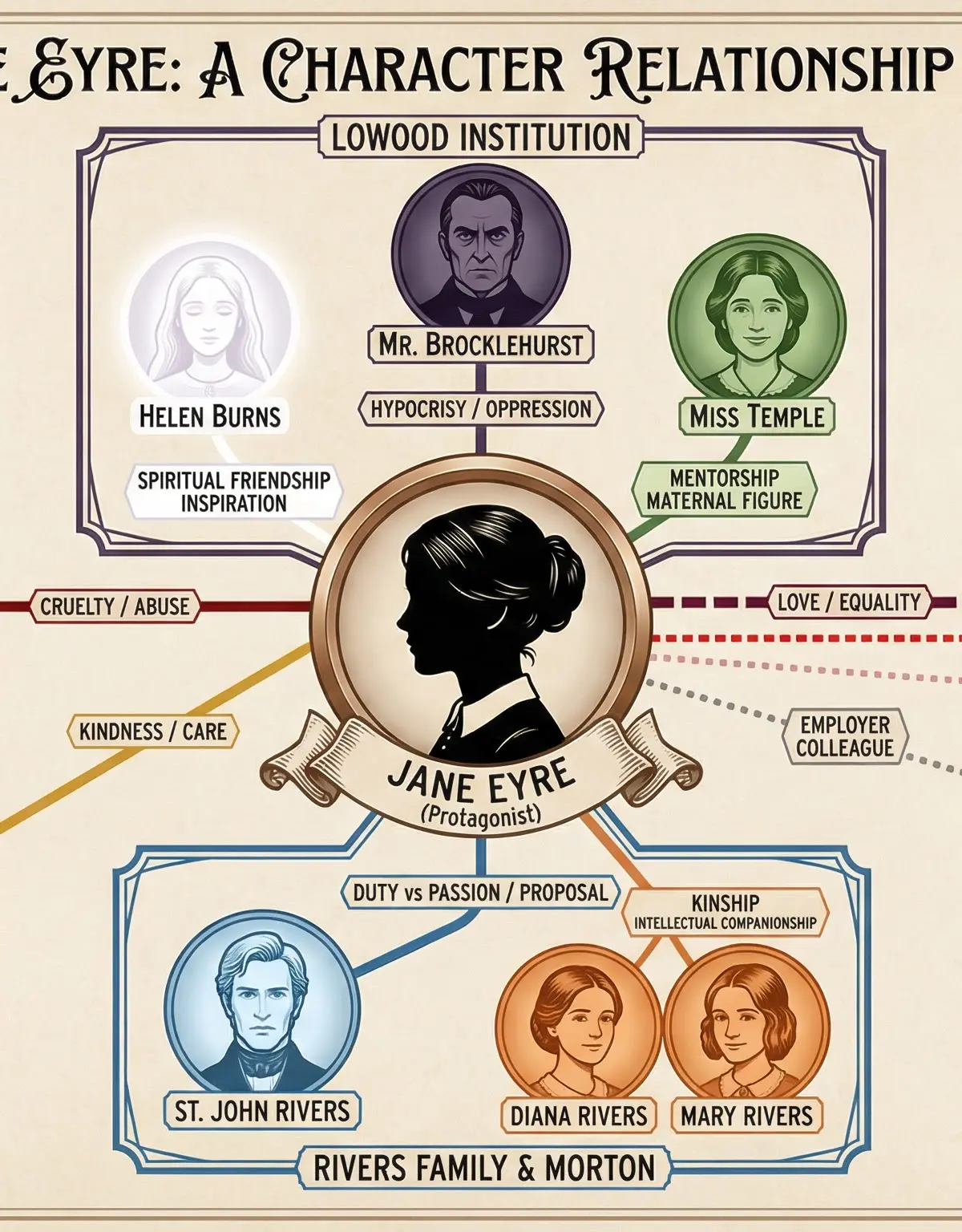
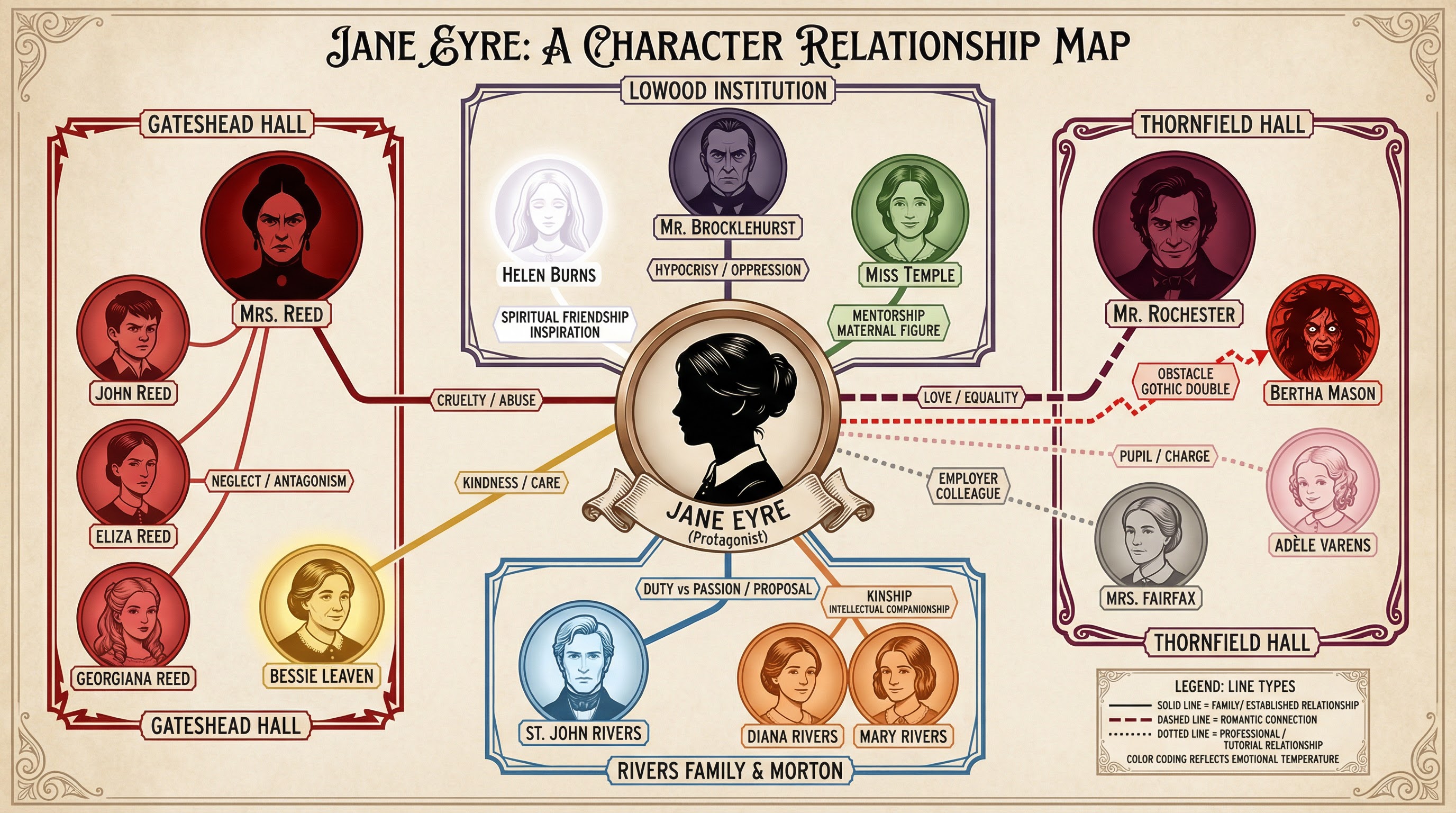
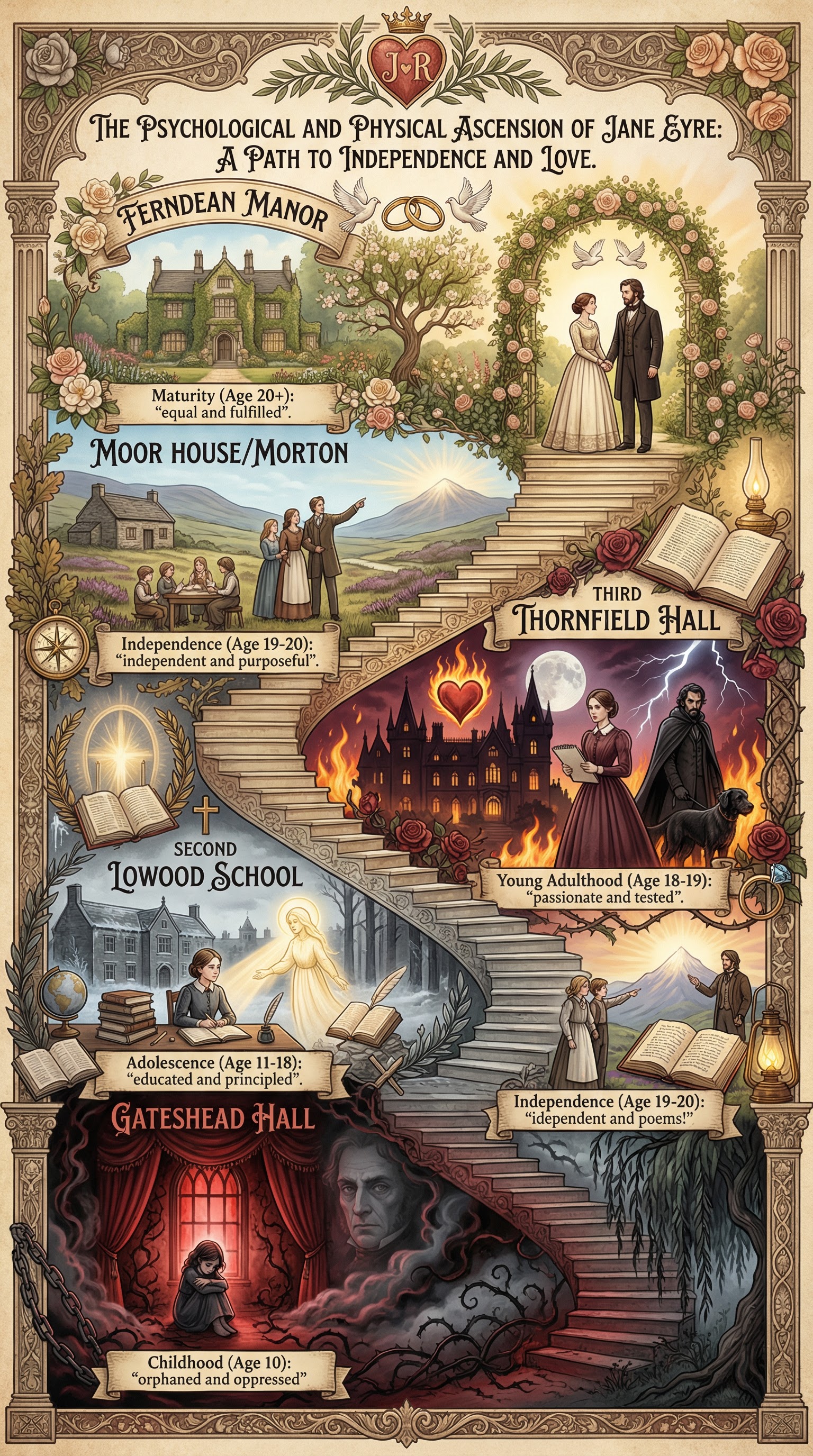
- Gateshead Hall (Chapters 1-4): The novel opens with the orphaned ten-year-old Jane living with her cruel aunt, Mrs. Reed, and her abusive cousins. After being unjustly punished and locked in the terrifying 'Red Room', Jane has a hysterical fit. This section establishes Jane's passionate nature and her deep-seated desire for justice and love.
- Lowood Institution (Chapters 5-10): Jane is sent to Lowood, a harsh charity school for orphaned girls run by the hypocritical Mr. Brocklehurst. She endures privation and witnesses the death of her gentle friend, Helen Burns, from consumption. However, she also receives a valuable education and finds a mentor in the kind Miss Temple. After eight years as a student and teacher, Jane yearns for new experiences.
- Thornfield Hall (Chapters 11-27): Jane takes a position as a governess at Thornfield Hall, where she falls in love with her enigmatic and brooding employer, Edward Rochester. Their intellectual and emotional connection transcends the rigid Victorian class structure. However, the house holds a dark secret in the form of strange, violent occurrences. Rochester proposes, but their wedding is dramatically halted by the revelation that he is already married to Bertha Mason, a Creole woman who is kept locked in the attic. Jane, her principles shattered, flees Thornfield.
- Moor House & Morton (Chapters 28-35): Destitute and starving, Jane is taken in by the Rivers family—St. John, Diana, and Mary—who are later revealed to be her cousins. She inherits a fortune from her uncle, giving her financial independence. The cold and ambitious clergyman St. John Rivers proposes a loveless marriage, asking Jane to join him as a missionary in India. Jane refuses, asserting her need for passionate love over selfless duty.
- Ferndean Manor (Chapters 36-38): Jane is supernaturally drawn back to Rochester. She finds Thornfield Hall burnt down, a fire started by Bertha who died in the blaze. Rochester, blinded and maimed while trying to save his wife, now lives in seclusion at Ferndean. Jane returns to him, and they are finally able to marry as equals. The novel concludes with Jane declaring, "Reader, I married him."
Themes
Love vs. Autonomy
This is the central conflict of the novel. Jane seeks love and belonging, but she is unwilling to sacrifice her independence or moral principles to achieve it. Her rejections of both Rochester's initial bigamous proposal and St. John's passionless one are crucial assertions of her self-worth. The final union with a disabled Rochester represents a marriage of equals, where love and autonomy can coexist.
Key Quotes:
- "I am no bird; and no net ensnares me: I am a free human being with an independent will." (Chapter 23) - Jane's powerful assertion of her autonomy to Rochester.
- "I care for myself. The more solitary, the more friendless, the more unsustained I am, the more I will respect myself." (Chapter 27) - Jane's resolution as she decides to leave Thornfield.
Social Class and Injustice
As a poor, orphaned governess, Jane is in a liminal social position. Brontë uses Jane's experiences to critique the rigid class hierarchy of Victorian England. Jane constantly challenges the prejudices of characters like Mrs. Reed, Blanche Ingram, and even, initially, Rochester.
Key Quotes:
- "Do you think, because I am poor, obscure, plain, and little, I am soulless and heartless? You think wrong!" (Chapter 23) - Jane's passionate outburst against Rochester's class-based assumptions.
- "Poverty for me was synonymous with degradation." (Chapter 3) - Young Jane's early understanding of the social stigma attached to poverty.
Religion and Morality
Brontë explores different forms of Christianity. Mr. Brocklehurst represents a cruel, hypocritical Evangelicalism. Helen Burns embodies a passive, self-sacrificing faith. St. John Rivers personifies a cold, ambitious form of Calvinism that prioritises duty over human feeling. Jane navigates these models to forge her own practical and personal moral code, one that balances passion with principle.
Key Quotes:
- "Prejudices, it is well known, are most difficult to eradicate from the heart whose soil has never been loosened or fertilised by education: they grow there, firm as weeds among stones." (Chapter 29) - Jane's reflection on the narrow-mindedness of uneducated religious belief.
- "Conventionality is not morality. Self-righteousness is not religion." (Chapter 4) - The narrator's sharp distinction, critiquing the superficial piety of characters like Brocklehurst.
The Gothic
The novel is steeped in Gothic conventions: the mysterious and isolated Thornfield Hall, the supernatural occurrences (the voice Jane hears calling her back to Rochester), the dark secrets (Bertha Mason), and the Byronic hero (Rochester). These elements create suspense and represent the hidden passions and psychological turmoil of the characters. Bertha, in particular, has been read by feminist critics as Jane's repressed double—the embodiment of female rage and sexuality that Victorian society sought to confine.
Key Quotes:
- "a curious laugh; distinct, formal, mirthless." (Chapter 11) - The first hint of Bertha's unsettling presence at Thornfield.
- "The clothed hyena rose up, and stood tall on its hind-feet." (Chapter 26) - Rochester's dehumanising description of his wife, Bertha.
Character Analysis
Jane Eyre
- Role: Protagonist and narrator.
- Key Traits: Principled, passionate, intelligent, resilient, fiercely independent.
- Character Arc: Jane's journey is a classic Bildungsroman. She develops from an oppressed but defiant child into an educated and morally resolute young woman who achieves both financial and emotional independence. She learns to balance her passionate nature with her strong sense of principle, ultimately finding a relationship where she is treated as an equal.
- Essential Quotes:
- "I am not an angel, I will be myself." (Chapter 24)
- "Reader, I married him." (Chapter 38)
Edward Rochester
- Role: Byronic hero and Jane's primary love interest.
- Key Traits: Passionate, cynical, intelligent, secretive, and deeply troubled.
- Character Arc: Rochester begins as a manipulative figure, attempting to deceive Jane into a bigamous marriage. His past actions (tricking his father and brother to marry Bertha for money) are morally questionable. However, his suffering after the fire—his blindness and loss of his hand—is a form of penance. He is humbled and transformed, allowing him to enter into a marriage of true equality with Jane.
- Essential Quotes:
- "I am a trite, commonplace sinner, hackneyed in all the poor petty dissipations with which the rich and worthless try to put on life." (Chapter 14)
- "To be your wife is, for me, to be as happy as I can be on earth." (Chapter 38) - This is Jane speaking, but it reflects the transformed nature of their relationship.
St. John Rivers
- Role: Jane's cousin and a foil to Rochester.
- Key Traits: Ambitious, cold, devout, rational, and controlling.
- Character Arc: St. John does not have a significant arc; he is a static character who represents a life of passionless duty and religious zealotry. He offers Jane a purpose but denies her emotional fulfillment. His proposal serves to clarify for Jane what she truly wants from life and love.
- Essential Quotes:
- "He is a good and a great man: but he is a man of marble." (Chapter 34)
- "God and nature intended you for a missionary's wife. It is not personal, but professional, attachment that I seek." (Chapter 34)
Writer's Methods
- First-Person Retrospective Narrative: The story is told by an older, wiser Jane looking back on her life. This allows for a dual perspective: the immediacy of the young Jane's experiences and the reflective, analytical commentary of the mature narrator. This technique allows Brontë to control the reader's sympathies and guide their interpretation of events.
- Pathetic Fallacy: Brontë frequently uses the weather and landscape to mirror Jane's internal emotional state. The storm on the night of Rochester's proposal, the icy cold when she rejects St. John, and the calm of Ferndean all serve to externalise her feelings.
- Symbolism: The Red Room symbolises the trauma and confinement of Jane's childhood. Fire and ice are recurring motifs representing passion and restraint, respectively. Bertha Mason acts as a powerful symbol of the repressed, animalistic side of female identity.
- Dialogue: The long, philosophical conversations between Jane and Rochester are crucial. They establish their intellectual equality and allow them to explore complex ideas about love, morality, and society. This was unusual for the time and is a key method Brontë uses to present their relationship as one of minds, not just hearts.
Context
- The Governess: In the 19th century, a governess occupied a difficult and lonely social position. She was an educated woman from a middle-class background, but she was also a paid employee, placing her in a liminal space between the family and the servants. Jane's story highlights the precariousness and isolation of this role.
- Victorian Gender Roles: The novel challenges the patriarchal norms of the Victorian era, which expected women to be passive, domestic, and subservient (the 'Angel in the House'). Jane's fierce desire for independence, her refusal to be treated as an inferior, and her insistence on her own moral compass were radical ideas for the time.
- Religion: The novel was written during a time of religious ferment in Britain. Brontë critiques the harsh, hypocritical brand of Evangelicalism represented by Mr. Brocklehurst, while also exploring more personal and sincere forms of faith through Jane and Helen Burns.
- The British Empire and Colonialism: Bertha Mason is a Creole from Jamaica, a British colony. Her otherness and eventual madness can be read through a postcolonial lens as representing the anxieties and guilt of the British Empire. Rochester's wealth, which allows him to employ Jane, is derived from his colonial marriage.
Visual Resources
2 diagrams and illustrations
Interactive Diagrams
1 interactive diagram to visualise key concepts
Conceptual Flow Outline
The five stages of Jane Eyre's Bildungsroman journey, showing her psychological and moral development at each key location.
Worked Examples
2 worked examples — open one to explore the question and available guidance.
Practice Questions
Test your understanding — click to reveal model answers
Starting with her experiences at Lowood, explore how Brontë presents the theme of religion in Jane Eyre.
Hint: Consider the contrast between Mr. Brocklehurst, Helen Burns, and later, St. John Rivers. How does Jane forge her own path between these different models of faith?
Explore the significance of settings in Jane Eyre.
Hint: Think about the five main locations (Gateshead, Lowood, Thornfield, Moor House, Ferndean). How does each setting reflect a stage in Jane's psychological development?
To what extent is Jane Eyre a feminist novel?
Hint: This is an 'evaluate' question. You need to argue both for and against. Consider Jane's independence and self-respect, but also the limitations she faces and the fact that her happy ending is marriage.
Starting with the extract where Bertha rips the wedding veil, explore how Brontë presents the character of Bertha Mason.
Hint: Consider her role as a plot device, a Gothic monster, and a symbolic double for Jane. Use contextual knowledge about colonialism and mental health in the Victorian era.
Test your understanding of Jane Eyre
Active recall beats re-reading. Take an instant quiz now to test what you’ve learned and lock it into long-term memory.
7 days Premium · Then free forever · No card, no charge