OCR · GCSE · English Literature
Macbeth
Unlock top marks in your OCR GCSE English Literature exam with this guide to Shakespeare's Macbeth. This guide deconstructs the play's core themes of ambition, guilt, and fate, providing examiner-level insights and multi-modal resources to elevate your analysis from mid-level to outstanding."
- 10 min read
- 2 worked examples
- 4 practice questions
Study Notes
Overview
Shakespeare's Macbeth is a dark, psychological thriller and one of the most powerful tragedies ever written. It charts the rapid, bloody rise and fall of a Scottish general whose ambition, spurred on by a supernatural prophecy, leads him to murder his king and seize the throne. For the OCR J352/02 exam, candidates must demonstrate a dual skillset: forensic analysis of Shakespeare's language and structure in a specific extract (Part a), and a broader, conceptualised argument about a theme or character across the entire play, integrating contextual understanding (Part b). Examiners are looking for a critical, argumentative style, not just a summary of the plot. Credit is given for precise textual references and a sophisticated understanding of how Shakespeare’s methods shape meaning and affect the audience. This guide will equip you with the tools to analyse the text with precision and construct the high-level arguments required for the top grades.
Plot/Content Overview
- Act 1: On a desolate heath, three witches prophesy that Macbeth will be Thane of Cawdor and then King of Scotland. When the first part of the prophecy comes true, Macbeth, encouraged by his ruthlessly ambitious wife, Lady Macbeth, begins to contemplate murdering King Duncan. He struggles with his conscience but is ultimately persuaded by Lady Macbeth's manipulation.
- Act 2: Macbeth sees a vision of a bloody dagger and, after a moment of hesitation, murders Duncan in his sleep. He is immediately consumed by guilt. Duncan's sons, Malcolm and Donalbain, flee, fearing for their lives, which allows Macbeth to frame them for the murder and claim the throne.
- Act 3: Now king, Macbeth is paranoid and insecure. He remembers the witches prophesied that Banquo's descendants would be kings, so he hires murderers to kill Banquo and his son, Fleance. Banquo is killed, but Fleance escapes. At a state banquet, Macbeth is tormented by the ghost of Banquo, invisible to everyone else. His erratic behaviour alarms the court.
- Act 4: Macbeth seeks out the witches again. They show him a series of apparitions that give him a false sense of security: he is told to beware Macduff, but also that "none of woman born shall harm Macbeth" and that he will be safe until Birnam Wood comes to Dunsinane Hill. Meanwhile, Macduff has fled to England to join forces with Malcolm. In a fit of rage, Macbeth orders the slaughter of Macduff's wife and children.
- Act 5: Lady Macbeth, driven mad by guilt, is seen sleepwalking and trying to wash imaginary bloodstains from her hands. She dies, likely by suicide. Malcolm and Macduff's army, using branches from Birnam Wood as camouflage, advances on Macbeth's castle at Dunsinane. Macbeth, clinging to the witches' prophecies, goes into battle. He learns that Macduff was "from his mother's womb untimely ripped" (born by Caesarean section) and is therefore not 'of woman born'. Macduff kills Macbeth, and Malcolm is hailed as the rightful King of Scotland.
Themes
Theme 1: Ambition
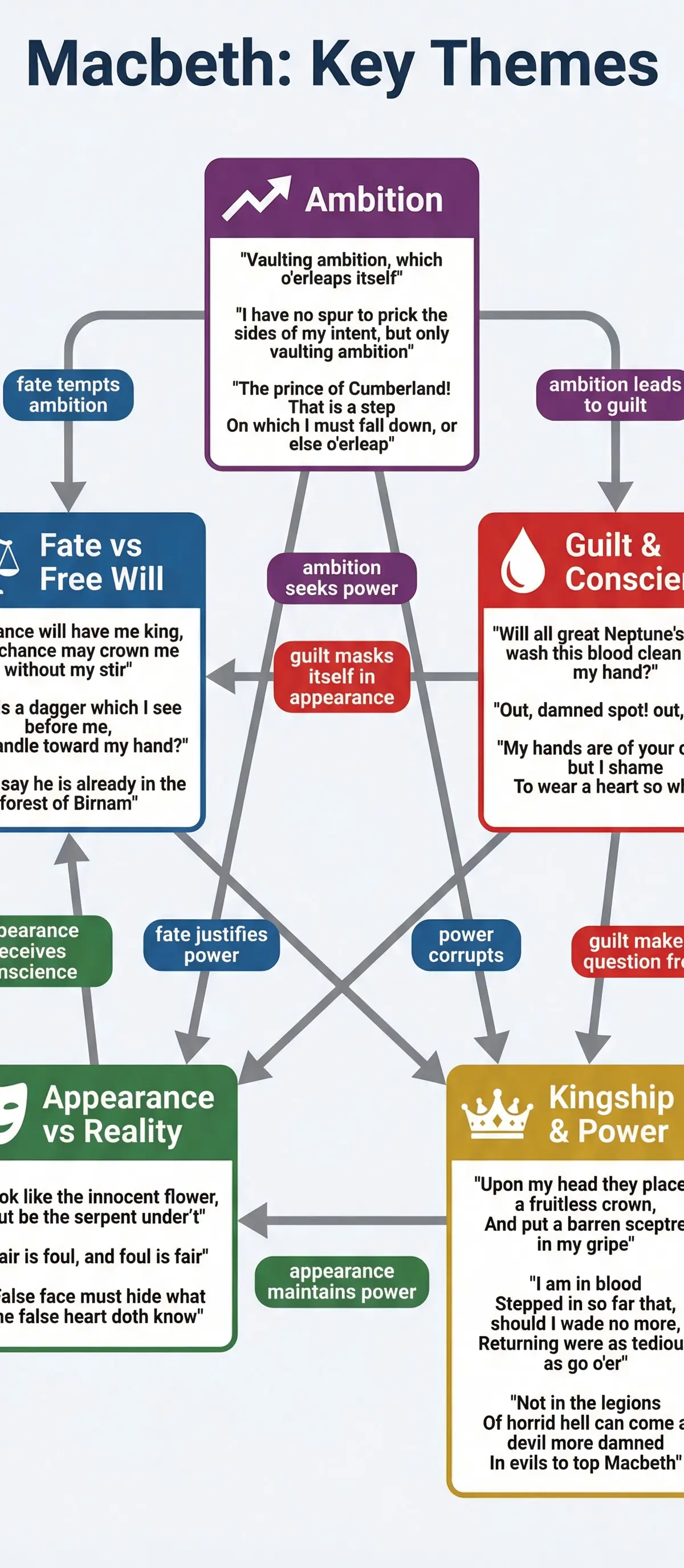
Ambition is the central driving force of the play. It is Macbeth's "vaulting ambition" that leads him down a path of destruction. Shakespeare presents ambition as a dangerous and corrupting quality when it is not tempered by morality. Initially, Macbeth is a celebrated hero, but his desire for power, ignited by the witches' prophecy, consumes him.
Key Quotes:
- "I have no spur / To prick the sides of my intent, but only / Vaulting ambition, which o'erleaps itself / And falls on th' other" (Act 1, Scene 7) - Macbeth himself recognises that his ambition is a wild horse that is likely to lead to his own downfall. This metaphor is a crucial piece of analysis for AO2.
- "To be thus is nothing, / But to be safely thus" (Act 3, Scene 1) - This shows that even after becoming king, Macbeth's ambition is not satisfied. It has morphed into a paranoid desire to secure his power at any cost, highlighting its insatiable and destructive nature.
Theme 2: Guilt and Conscience
Shakespeare explores the psychological consequences of evil actions. Both Macbeth and Lady Macbeth are tormented by guilt, which manifests in different ways. Macbeth is plagued by visions and paranoia, while Lady Macbeth descends into madness. The play suggests that it is impossible to escape the consequences of one's actions, and that the internal punishment of guilt can be more terrible than any external one.
Key Quotes:
- "Will all great Neptune’s ocean wash this blood / Clean from my hand? No, this my hand will rather / The multitudinous seas incarnadine, / Making the green one red." (Act 2, Scene 2) - Macbeth's hyperbolic language reveals the depth of his guilt immediately after murdering Duncan. The imagery of blood is a powerful motif for guilt throughout the play.
- "Out, damned spot! Out, I say!" (Act 5, Scene 1) - Lady Macbeth's desperate, fragmented speech in her sleepwalking scene shows the complete breakdown of her once-steely resolve. The blood she once thought could be washed away has permanently stained her conscience.
Theme 3: Kingship vs. Tyranny
The play contrasts the qualities of a good king with the actions of a tyrant. Duncan is presented as a virtuous, divinely appointed ruler who brings order and stability to Scotland. Macbeth, in contrast, is a usurper who rules through fear and violence, plunging the country into chaos. This theme would have resonated strongly with a Jacobean audience, who believed in the Divine Right of Kings.
Key Quotes:
- "[Duncan's] virtues / Will plead like angels, trumpet-tongued, against / The deep damnation of his taking-off" (Act 1, Scene 7) - Macbeth acknowledges Duncan's goodness, which makes his crime seem even more heinous. The angelic imagery contrasts sharply with the hellish descriptions of Macbeth's reign.
- "Not in the legions / Of horrid hell can come a devil more damned / In evils to top Macbeth." (Act 4, Scene 3) - Macduff's description of Macbeth shows how he is viewed by his subjects. He is not just a bad king; he is seen as a demonic figure, the antithesis of a true, God-given monarch.
Character Analysis
Macbeth
Role: The tragic hero and protagonist of the play.
Key Traits: Brave, ambitious, imaginative, but also weak-willed, impressionable, and ultimately tyrannical.
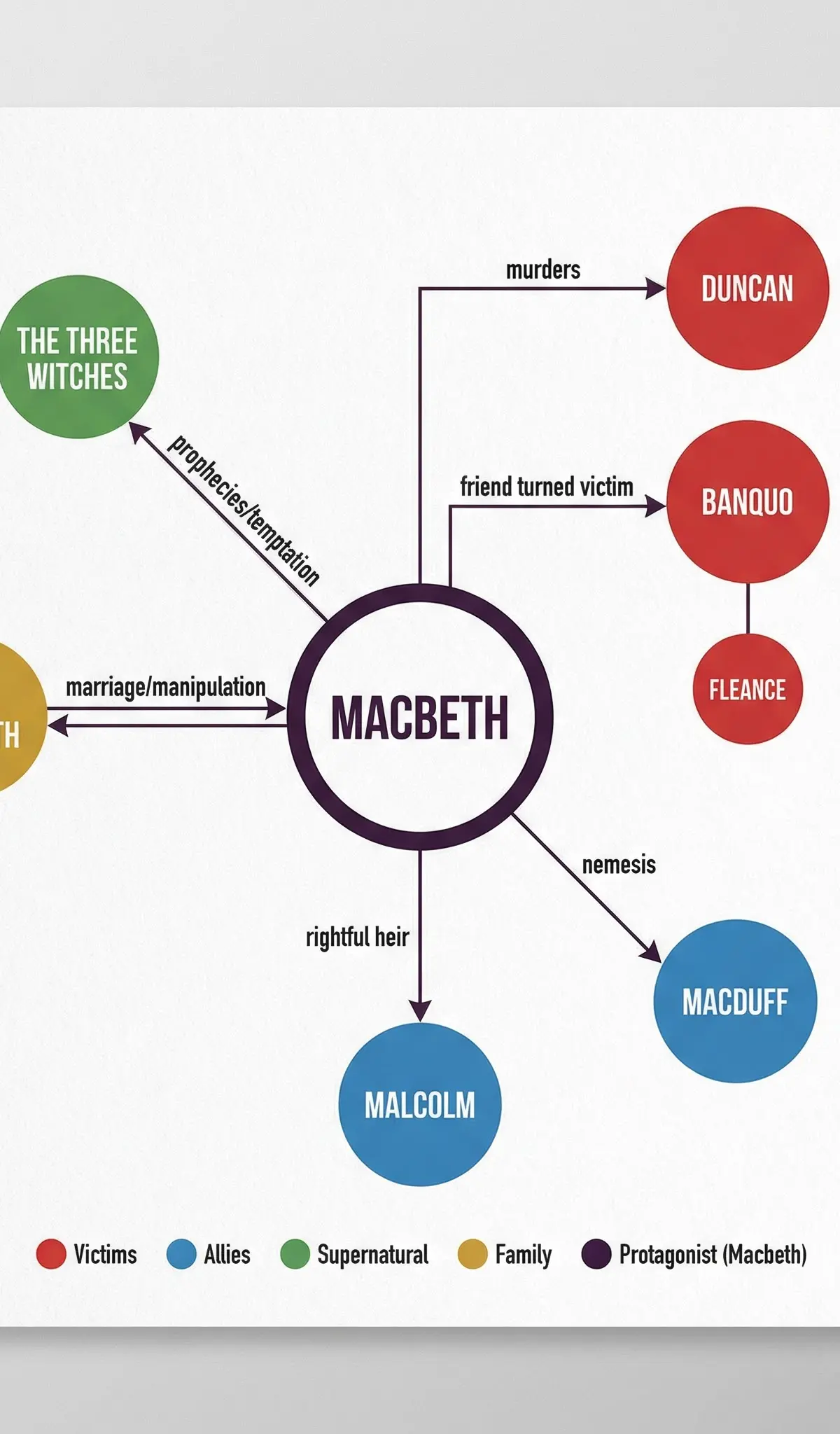
Character Arc: Macbeth begins as a loyal and courageous nobleman. However, his encounter with the witches and the manipulation of his wife ignite his dormant ambition. He murders his way to the throne, but his reign is marked by paranoia, guilt, and further bloodshed. By the end of the play, he is a nihilistic, battle-hardened tyrant who has lost everything, including his own humanity.
Essential Quotes:
- "Stars, hide your fires; / Let not light see my black and deep desires" (Act 1, Scene 4)
- "I am in blood / Stepped in so far that, should I wade no more, / Returning were as tedious as go o'er" (Act 3, Scene 4)
- "Life's but a walking shadow, a poor player / That struts and frets his hour upon the stage / And then is heard no more." (Act 5, Scene 5)
Lady Macbeth
Role: Macbeth's wife and a key instigator of the plot.
Key Traits: Ambitious, ruthless, manipulative, and initially more determined than her husband.
Character Arc: Lady Macbeth is a complex and fascinating character. She calls upon evil spirits to "unsex" her, wishing to cast off her feminine qualities to be capable of murder. She is the driving force behind the plot to kill Duncan. However, she underestimates the psychological toll of their actions. While Macbeth grows hardened to violence, Lady Macbeth is consumed by guilt, eventually leading to her madness and death.
Essential Quotes:
- "Come, you spirits / That tend on mortal thoughts, unsex me here, / And fill me from the crown to the toe top-full / Of direst cruelty!" (Act 1, Scene 5)
- "Look like the innocent flower, / But be the serpent under't." (Act 1, Scene 5)
- "A little water clears us of this deed." (Act 2, Scene 2) - This line provides a stark, ironic contrast to her later obsession with washing the blood from her hands.
Writer's Methods
- Soliloquy: Shakespeare uses soliloquies to provide the audience with direct access to the inner thoughts and turmoil of his characters, particularly Macbeth. The famous "Is this a dagger which I see before me?" soliloquy is a prime example, revealing Macbeth's psychological state on the brink of regicide.
- Imagery: The play is rich with powerful and recurring patterns of imagery. The most significant are blood (symbolising guilt), darkness and night (symbolising evil), and sleep (or the lack of it, symbolising a guilty conscience).
- Dramatic Irony: The audience often knows more than the characters on stage, creating tension and suspense. For example, we know Macbeth is plotting to kill Duncan while Duncan is praising Macbeth's loyalty.
- Verse and Prose: Shakespeare varies the language used by his characters. The nobles generally speak in blank verse (unrhymed iambic pentameter), which gives their speech a sense of gravity and importance. The witches speak in rhyming trochaic tetrameter, which sounds unnatural and chant-like. Prose is used for moments of madness, such as Lady Macbeth's sleepwalking scene.
Context
- The Divine Right of Kings: The belief that the monarch was chosen by God and that to challenge the king was to challenge God. Shakespeare wrote Macbeth shortly after James I (James VI of Scotland) ascended to the English throne. The play can be seen as a warning against regicide and a validation of James's rightful claim.
- The Gunpowder Plot (1605): A failed attempt by a group of English Catholics to assassinate King James I. The plot heightened anxieties about treason and political instability, themes that are central to Macbeth. The Porter's speech in Act 2 contains a direct reference to "equivocation", a concept associated with the trial of one of the plotters.
- Witchcraft: In the Jacobean era, there was a widespread and genuine belief in witches and the supernatural. King James I himself was fascinated by the subject and had written a book called Daemonologie. The inclusion of the witches would have been genuinely terrifying for a contemporary audience.
- Gender Roles: Lady Macbeth subverts traditional Jacobean expectations of femininity. Her ambition, ruthlessness, and dominance in her relationship with Macbeth would have been seen as unnatural and shocking.
"
Worked Examples
2 worked examples — open one to explore the question and available guidance.
Practice Questions
Test your understanding — click to reveal model answers
Explore how Shakespeare presents the theme of guilt in Macbeth.
Hint: Consider how guilt affects both Macbeth and Lady Macbeth. Track the motif of blood and the theme of sleeplessness.
How does Shakespeare present the relationship between Macbeth and Lady Macbeth?
Hint: Think about how the power dynamic between them shifts throughout the play.
Explore the significance of the supernatural in Macbeth.
Hint: Consider the witches, the dagger, and Banquo's ghost. Are they real or just manifestations of Macbeth's psychology?
‘Lady Macbeth is a more evil character than her husband.’ To what extent do you agree?
Hint: This is an evaluative question. You need to define what you mean by 'evil' and compare the two characters throughout the play.
Test your understanding of Macbeth
Active recall beats re-reading. Take an instant quiz now to test what you’ve learned and lock it into long-term memory.
7 days Premium · Then free forever · No card, no charge