OCR · GCSE · English Literature
My Mother Said I Never Should
Unlock top marks for OCR's 'My Mother Said I Never Should' with this guide. We'll explore the play's time-shifting structure, complex mother-daughter relationships, and the secret that shapes four generations of women, providing examiner insights to help you ace your exam."
- 9 min read
- 2 worked examples
- 4 practice questions
Study Notes
Overview
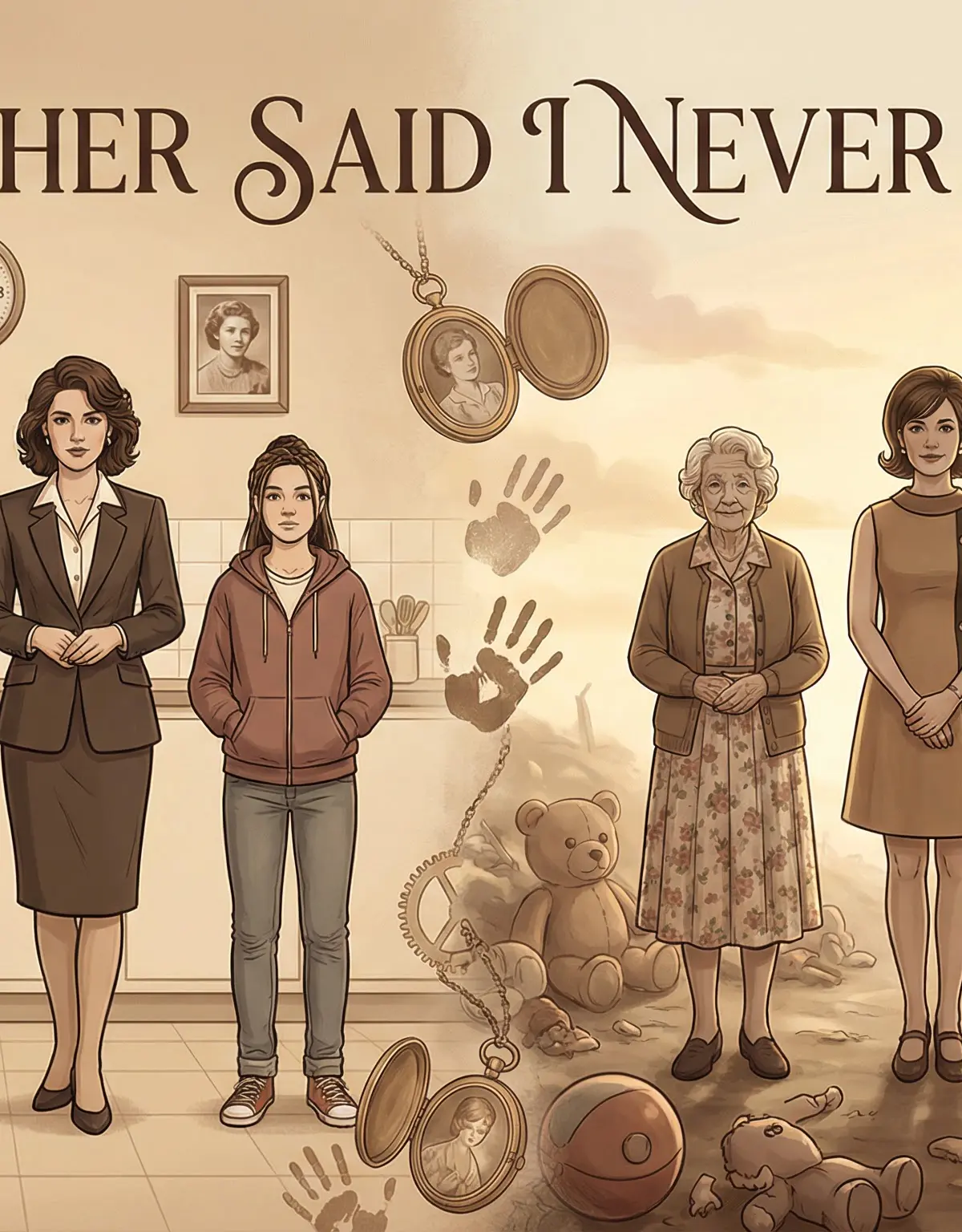
'My Mother Said I Never Should' is a landmark play by Charlotte Keatley that explores the lives and relationships of four generations of women from one family. Spanning from the 1940s to the 1980s, the play uses a non-linear, episodic structure to reveal the inherited patterns of behaviour and the changing social pressures on women. Examiners look for candidates who can confidently navigate the play's time-shifts, analysing how Keatley uses them to contrast the characters' experiences. A strong response will also focus on the symbolic 'Wasteground' scenes and the dramatic impact of the central secret: that Jackie is Rosie's biological mother, but has allowed her own mother, Margaret, to raise her. To gain high credit, candidates must integrate contextual understanding of each period with a detailed analysis of dramatic methods (AO2) and characterisation (AO1).
Plot/Content Overview
The play unfolds in a series of scenes that are not in chronological order. The narrative thread connects Doris, born in the early 1900s, her daughter Margaret, her granddaughter Jackie, and her great-granddaughter Rosie. The play opens with the characters as children in a 'Wasteground', a symbolic space of memory. We then see snapshots of their lives: Doris's loveless marriage and wartime sacrifices; Margaret's unfulfilled artistic ambitions; Jackie's pursuit of a career in the competitive 1980s art world; and Rosie's childhood, shaped by the secret of her parentage. The central event is Jackie's pregnancy and her decision to give Rosie to Margaret to raise. The play culminates in the revelation of this secret and a final, poignant scene where the four women, as children again, play a game that encapsulates the cycle of their lives.
Themes
Theme 1: Mother-Daughter Relationships
This is the core theme of the play. Keatley presents these relationships as a complex mix of love, resentment, sacrifice, and misunderstanding. Each daughter struggles to separate from her mother and define her own identity, yet simultaneously repeats her mother's patterns. The central relationship between Margaret and Jackie is fraught with tension, stemming from Margaret's own unfulfilled ambitions which she projects onto her daughter. The ultimate expression of this complex bond is Margaret raising Jackie's child as her own.
Key Quotes:
- "You were a real trial to me, you were." (Doris to Margaret) - This quote reveals the underlying resentment and hardship that has shaped their relationship, a stark contrast to the idealised view of motherhood.
- "I don't want to be like you!" (Jackie to Margaret) - A classic expression of adolescent rebellion, but in this play, it carries the weight of generations of female expectation.
Theme 2: Secrets and Deception
The play is built around the secret of Rosie's parentage. This secret poisons the family relationships, creating a web of guilt and unspoken truths. Keatley uses dramatic irony masterfully; the audience is often aware of the secret long before the characters are, which builds tension. The lie affects each character's identity, particularly Rosie's, and the eventual revelation forces a painful but necessary confrontation with the truth.
Key Quotes:
- "It's a secret." (Young Jackie) - This childish phrase becomes a recurring motif, highlighting how the pattern of keeping secrets is established early in life.
- "She's not your baby, she's ours." (Margaret to Jackie) - This line encapsulates the blurring of roles and the ownership Margaret takes over Rosie, deepening the central deception.
Character Analysis
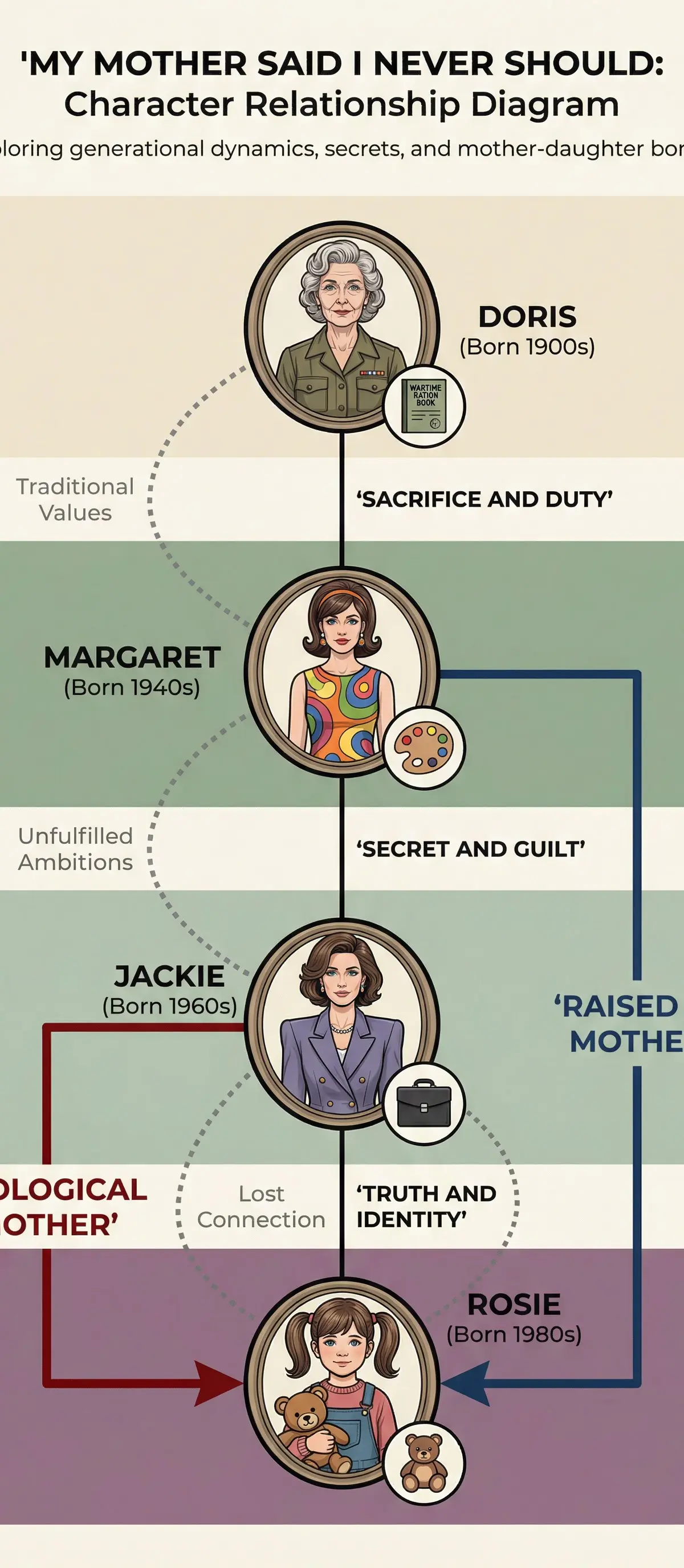
Doris
Role: The matriarch of the family, representing the values and hardships of the wartime generation.
Key Traits: Stoic, pragmatic, emotionally repressed, but with flashes of wit and a deep-seated sense of duty.
Character Arc: Doris begins as a young woman constrained by the expectations of her time, entering a marriage for security rather than love. She carries the emotional scars of this throughout her life, which manifests as a critical and often unsympathetic attitude towards her daughter and granddaughter. However, by the end of the play, there is a sense of reconciliation and understanding, particularly in her interactions with Rosie.
Essential Quotes:
- "You've got to get on with it. No use crying over spilt milk." - This sums up her stoic, no-nonsense philosophy.
- "I did my best. That's all you can say." - A poignant admission of her own perceived failings and the limitations she faced.
Margaret
Role: The bridge between the old world and the new, caught between her mother's traditional values and her daughter's modern ambitions.
Key Traits: Artistic, resentful, loving but suffocating. She is defined by her unfulfilled potential.
Character Arc: Margaret dreams of being an artist but sacrifices her ambitions for marriage and motherhood. This creates a deep well of resentment that she directs towards Jackie, both pushing her to succeed and envying her freedom. Her decision to raise Rosie is complex: an act of love, but also a way to have a 'second chance' at motherhood, free from the mistakes she felt she made with Jackie.
Essential Quotes:
- "I could have been a contender." - A direct quote from the film 'On the Waterfront', which she uses to express her own sense of lost potential.
- "We’ll say she’s ours. It’ll be our secret." - The pivotal line where the central deception is initiated.
Jackie
Role: The modern woman of the 1980s, representing the freedoms and pressures of second-wave feminism.
Key Traits: Ambitious, independent, but also insecure and overwhelmed. She embodies the conflict between career and motherhood.
Character Arc: Jackie is determined not to repeat her mother's life. She pursues a career in the competitive London art scene, but an unplanned pregnancy throws her life into turmoil. Her inability to cope and her decision to give Rosie to Margaret is the central crisis of her life, leading to years of guilt and a fractured relationship with both her mother and her daughter.
Essential Quotes:
- "I’m not a natural mother, you see." - Her painful confession, revealing her deep-seated insecurity.
- "I want her back." - The cry that the audience has been waiting for, signaling her desire to reclaim her role as Rosie's mother.
Rosie
Role: The product of the family's secrets and the hope for the future.
Key Traits: Inquisitive, perceptive, and emotionally resilient. She has a strong sense of her own identity, despite the confusion surrounding her parentage.
Character Arc: Rosie grows up in a loving home but is aware of the unspoken tensions. Her journey is one of discovery, as she pieces together the truth about her identity. Her confrontation with Jackie is the climax of the play, and her ability to forgive and understand offers a sense of hope that the destructive patterns of the past can be broken.
Essential Quotes:
- "Why are you my grandmother, but you're her mother?" - Her innocent but perceptive question that cuts through the layers of deception.
- "It's alright, Jackie." - Her simple words of forgiveness to her biological mother, offering a moment of profound grace and reconciliation.
Writer's Methods
Keatley employs a range of dramatic methods to explore her themes. The most significant is the non-linear structure. By juxtaposing scenes from different time periods, she invites the audience to make connections and comparisons. For example, a scene showing Margaret's frustration as a young mother might be followed by a scene of Jackie facing similar challenges, highlighting the cyclical nature of their experiences. This structure is essential to the play's meaning and must be a focus of any high-level analysis. Another key method is the use of the symbolic 'Wasteground'. This is not a realistic setting but a psychological space where the characters' inner lives are revealed. The games they play and the rhymes they chant are all symbolic of their adult conflicts. For example, the game of 'doctors and nurses' foreshadows the real-life medical drama of Rosie's birth. Finally, Keatley uses overlapping dialogue and fragmented speech to create a sense of realism and to show the characters talking past each other, unable to truly communicate. This is particularly effective in the scenes of family conflict.
Context
To achieve high marks for AO3, candidates must integrate contextual understanding. The play spans a period of immense social change for women in Britain. Doris's generation was shaped by the two World Wars and the expectation that women's primary role was in the home. Margaret's generation, coming of age in the 1950s and 60s, experienced the beginning of the sexual revolution and the expansion of educational opportunities for women, yet the domestic ideal was still powerful. Jackie's generation is a product of 1970s and 80s second-wave feminism, which championed female independence and career ambition. The play explores the 'superwoman' myth of the 80s - the pressure on women to succeed in a career while also being a perfect mother. Rosie represents a future generation, hopefully free from the guilt and conflict that plagued her mother and grandmother. A feminist reading of the play would focus on how these patriarchal structures and expectations have shaped the women's lives and choices."
Worked Examples
2 worked examples — open one to explore the question and available guidance.
Practice Questions
Test your understanding — click to reveal model answers
How does Keatley use the 'Wasteground' scenes to explore the characters' inner lives?
Hint: Think about what the games they play and the things they say in the Wasteground reveal about their fears and desires as adults. Analyse the symbolism.
Explore the ways Keatley presents the theme of ambition in the play.
Hint: Consider how ambition is presented differently in each generation. Is it seen as a positive or negative force?
How does Keatley explore the idea of time in 'My Mother Said I Never Should'?
Hint: Think about the non-linear structure, the characters playing themselves as children, and the way the past constantly intrudes on the present.
‘The men in the play are absent but powerful.’ To what extent do you agree?
Hint: Consider the roles of Jack, Geoffrey, and Ken. How do their actions and the characters' memories of them affect the four women?
Test your understanding of My Mother Said I Never Should
Active recall beats re-reading. Take an instant quiz now to test what you’ve learned and lock it into long-term memory.
7 days Premium · Then free forever · No card, no charge