OCR · GCSE · English Literature
Never Let Me Go
Kazuo Ishiguro's *Never Let Me Go* is a haunting dystopian novel that explores what it means to be human through the lives of clones raised for organ donation. Studying this text rewards candidates who can analyse Ishiguro's subtle narrative techniques, the tragic passivity of his characters, and the profound ethical questions about identity, memory, and mortality that underpin the novel.
- 12 min read
- 2 worked examples
- 4 practice questions
- 9 key terms
Study Notes
Overview
Never Let Me Go is a dystopian novel published in 2005 by Nobel Prize-winning author Kazuo Ishiguro. Set in an alternative late-1990s England, the novel follows Kathy H., a 'carer' who looks after organ donors—clones created solely to provide transplants for 'normal' humans. Through Kathy's retrospective first-person narration, we revisit her childhood at Hailsham, an idyllic boarding school, her adolescence at the Cottages, and her adult life working in recovery centres. The novel is a meditation on mortality, memory, and the ethics of dehumanisation. Examiners reward candidates who can analyse Ishiguro's restrained prose, his use of euphemism and unreliable narration, and the structural journey from innocence to tragic acceptance. The central question is not 'why don't they escape?' but 'why does Ishiguro construct them to accept their fate?'—and answering this demonstrates a sophisticated understanding of authorial intent and thematic purpose.
Plot/Content Overview
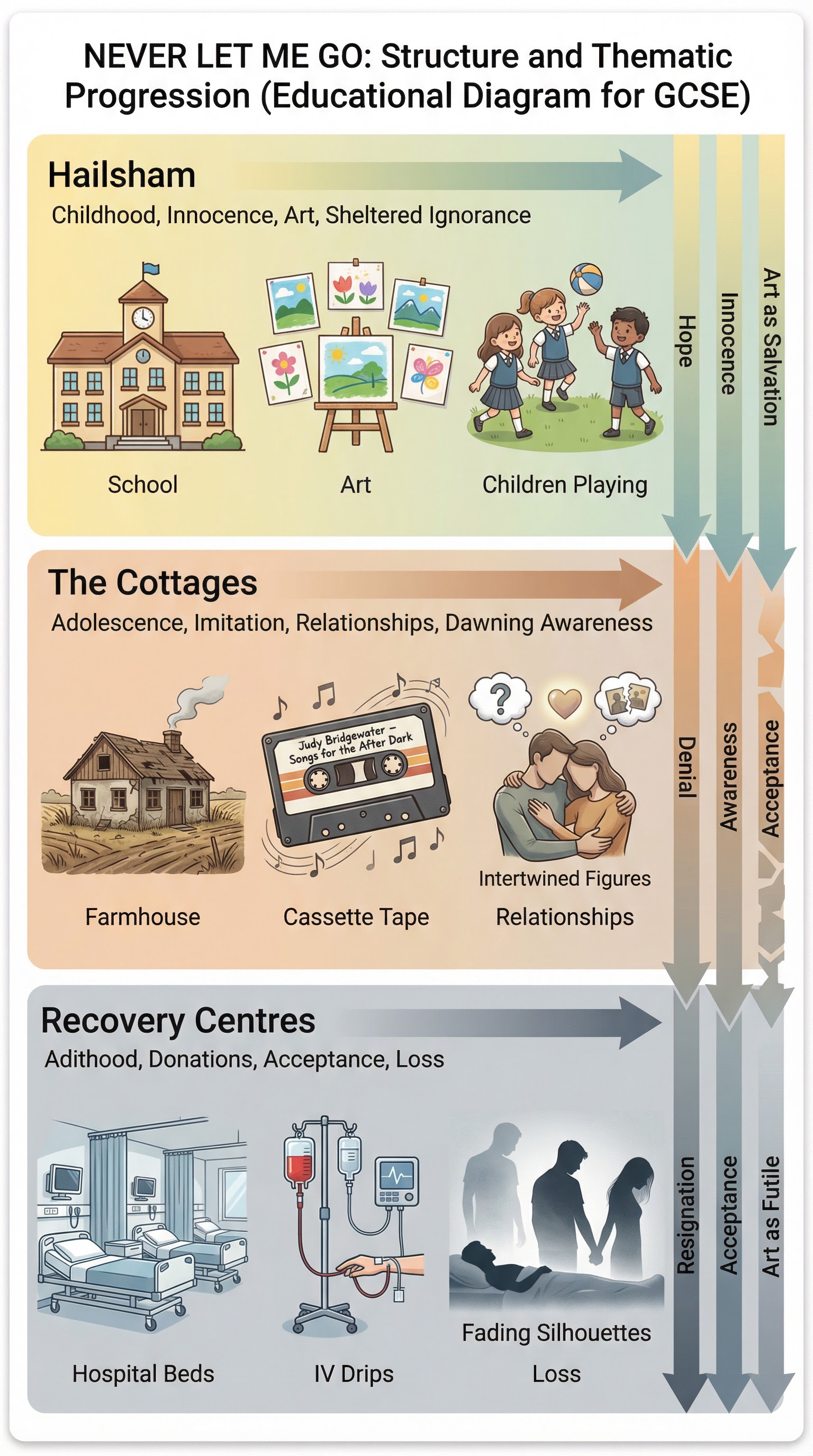
The novel is structured in three parts, corresponding to three settings. Part One introduces Kathy's childhood at Hailsham, a seemingly progressive boarding school where students are encouraged to create art. The guardians, particularly Miss Lucy, hint at the students' futures as donors, but the full reality is obscured by euphemistic language. Kathy recalls her friendships with Ruth and Tommy, the mysterious figure of Madame who collects their artwork, and the rumour of 'deferrals'—a postponement of donations for couples truly in love. Part Two follows the trio to the Cottages, a transitional space where they encounter other clones and attempt to imitate 'normal' life. Ruth and Tommy become a couple, causing tension with Kathy. They search for Ruth's 'possible'—the original person she was cloned from—but the encounter is disillusioning. Part Three sees Kathy working as a carer, looking after donors including Ruth, who eventually 'completes' (dies). Ruth facilitates a reconciliation between Kathy and Tommy, who begin a relationship and seek a deferral from Madame and Miss Emily. They discover the truth: deferrals never existed, and the art was collected only to prove clones had souls. Tommy completes shortly after, and Kathy reflects on her own impending donations, standing alone by a barbed-wire fence, imagining the losses of her past drifting away.
Themes
Theme 1: Humanity and Identity
The novel's central question is whether the clones are fully human. Ishiguro explores this through the students' creation of art, which they believe proves their inner lives and souls. Madame's gallery becomes a symbol of hope—if their art is valued, perhaps they are valued. The devastating revelation that the gallery was merely an experiment to demonstrate that clones have souls (rather than to celebrate them) underscores the tragedy. The clones are human enough to suffer, love, and create, but not human enough to be granted autonomy or life. Kathy's narration itself is evidence of her humanity; her reflections, memories, and emotional depth mirror our own. Ishiguro uses the clones as a metaphor for any marginalised group denied full personhood.
Key Quotes:
- "We all know it. We're modelled from trash. Junkies, prostitutes, winos, tramps. Convicts, maybe, just so long as they aren't psychos." (Part Two) - This reveals the students' internalised dehumanisation and the societal contempt for their 'originals'.
- "Your art will reveal your inner selves! That's it, isn't it?" (Part Three, Miss Emily) - The bitter irony that art was used as evidence, not celebration, of their humanity.
Theme 2: Memory and Nostalgia
Kathy's retrospective narration is suffused with nostalgia. She revisits Hailsham as a lost Eden, even though it was a place of control and conditioning. Ishiguro explores how memory is selective and unreliable; Kathy admits she may misremember events, and her rose-tinted recollections contrast with the grim reality of her present. The novel suggests that memory is how we construct meaning and identity, even when the past was far from perfect. The motif of the cassette tape, Songs After Dark, represents Kathy's private emotional world and her longing for connection and meaning.
Key Quotes:
- "I lost that tape, and for years it stayed lost." (Part One) - The tape symbolises lost innocence and the fragility of memory.
- "What he wanted was not just to hear the song again; he wanted to hear it the way he'd heard it that first time." (Part Three) - This reflects the impossibility of recapturing the past.
Theme 3: Passivity and Acceptance
The most striking feature of the novel is the characters' lack of rebellion. They accept their fate with quiet resignation. Ishiguro constructs this passivity through lifelong conditioning, euphemistic language that obscures reality, and the absence of any model of resistance. The clones are raised to believe their purpose is noble and inevitable. This passivity is the novel's central tragedy and invites readers to reflect on how systems of power can make individuals complicit in their own oppression. The lack of escape is not a plot hole; it is the point.
Key Quotes:
- "We all complete. Maybe none of us really understand it. But we do it all the same." (Part Three) - Kathy's acceptance is framed as universal human mortality, but it is also a chilling indictment of her conditioning.
- "I was pretty much ready when I became a donor." (Part Three) - The phrase 'ready' reveals how thoroughly the system has shaped her worldview.
Theme 4: Love and Loss
The love triangle between Kathy, Tommy, and Ruth is central to the novel's emotional impact. Their relationships are shaped by jealousy, manipulation, and ultimately reconciliation. Ruth's deathbed confession and her attempt to reunite Kathy and Tommy is a moment of grace, but it comes too late. The novel uses their love as a metaphor for the human condition: we hold onto each other in the face of inevitable loss. Tommy's image of two people in a river, holding on until they must let go, encapsulates this theme.
Key Quotes:
- "The fantasy never got beyond that—I didn't let it—and though the tears rolled down my face, I wasn't sobbing or out of control." (Part Three) - Kathy's restrained grief reflects her lifelong conditioning to suppress emotion.
- "We took away your art because we thought it would reveal your souls. Or to put it more finely, we did it to prove you had souls at all." (Part Three) - The revelation that their love and art were never enough to save them.
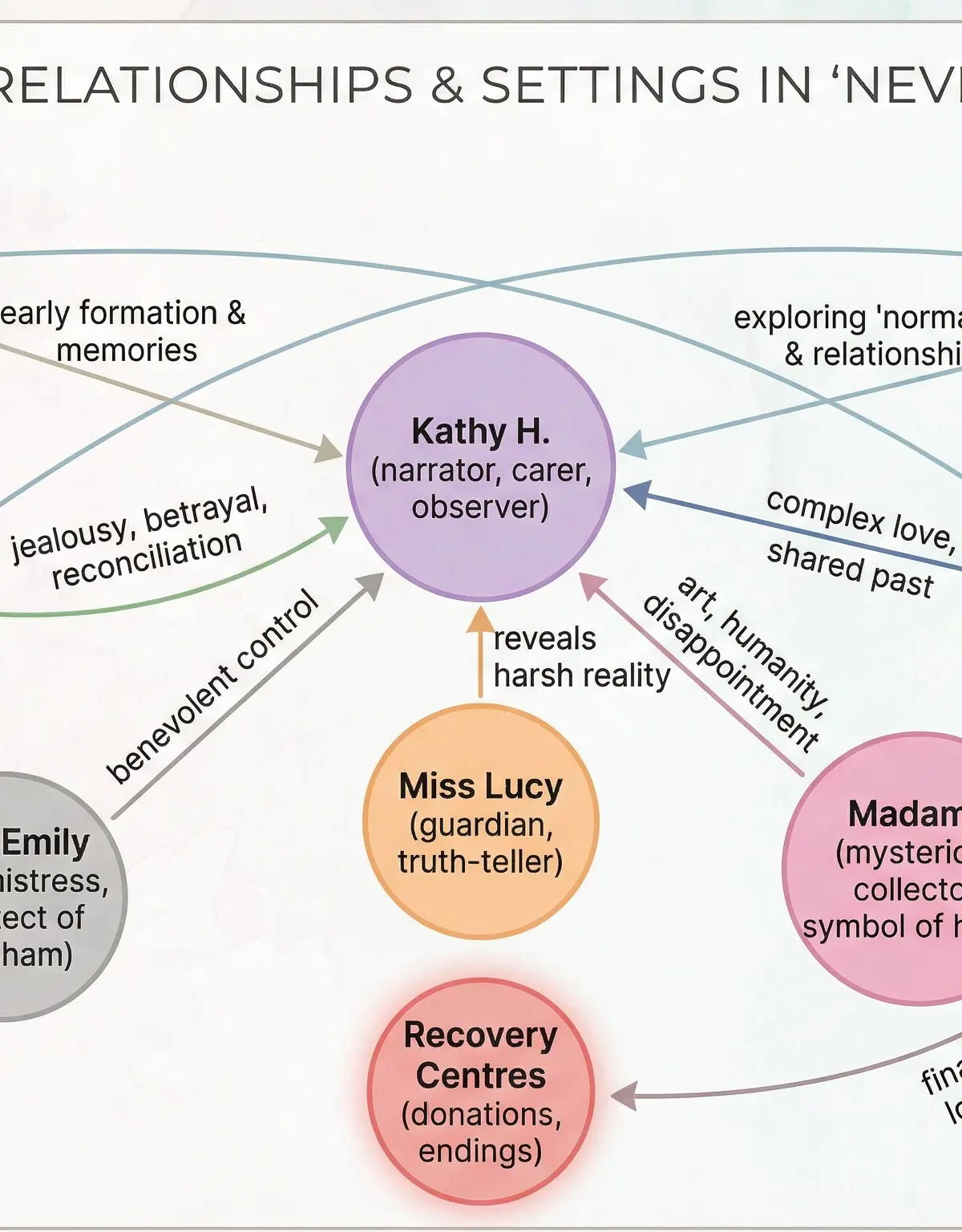
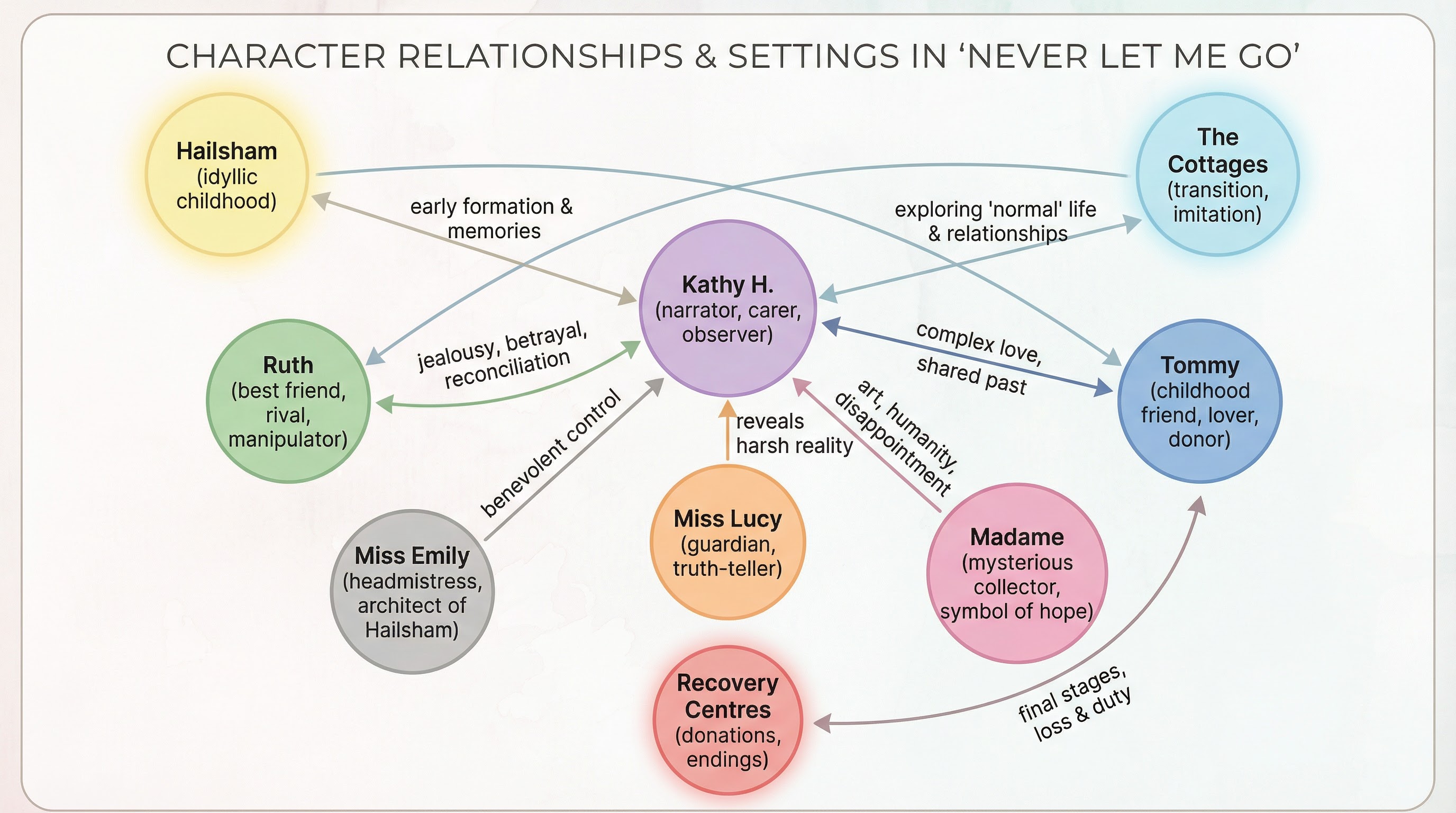
Character Analysis
Kathy H.
Role: Narrator, protagonist, and carer. Kathy is the lens through which we experience the novel.
Key Traits: Observant, introspective, emotionally restrained, loyal, and complicit. Kathy is a 'good carer' who takes pride in her work, even though it involves preparing her friends for death. She is both victim and enabler of the system.
Character Arc: Kathy moves from innocent child to disillusioned adult. Her arc is not one of rebellion but of deepening understanding and acceptance. By the novel's end, she stands alone, reflecting on her losses and awaiting her own donations.
Essential Quotes:
- "My name is Kathy H. I'm thirty-one years old, and I've been a carer now for over eleven years." (Opening line) - Establishes her voice and role.
- "I keep thinking about this river somewhere, with the water moving really fast. And these two people in the water, trying to hold onto each other, holding on as hard as they can, but in the end it's just too much." (Part Three, recalling Tommy's image) - Encapsulates the novel's central metaphor of love and loss.
Tommy
Role: Kathy's childhood friend and eventual lover; a symbol of vulnerability and rage.
Key Traits: Emotionally volatile, creative, naive, and ultimately tragic. Tommy's tantrums as a child are a form of protest, but he learns to suppress them. His animal drawings represent his inner life and his desperate hope for a deferral.
Character Arc: Tommy moves from an outsider mocked for his lack of creativity to a young man who believes his art might save him. His final tantrum in the field after learning the truth about deferrals is a moment of raw, uncontrolled grief—a rare break in the novel's emotional restraint.
Essential Quotes:
- "I'm not sure what you mean, Miss." (Part One, to Miss Lucy) - Tommy's confusion reflects the students' incomplete understanding of their fate.
- "It was like when you make a move in chess and just as you take your finger off the piece, you see the mistake you've made, and there's this panic because you don't know yet the scale of disaster you've left yourself open to." (Part Three) - Tommy's realisation of the futility of his hopes.
Ruth
Role: Kathy's best friend and rival; a symbol of manipulation and eventual redemption.
Key Traits: Charismatic, insecure, manipulative, and ultimately remorseful. Ruth is a social climber who uses others to feel superior, but her deathbed confession reveals her awareness of her own cruelty.
Character Arc: Ruth moves from a confident, controlling figure at Hailsham to a broken, regretful donor. Her final act—giving Kathy Madame's address—is an attempt at redemption.
Essential Quotes:
- "I was pretty much ready when I became a donor. It felt right. After all, it's what we're supposed to do, isn't it?" (Part Three) - Ruth's acceptance is chilling in its matter-of-factness.
- "I'm not even sure if it was ever really about Tommy. It was about me, and what I needed." (Part Three) - Ruth's self-awareness comes too late.
Miss Lucy
Role: A guardian at Hailsham who briefly tells the students the truth about their futures.
Key Traits: Honest, conflicted, and ultimately silenced. Miss Lucy represents the moral discomfort of those who benefit from the system but cannot change it.
Character Arc: Miss Lucy's outburst—"Your lives are set out for you. You'll become adults, then before you're old, before you're even middle-aged, you'll start to donate your vital organs"—is a moment of brutal honesty, but she is removed from Hailsham for it.
Essential Quotes:
- "If you're to have decent lives, you have to know who you are and what lies ahead of you, every one of you." (Part One) - Miss Lucy's attempt to give the students agency through knowledge.
Madame (Marie-Claude)
Role: Collector of the students' art; a symbol of false hope.
Key Traits: Mysterious, distant, and ultimately complicit. Madame's tears when she sees Kathy dancing to the cassette tape suggest empathy, but her role in the system is exploitative.
Character Arc: Madame is revealed to have collected art not out of love for the students, but to prove a political point about their humanity.
Essential Quotes:
- "We took away your art because we thought it would reveal your souls." (Part Three) - The revelation that the students were always objects of study, not subjects of care.
Writer's Methods
Ishiguro employs a range of sophisticated techniques to create the novel's haunting effect. The first-person retrospective narration creates intimacy and unreliability; Kathy's voice is conversational and confessional, but she admits to gaps and distortions in her memory. This mirrors the novel's theme of how we construct identity through selective recollection. The non-linear structure allows Ishiguro to reveal information gradually, creating suspense and forcing readers to piece together the truth alongside Kathy. The euphemistic language—'donations', 'carers', 'completing'—is a form of linguistic control that obscures the horror of the clones' fate. By adopting this language, Kathy reveals her internalisation of the system. The restrained, understated prose contrasts with the novel's disturbing content, creating a sense of quiet tragedy. Ishiguro's use of motifs—the cassette tape, the boat, the Norfolk landscape—creates symbolic resonance. The tripartite structure (Hailsham, Cottages, Recovery Centres) mirrors the clones' journey from innocence to experience to death, and the physical spaces reflect their psychological states. Finally, the absence of rebellion is itself a method; by refusing to give readers a heroic escape narrative, Ishiguro forces us to confront the insidious power of systemic conditioning.
Context
Ishiguro published Never Let Me Go in 2005, during a period of intense debate about bioethics, particularly cloning and stem cell research. The novel can be read as a response to the 1996 cloning of Dolly the sheep and subsequent discussions about the moral status of cloned beings. The novel also engages with post-war British history; Hailsham's progressive ideals echo the optimism of the welfare state, while its ultimate failure reflects disillusionment with utopian projects. The clones' status as a marginalised underclass invites comparisons to historical and contemporary forms of dehumanisation, including slavery, eugenics, and the treatment of refugees. Ishiguro, a British author of Japanese descent, has spoken about his interest in memory and national identity, themes that resonate in Kathy's nostalgic recollections. The novel's dystopian genre places it in conversation with works like Orwell's 1984 and Atwood's The Handmaid's Tale, but Ishiguro's focus is less on political resistance than on the psychological mechanisms of compliance. Understanding these contexts allows candidates to integrate AO3 seamlessly, demonstrating how the novel reflects and critiques its historical moment.
Visual Resources
2 diagrams and illustrations
Interactive Diagrams
1 interactive diagram to visualise key concepts
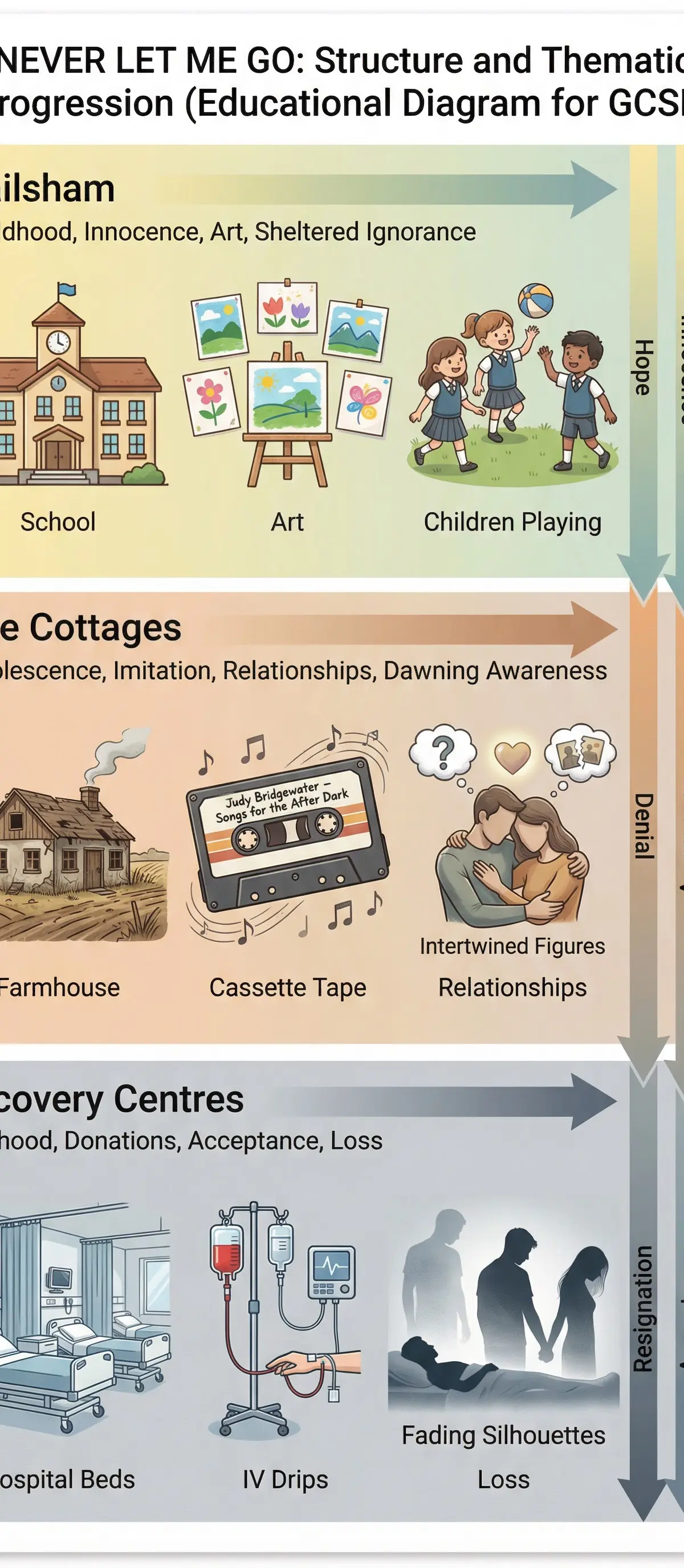
Conceptual Flow Outline
Tripartite Structure: Settings and Thematic Progression in *Never Let Me Go*
Worked Examples
2 worked examples — open one to explore the question and available guidance.
Practice Questions
Test your understanding — click to reveal model answers
Starting with this extract from Part One, explore how Ishiguro presents the theme of identity in Never Let Me Go. Write about: how identity is presented in this extract; how identity is presented in the novel as a whole.
Hint: Consider how the students' creation of art is linked to their search for identity, and how the revelation about Madame's gallery undermines their sense of self.
Explore how Ishiguro presents the relationship between Kathy and Ruth in Never Let Me Go.
Hint: Consider the power dynamics in their friendship, Ruth's manipulations, and her deathbed reconciliation with Kathy.
How does Ishiguro use the motif of the cassette tape to explore themes in Never Let Me Go?
Hint: Consider what the tape represents (memory, identity, connection) and how its loss and recovery mirror the novel's structure.
Explore how Ishiguro presents the theme of mortality in Never Let Me Go.
Hint: Consider how the clones' awareness of their mortality shapes their lives, and how Ishiguro uses their fate to explore universal human experiences of death.
Test your understanding of Never Let Me Go
Active recall beats re-reading. Take an instant quiz now to test what you’ve learned and lock it into long-term memory.
7 days Premium · Then free forever · No card, no charge