OCR · GCSE · English Literature
Romeo and Juliet
Unlock top marks for OCR's Romeo and Juliet paper with this guide. We focus on the closed-book exam, giving you the tools to build a powerful argument from memory, analysing Shakespeare's dramatic methods and integrating context seamlessly.
- 13 min read
- 2 worked examples
- 4 practice questions
- 8 key terms
Study Notes
Overview
Welcome to your essential guide for OCR GCSE English Literature, Component 02, Section B: Romeo and Juliet. This section is a true test of your knowledge and analytical skills. Unlike other exam boards, OCR provides no extract; you must enter the exam with a deep, memorised understanding of the play. Candidates are required to answer one of two broad, discursive questions, constructing a sustained argument that showcases critical thinking and detailed textual recall. This guide is designed to equip you for that challenge. Examiners are looking for a perceptive, integrated response that moves beyond simple plot summary. Credit is awarded for candidates who can analyse Shakespeare's dramatic methods (AO2), link them to the play's powerful themes, and weave in contextual understanding (AO3) to illuminate meaning. High-level responses will demonstrate a conceptualised argument, using precise, embedded quotations to support every point. This guide will provide you with the key knowledge, exam techniques, and multi-modal resources to achieve this.
Plot/Content Overview
Prologue: A chorus introduces the setting of Verona, the feuding families of Montague and Capulet, and the play's tragic trajectory of two "star-crossed lovers" whose deaths will end the feud.
Act 1: The play opens with a street brawl between the rival families, broken up by Prince Escalus who decrees a death penalty for any further public fighting. Romeo, a Montague, is introduced as a melancholy figure, pining for Rosaline. To see her, he and his friends Mercutio and Benvolio gatecrash a Capulet feast. There, he meets Juliet, a Capulet, and they fall instantly in love, discovering their rival identities only after they have kissed.
Act 2: After the feast, Romeo climbs into the Capulet orchard. In the famous balcony scene, he and Juliet exchange vows of love and agree to marry in secret. The next day, with the help of Friar Lawrence, who hopes the union might end the feud, they are wed.
Act 3: The play's turning point. Tybalt, Juliet's cousin, challenges Romeo. Romeo, now related to Tybalt by marriage, refuses to fight. Mercutio, disgusted by Romeo's apparent cowardice, fights Tybalt instead and is killed. Enraged, Romeo avenges his friend, killing Tybalt. He is banished from Verona. After a secret wedding night with Juliet, he flees to Mantua. Lord Capulet, unaware of the marriage, arranges for Juliet to marry Paris in three days.
Act 4: Desperate, Juliet seeks help from Friar Lawrence. He devises a plan: she will take a potion that simulates death for 42 hours. He will send a letter to Romeo in Mantua, explaining the plan, so Romeo can retrieve her from the family tomb when she wakes. Juliet bravely takes the potion.
Act 5: The Friar's letter fails to reach Romeo. Instead, Romeo's servant brings him news of Juliet's 'death'. Devastated, Romeo buys poison and returns to Verona. At the Capulet tomb, he encounters a mourning Paris, whom he kills in a duel. Inside, he finds Juliet's seemingly lifeless body, drinks the poison, and dies. Juliet awakens to find Romeo dead. She refuses to leave with the Friar and, finding no poison left, stabs herself with Romeo's dagger. The play ends with the feuding families discovering the tragic scene and finally reconciling, their hate ended by their children's sacrifice.
Themes
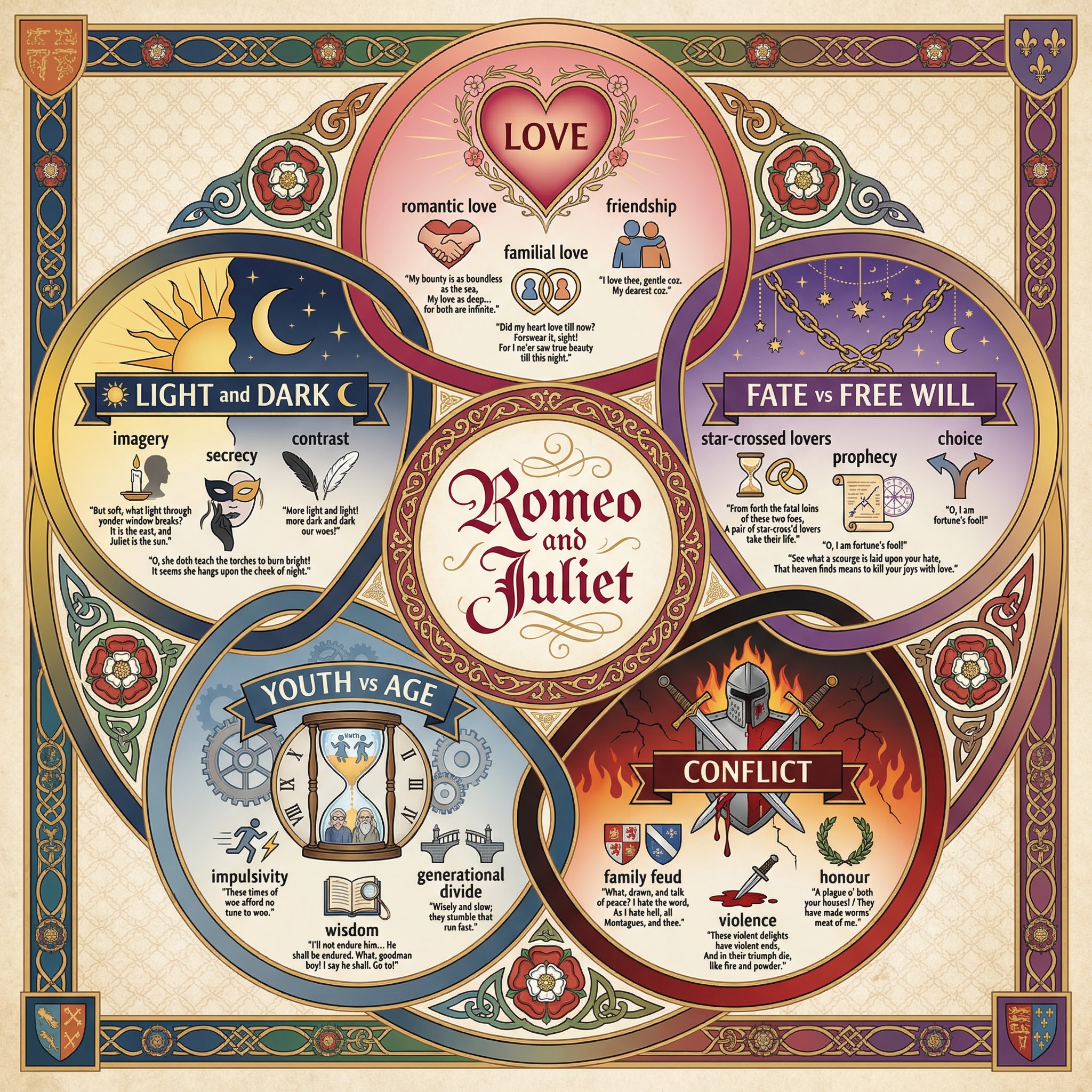
Theme 1: Love
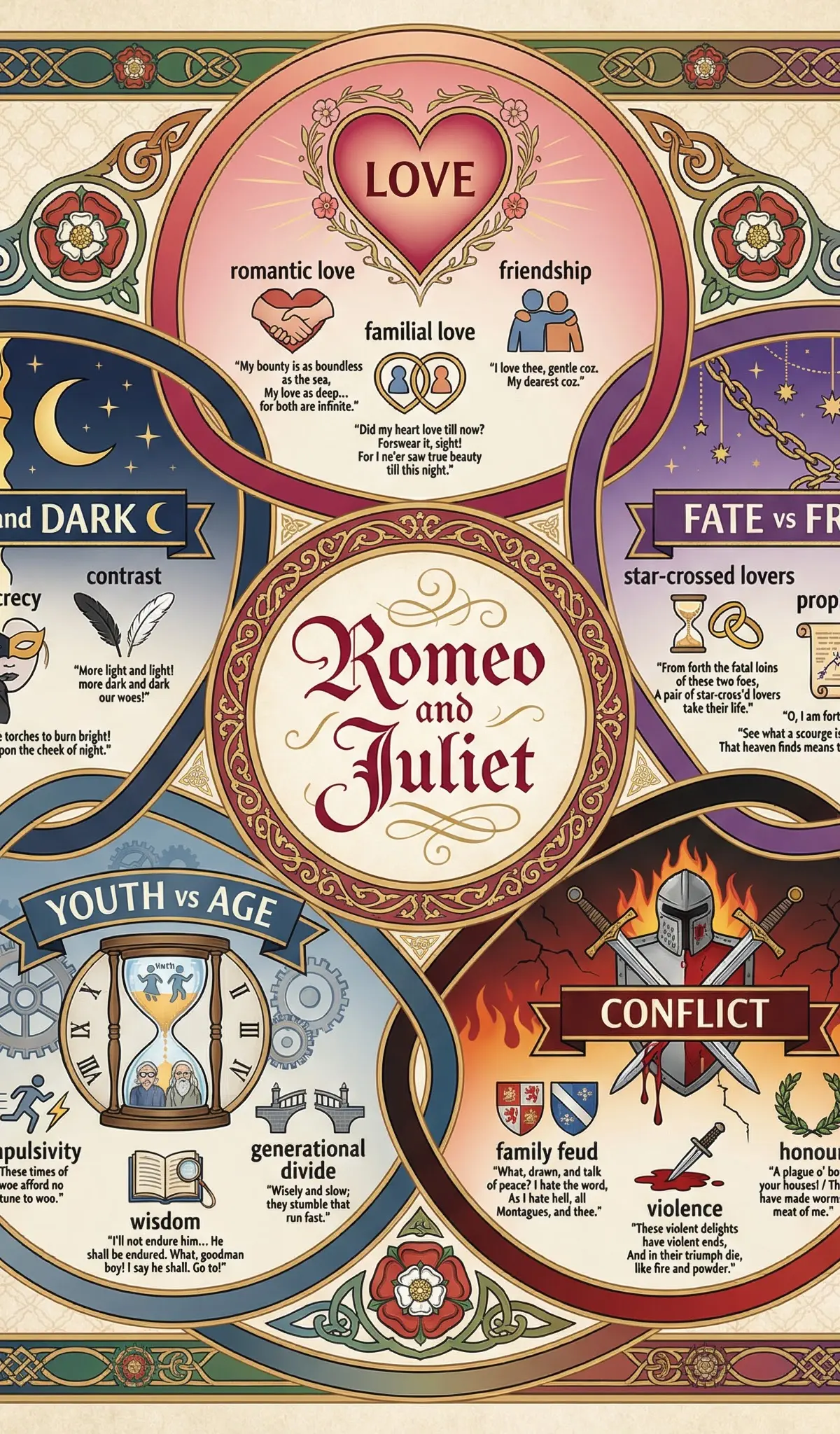
Shakespeare presents love in many forms, contrasting the impulsive, all-consuming passion of the protagonists with the bawdy pragmatism of the Nurse and the formal, courtly love Paris offers. Romeo's initial infatuation with Rosaline is presented as a shallow, Petrarchan performance, which makes his instant connection with Juliet seem more authentic and powerful. Their love is often described in religious and celestial terms, suggesting its purity and intensity. However, it is also depicted as a destructive force, a "violent delight" that leads directly to their tragic end. Candidates are rewarded for exploring this duality.
Key Quotes:
- "My only love sprung from my only hate!" (Juliet, 1.5) - Captures the central paradox of their love, born from the very conflict that will destroy it.
- "My bounty is as boundless as the sea, / My love as deep; the more I give to thee, / The more I have, for both are infinite." (Juliet, 2.2) - Shows the depth and generosity of her love, contrasting with Romeo's more self-indulgent melancholy.
Theme 2: Conflict
The "ancient grudge" between the Montagues and Capulets is the engine of the tragedy. Shakespeare opens with a public brawl to establish the depth of this societal sickness. The conflict is perpetuated by a culture of honour and toxic masculinity, embodied by Tybalt, the "prince of cats", who is driven by a need to defend his family's name. The conflict is not just physical; it is verbal, with characters trading insults and threats. The tragic irony is that the only thing that can end the feud is the ultimate loss of the families' children.
Key Quotes:
- "Two households, both alike in dignity, / In fair Verona, where we lay our scene, / From ancient grudge break to new mutiny, / Where civil blood makes civil hands unclean." (Prologue) - Establishes the setting and the deep-rooted nature of the feud from the outset.
- "A plague o' both your houses!" (Mercutio, 3.1) - A powerful curse that marks the play's turning point, condemning the futility and destructiveness of the feud.
Theme 3: Fate vs. Free Will
From the prologue's declaration of "star-crossed lovers", the theme of fate is inescapable. Characters frequently refer to the stars, destiny, and fortune, suggesting they are puppets in a larger cosmic drama. The series of unfortunate coincidences—the failed letter, the timing of Romeo's arrival at the tomb—seems to confirm this. However, an alternative reading is that the tragedy results from the characters' own choices: their impulsivity, their secrecy, and their violent reactions. A top-level response will explore this tension, arguing that while the characters may feel fated, their actions are what ultimately seal their doom.
Key Quotes:
- "A pair of star-crossed lovers take their life." (Prologue) - The most famous quote on fate, telling the audience from the start that destiny is at play.
- "O, I am fortune's fool!" (Romeo, 3.1) - Romeo's cry after killing Tybalt, showing his belief that he is a plaything of fate, unable to control his own destiny.
Character Analysis
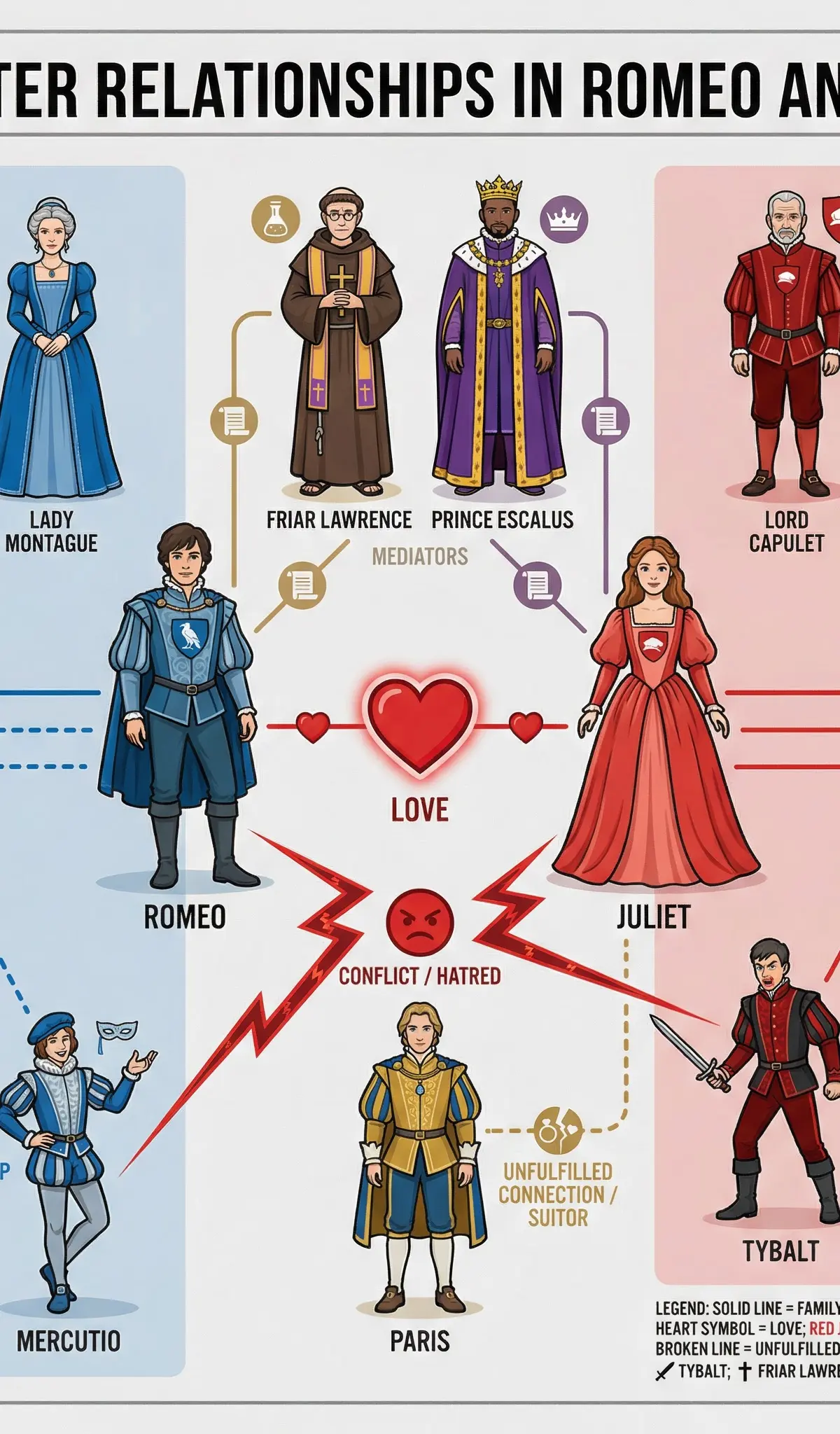
Romeo
Role: The male protagonist and a Montague.
Key Traits: Passionate, impulsive, idealistic, and initially, melancholic. His idealism is both his greatest strength and his fatal flaw.
Character Arc: Romeo transforms from a Petrarchan lover, performing sadness over Rosaline, to a man of intense, genuine passion for Juliet. His language shifts from clichéd oxymorons to rich, religious, and light-based imagery. However, his impulsivity remains constant. He rushes into marriage, kills Tybalt in a fit of rage, and makes the fatal decision to commit suicide without verifying the news of Juliet's death. His arc is a tragic one, as his capacity for great love is matched by his capacity for rash action.
Essential Quotes:
- "O brawling love, O loving hate..." (1.1) - Demonstrates his initial, artificial melancholy over Rosaline.
- "But soft, what light through yonder window breaks? It is the east, and Juliet is the sun." (2.2) - Shows the shift to genuine, powerful love, using light imagery.
- "Then I defy you, stars!" (5.1) - A moment of supposed defiance against fate that ironically seals his fate.
Juliet
Role: The female protagonist and a Capulet.
Key Traits: Courageous, intelligent, pragmatic, and determined. Despite her youth, she is often the more mature and thoughtful of the two lovers.
Character Arc: Juliet begins as an obedient daughter but quickly develops into a strong, independent woman who defies her family and society for love. She is practical where Romeo is idealistic, questioning the speed of their love: "It is too rash, too unadvised, too sudden." Her journey is one of increasing isolation as she loses the support of her Nurse and parents. Her decision to take the potion is an act of immense bravery, not passive victimhood. Her arc is one of tragic empowerment; she takes control of her destiny, but the only path available to her is death.
Essential Quotes:
- "My only love sprung from my only hate!" (1.5) - Shows her immediate grasp of the central conflict.
- "What's in a name? That which we call a rose / By any other name would smell as sweet." (2.2) - A moment of profound philosophical insight, questioning the arbitrary nature of the feud.
- "O happy dagger, / This is thy sheath; there rust, and let me die." (5.3) - Her final words are an active choice, taking control in the only way she can.
Mercutio
Role: Romeo's best friend and a kinsman to the Prince.
Key Traits: Witty, cynical, charismatic, and volatile. He is a foil to Romeo's romanticism.
Character Arc: Mercutio is a static character, but his presence is crucial. His Queen Mab speech reveals a wild imagination, but also a deep cynicism about love and dreams. He represents a world of masculine honour and public reputation that clashes with Romeo's private world of love. His death is the catalyst for the play's shift into tragedy, and his dying curse, "A plague o' both your houses!", serves as a powerful indictment of the feud.
Essential Quotes:
- "If love be rough with you, be rough with love." (1.4) - His pragmatic and cynical advice to Romeo.
- "A plague o' both your houses!" (3.1) - The pivotal line of the play, marking the point of no return.
Tybalt
Role: Juliet's cousin and a Capulet.
Key Traits: Aggressive, honour-obsessed, and fiercely loyal to his family.
Character Arc: Tybalt is the embodiment of the feud. He is quick to anger and refuses any form of peace with the Montagues. His challenge to Romeo and subsequent death at Romeo's hands is the event that transforms the play from a romantic comedy into a tragedy.
Essential Quotes:
- "What, drawn, and talk of peace? I hate the word." (1.1) - Establishes his violent nature from the start.
- "Boy, this shall not excuse the injuries that thou hast done me; therefore turn and draw." (3.1) - His final challenge to Romeo.
The Nurse
Role: Juliet's confidante and surrogate mother.
Key Traits: Bawdy, affectionate, pragmatic, but ultimately disloyal.
Character Arc: The Nurse is Juliet's closest ally in the first half of the play, helping to arrange her secret marriage to Romeo. However, when the situation becomes dangerous, she advises Juliet to forget Romeo and marry Paris, a profound betrayal that leaves Juliet completely isolated.
Essential Quotes:
- "I think it best you married with the County." (3.5) - The moment of betrayal.
Friar Lawrence
Role: A Franciscan friar and Romeo's confidant.
Key Traits: Well-meaning, idealistic, but reckless and short-sighted.
Character Arc: The Friar hopes to end the feud by secretly marrying Romeo and Juliet. However, his plans are consistently flawed, culminating in the disastrous potion scheme. His failure to ensure the letter reaches Romeo is the final, fatal mistake.
Essential Quotes:
- "These violent delights have violent ends." (2.6) - A prophetic warning that foreshadows the tragedy.
Writer's Methods
Shakespeare uses a range of dramatic and poetic methods to shape meaning. Candidates must analyse these for AO2.
Structure: The play is a tragedy, but it follows a comedic structure in the first half (lovers meet, overcome obstacles, marry). The turning point is Mercutio's death in Act 3, Scene 1, after which the play spirals into darkness and death. This structural shift wrong-foots the audience and makes the tragedy more devastating.
Verse and Prose: High-status characters speak in iambic pentameter (blank verse), which gives their speech a natural yet elevated rhythm. The lovers often share sonnets, a form associated with love poetry, showing their perfect connection. By contrast, servants and the Nurse often speak in prose, which is more grounded and common. Mercutio switches between verse and prose, showing his mercurial nature.
Imagery: The play is rich with recurring patterns of imagery. The most significant are light and dark, with the lovers finding their sanctuary in the night while the violence of the feud happens in broad daylight. Juliet is the "sun", a "bright angel", yet their love is a "flash of lightning". This contrast creates a sense of beauty and danger. Other key image patterns include religion (the lovers worship each other) and death (personified as a bridegroom for Juliet).
Dramatic Irony: This is a key device. The audience knows from the prologue that the lovers will die. We know Juliet is not really dead when Romeo finds her in the tomb. This creates immense tension and a sense of tragic inevitability. The audience is positioned as helpless observers, watching the tragedy unfold.
Context
For AO3, context must be integrated to illuminate the text. Do not bolt it on.
Patriarchy: In Elizabethan England, women had very little power. Marriages were often arranged for wealth and status, and daughters were considered their father's property. Juliet's defiance of Lord Capulet ("He shall not make me there a joyful bride!") would have been shocking to a contemporary audience. Her actions are a rebellion against the patriarchal structure of her society.
Religion: England was a Christian country, and religion was a central part of life. Suicide was considered a mortal sin. The lovers' decision to kill themselves is therefore a profound and desperate act, showing the complete collapse of their world and their faith in anything but their love for each other. The Friar, a religious figure, is ironically the one whose plans lead to this sinful end.
Fate and Astrology: Elizabethans had a strong belief in fate and the influence of the stars on human life. The idea of being "star-crossed" was a genuine belief. This context helps explain why the characters, and the audience, might see the events as predetermined, rather than just a series of unlucky accidents.
Honour and Feuding: Duelling and feuding among aristocratic families were common, though illegal. A man's honour was paramount, and insults had to be answered with violence. This context explains the behaviour of characters like Tybalt and Mercutio, and why Romeo feels compelled to avenge his friend's death, even though it leads to his banishment.
Visual Resources
2 diagrams and illustrations
Interactive Diagrams
1 interactive diagram to visualise key concepts
Conceptual Flow Outline
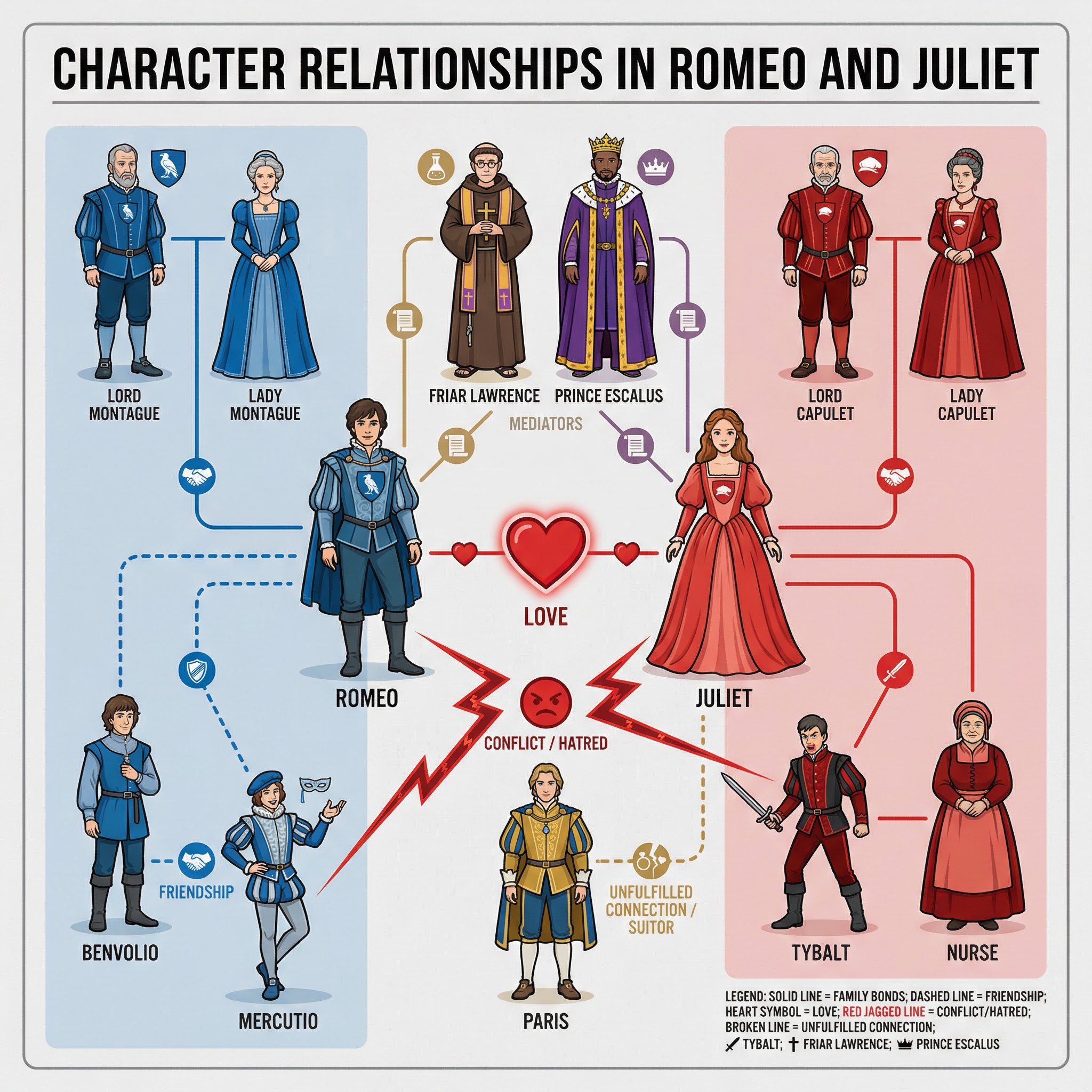
This diagram shows the five-act structure of the play, highlighting the central turning point in Act 3 and the overarching conflict between love and hate that drives the plot towards its tragic conclusion.
Worked Examples
2 worked examples — open one to explore the question and available guidance.
Practice Questions
Test your understanding — click to reveal model answers
Explore how Shakespeare presents the theme of fate in Romeo and Juliet.
Hint: Consider the prologue, the characters' own words (e.g., Romeo's 'fortune's fool' cry), and the series of coincidences in the final acts. Is it all destiny, or do their choices matter more?
How does Shakespeare present the relationship between parents and children in Romeo and Juliet?
Hint: Contrast the Capulets' relationship with Juliet with the Montagues' more distant relationship with Romeo. Consider the Nurse and Friar as surrogate parental figures.
Explore the presentation of violence in the play.
Hint: Think about different kinds of violence: the public brawls, the honour-driven duels, the emotional violence of Lord Capulet, and the final self-inflicted violence of the suicides.
How does Shakespeare use the characters of the Nurse and Friar Lawrence in the play?
Hint: Consider their roles as helpers, confidantes, and surrogate parents. Also, analyse how their actions and flaws contribute to the tragic ending. Are they well-meaning but incompetent?
Test your understanding of Romeo and Juliet
Active recall beats re-reading. Take an instant quiz now to test what you’ve learned and lock it into long-term memory.
7 days Premium · Then free forever · No card, no charge