The Manhunt (Simon Armitage)
Simon Armitage's 'The Manhunt' offers a powerful and intimate exploration of the devastating impact of war on both the soldier and their loved ones. This guide will equip you to analyse the poem's delicate structure and visceral imagery, securing top marks in your OCR GCSE English Literature exam.
Study Notes
Overview
'The Manhunt' is a profoundly moving poem that chronicles a wife's attempt to reconnect with her husband, a soldier who has returned from an unnamed conflict (based on the real-life experience of a Bosnian War peacekeeper) with severe physical and psychological injuries. Candidates are rewarded for exploring the poem's central metaphor: the 'manhunt' is not for a fugitive, but for the man her husband was before the trauma of war. The poem's journey is one of immense tenderness and patience, moving from the external, visible scars to the deep, internal wounds. Examiners look for a sensitive understanding of how Armitage uses the poem's unique structure of unrhymed, fragmented couplets to mirror the soldier's shattered state and the fragile process of healing. A top-band response will analyse the progression of metaphors, from the delicate 'porcelain' to the visceral 'foetus of metal', linking them to the overarching theme of post-traumatic stress disorder (PTSD).
Plot/Content Overview
The poem follows a clear, progressive structure. It is not a narrative in the traditional sense, but a journey of rediscovery. The speaker, the soldier's wife, acts as a guide, taking the reader through the process of re-acquainting herself with her husband's body and mind.
- The Gentle Beginning (Stanzas 1-3): The poem opens with the first days after his return. The tone is gentle, cautious. The wife uses the verb 'trace' to describe her exploration, suggesting a delicate, tentative approach. She begins with his face, then moves to his shoulder, where the first signs of serious injury appear.
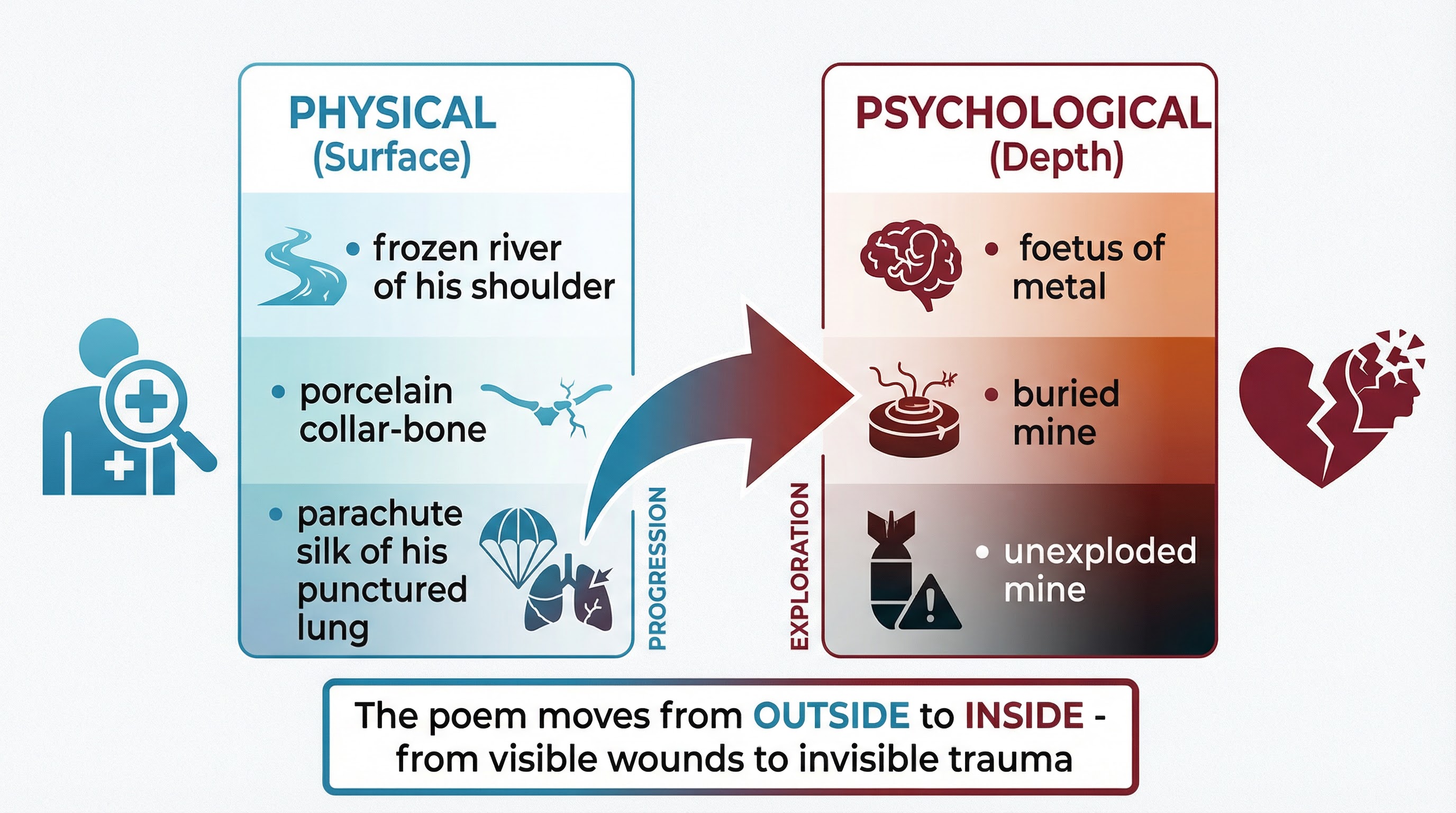
- Exploring the Physical Scars (Stanzas 4-8): The central section of the poem is a catalogue of injuries. The wife moves systematically over his body, discovering a 'fractured rudder of shoulder-blade', a 'collapsed lung', and 'broken ribs'. Each injury is described with a striking and often unexpected metaphor, transforming the body into a landscape of damage.
- Reaching the Psychological Trauma (Stanzas 9-12): The journey shifts from the physical to the psychological. The discovery of a bullet, the 'foetus of metal', marks a turning point. This leads to the realisation that the deepest wounds are invisible: the 'unexploded mine' of his trauma, buried deep within his mind.
- The Unresolved Conclusion (Stanza 13): The final couplet offers a poignant and realistic conclusion. After her long and patient 'manhunt', the wife feels she has only come 'close' to understanding her husband's pain. There is no simple resolution, reflecting the long-lasting and often insurmountable nature of war trauma.
Themes
Theme 1: The Physical and Psychological Effects of Conflict
Armitage masterfully illustrates how conflict inflicts wounds that are both seen and unseen. The poem argues that the psychological damage is far more profound and difficult to heal than the physical injuries. The speaker's journey into the 'mind's dark earth' shows that true recovery requires confronting the mental trauma, not just patching up the physical scars. Credit is given for analysing how the poem's structure, with its shift from body to mind, reinforces this theme.
Key Quotes:
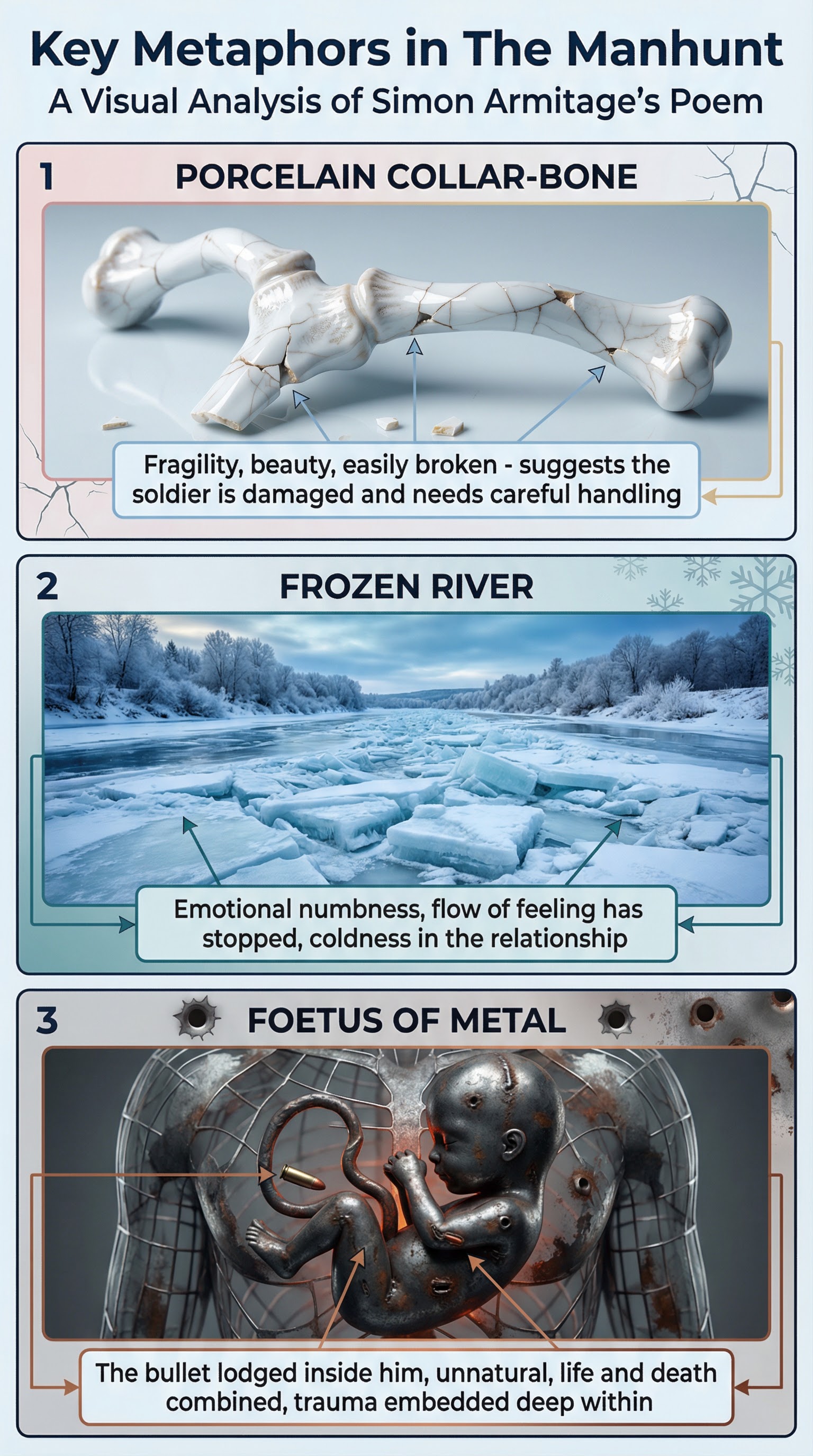
- "the frozen river which ran through his shoulder" - The metaphor of a 'frozen river' suggests a complete lack of feeling and movement, a numbness that is both physical and emotional. The emotional connection in the relationship has been halted by trauma.
- "the foetus of metal beneath his chest" - This powerful oxymoron combines the life-giving image of a 'foetus' with the death-dealing reality of a 'metal' bullet. It suggests the trauma is now a part of him, a dark and unnatural growth born from conflict.
- "a sweating, unexploded mine / buried deep in his mind" - This is the ultimate destination of the 'manhunt'. The most dangerous wound is not in his body but in his mind, a latent threat that could detonate at any time, highlighting the constant, ongoing anxiety of living with PTSD.
Theme 2: Love, Patience, and Intimacy
The poem is also a profound love story. The speaker's actions are defined by their tenderness and extraordinary patience. She does not rush; she 'traces', 'handles', and 'nurses'. This is a portrait of love adapting to the horrific reality of war. The intimacy is not passionate or romantic in a traditional sense, but is instead a quiet, determined, and therapeutic act of care.
Key Quotes:
- "After the first phase, / after passionate nights and intimate days" - This opening establishes that the initial romance has passed, and now a new, more challenging phase of the relationship must begin.
- "Only then would he let me trace / the frozen river..." - The use of 'let me' shows that the soldier is in control of this process. He must grant permission for this intimacy, highlighting his vulnerability and her respect for his boundaries.
- "Then, and only then, did I come close." - The final line is a testament to her enduring effort. While the ending is tinged with sadness, the fact she comes 'close' is a victory in itself, a testament to the power of her love and patience.
Character Analysis
The Speaker (Laura)
Role: The speaker is the wife of the returning soldier and the narrator of the poem. She acts as a guide for the reader, leading us on the 'manhunt' for her husband's true self.
Key Traits: Patient, loving, gentle, determined, and methodical. Her approach is almost clinical at times, yet it is underpinned by a deep emotional commitment. She is both a lover and a nurse, a detective and a therapist.
Character Arc: The speaker moves from a state of relative ignorance about the extent of her husband's trauma to a profound, if incomplete, understanding. Her journey is one of discovery, as she uncovers the layers of his physical and psychological pain.
Essential Quotes:
- "I let him know that I was there..."
- "and handle and hold..."
- "Then, and only then, did I come close."
The Soldier (Eddie)
Role: The soldier is the subject of the poem, but he is almost entirely silent and passive. He is the landscape being explored, the mystery being solved. His body and mind are the focus of the speaker's 'manhunt'.
Key Traits: Damaged, vulnerable, traumatised, and distant. He is described through a series of metaphors that emphasise his fragility ('porcelain') and the extent of his suffering ('blown hinge of his lower jaw').
Character Arc: The soldier does not have a conventional arc. Instead, the reader's understanding of him develops. He is gradually revealed, layer by layer, through the speaker's exploration. The poem suggests his journey to recovery will be long and may never be fully complete.
Essential Quotes:
- "the fractured rudder of his shoulder-blade"
- "the parachute silk of his punctured lung"
- "the sweating, unexploded mine / buried deep in his mind"
Writer's Methods
Structure and Form: The poem is written in thirteen unrhymed couplets. This fragmented structure is crucial. Candidates should argue that the two-line stanzas, often unrhymed and of varying lengths, create a sense of disjointedness and fragility. The poem is visually broken on the page, mirroring the soldier's broken body and mind, and the fractured state of the couple's relationship. The lack of a regular rhyme scheme prevents the poem from sounding too neat or musical, reflecting the harsh, unromantic reality of their situation.
Metaphor and Imagery: Armitage's use of metaphor is the poem's most defining feature. Credit is given for detailed analysis of how these metaphors work. The imagery moves from the delicate and inanimate ('porcelain', 'silk') to the mechanical and dangerous ('blown hinge', 'unexploded mine'). This progression shows the speaker getting closer to the brutal, metallic truth of war.
Verbs: The choice of verbs is deliberate and significant. The speaker 'traces', 'handles', and 'holds'. These are gentle, caring actions. In contrast, the soldier's body has been subjected to violent actions in the past - it is 'fractured', 'punctured', and 'blown'. The contrast between these two sets of verbs highlights the difference between the violence of war and the tenderness of love.
First-Person Narration: The poem is told from the wife's perspective. This intimate, first-person narration creates a strong sense of personal experience and allows the reader to empathise with her journey. We see the soldier only through her eyes, which emphasises his passivity and her active role in the healing process.
Context
To achieve high marks for AO3, candidates must integrate contextual understanding seamlessly into their analysis.
- Biographical Context: The poem is from Armitage's 2008 collection, The Not Dead. It is based on the true story of Eddie Beddoes, a British soldier who served in the Bosnian War as a peacekeeper, and his wife, Laura. Eddie sustained serious injuries and suffered from severe PTSD. Knowing this adds a layer of authenticity and poignancy to the poem. It is not an abstract poem about war; it is grounded in the real, lived experience of a specific individual.
- Post-Traumatic Stress Disorder (PTSD): The poem is a clinical and accurate depiction of PTSD. The 'unexploded mine' in the mind is a perfect metaphor for the latent trauma, flashbacks, and hyper-vigilance associated with the condition. Candidates can link the soldier's emotional numbness ('frozen river') and his buried trauma to the known symptoms of PTSD.
- The Title: The title itself is a contextual clue. A 'manhunt' is usually a search for a criminal. By using this title, Armitage subverts our expectations. The soldier is not a perpetrator but a victim, and the hunt is one of love and reclamation, not pursuit and capture.
- Alternative Interpretation (Feminist Reading): A feminist critic might focus on the role of the wife. She is presented as a caregiver, a nurse, and a therapist. Her identity is almost entirely defined by her relationship to her husband and his trauma. While she is active and he is passive, her actions are all in service of him. One could argue that the poem, while sympathetic to the soldier, inadvertently reinforces traditional gender roles where the woman is the selfless healer of the male protagonist. This perspective allows for a more critical evaluation of the poem's dynamics.
Visual Resources
2 diagrams and illustrations
Interactive Diagrams
1 interactive diagram to visualise key concepts
Conceptual Flow Outline
This diagram shows the structural journey of 'The Manhunt', moving from the initial intimacy through the exploration of physical injuries to the final discovery of psychological trauma. The progression from green (hope/love) to red (danger/trauma) illustrates the deepening understanding of the soldier's pain.
Worked Examples
2 detailed examples with solutions and examiner commentary
Practice Questions
Test your understanding — click to reveal model answers
How does Armitage present the relationship between the speaker and the soldier in 'The Manhunt'?
Hint: Focus on the verbs used by the speaker and the metaphors used to describe the soldier. Is this a relationship of equals?
Explore the significance of the title, 'The Manhunt'.
Hint: Think about the usual connotations of a 'manhunt'. How does Armitage subvert these expectations? Who is being hunted and why?
Analyse how Armitage uses imagery of the body to explore the effects of war.
Hint: Trace the progression of the bodily imagery from the start to the end of the poem. How does it change?
How does Armitage use structure and form in 'The Manhunt' to reflect the poem's themes?
Hint: Think about the layout on the page. Why couplets? Why no rhyme? How does the poem's overall structure (its journey) contribute to its meaning?